
Scania will achieve a range of 720 km with its new battery solution.
Jump to content
- Newsletter
- Podcast
- Conference
- Media details
- electrive global
The leading publication on electromobility
[](https://www.electrive.net/suche/)
All categoriesAll categories
- Fuel cell
- Off-Highway
- Bicycles
- Politics
- Air transport
- Data
- Water
- Careers
- Autonomous driving
- Test drives
- Automobiles
- Infrastructure
- Batteries
- Vehicles
- Fleets
- IAA Transportation
- Job market
- Calendar
- Studies
[](https://www.electrive.net/2026/09/15/scania-neue-batterie-reichweite/#overlay)
[](https://www.electrive.net/2026/09/15/scania-neue-batterie-reichweite/#)
- Automobiles
- Infrastructure
- Batteries
All CategoriesAll Categories
- Fuel Cells
- Off-Highway
- Bicycles
- Policy
- Air Transport
- Data
- Water
- Careers
- Autonomous Driving
- Test Drives
- Job Market
- Calendar
- Studies
- Newsletter
- Podcast
- Conferences
- Media Info
- electrive global
Commercial Vehicles
Scania aims to achieve a range of 720 km with new battery solution
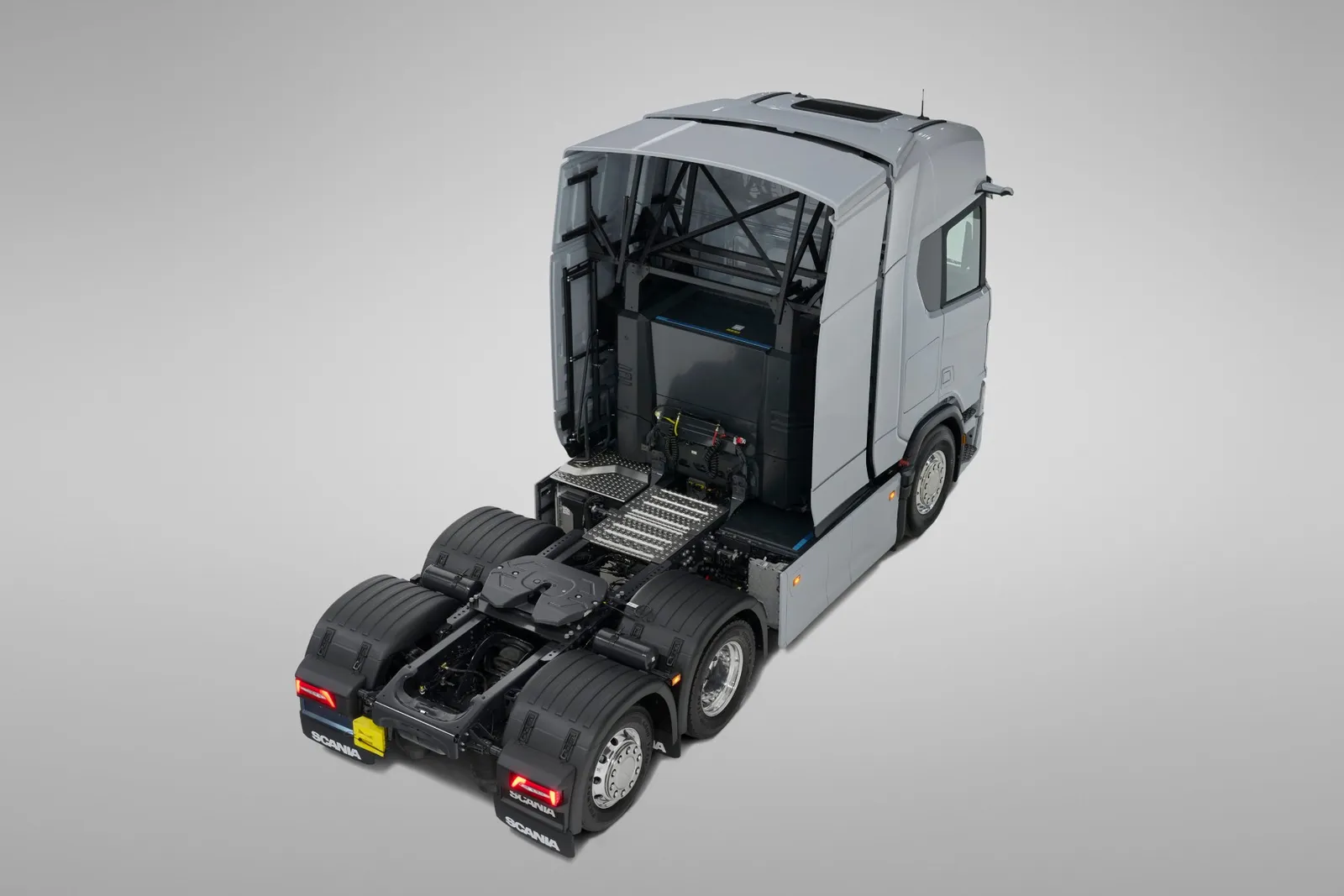
Scania introduces a battery solution for its electric trucks, where batteries are mounted behind the cab. In a typical configuration, two MP20 battery packs can be installed behind the cab. This significantly increases battery capacity, enabling ranges of up to 720 kilometers.
New battery technology is being integrated into Scania’s electric trucks
Image: Scania
By Florian Treiß
15.09.2026 - 11:02 AM
- [Scania](https://www.electrive.net/tag/scania/ "Scania")
- [Electric trucks](https://www.electrive.net/tag/e-lkw/ "Electric trucks")
- [BEV](https://www.electrive.net/tag/bev/ "BEV")
- [](https://www.electrive.net/2026/09/15/scania-neue-batterie-reichweite/# "Share")
- [X](https://twitter.com/share?url=https%3A%2F%2Fwww.electrive.net%2F2026%2F09%2F15%2Fscania-neue-batterie-reichweite%2F&text=Scania+will+use+a+new+battery+technology+to+achieve+a+range+of+720+km&via=electrive "Share on X")
Scania makes it possible to configure electric trucks with a longer range through a new battery solution, without sacrificing the operational flexibility required for long-distance use in Europe. In a 6×2*4 semi-truck combination, additional batteries can be installed behind the cab, in addition to those mounted on the chassis.
This feature, called “Battery Behind Cab,” works in conjunction with Scania’s aforementioned IVD front (Increased Vehicle Dimension). The Swedish manufacturer uses this term to describe a slightly forward-leaning, aerodynamically optimized truck front. This allows for the new battery layout behind the cab even when the vehicle’s total length exceeds 16.5 meters.
Scania reduces energy consumption by three percent
Together with the new front end, the vehicle can reduce energy consumption by up to three percent depending on the configuration and usage, as aerodynamic resistance accounts for a larger share of total energy consumption in electric trucks, according to the company.
"Electric trucks are already part of the transportation system, but long-distance transport poses entirely different requirements regarding range, payload, and charging processes. With this solution, Scania demonstrates how these factors can be combined in a practical way—for customers who want to electrify demanding long-distance routes," says Lars Gustafsson, Senior Vice President and Head of Solutions Management at Scania.
In May, Scania announced that it would offer seven battery packs instead of six as the maximum configuration going forward, along with the introduction of MCS. These will be equipped with NMC cells from CATL, just like those used in MAN vehicles — both brands are sister companies within the Traton group. Now, this topic is becoming more concrete, with Scania claiming a range of 720 kilometers for the new maximum configuration.
This figure is also familiar from MAN: At the IAA Transportation, the manufacturer announced that it would soon offer its electric flagship eTGX as a tractor truck with seven battery packs as well, boasting the same 720-kilometer range. Importantly, at Scania, this battery option, like at MAN, is only available in combination with a 6×2 axle configuration.
scania.com
Keywords
- Scania
- E-trucks
- BEV
8 Comments
on “Scania will achieve a range of 720 km with new battery solution”
Gregor
15.09.2026 at 11:34
Beautiful and technically outstanding European and Chinese products, especially those from Germany. There’s nothing better in the field of electric mobility. It’s strange that people still stick to outdated products from America (the brand with T) or South Korea/Japan, just because someone on the Internet once let go of the “hype train” and false claims. The electric mobility market is slowly maturing. But especially newcomers to this field know too little about technical specifications and market offerings, which sometimes leads them to follow the “hype train” and false claims anyway. This is where the cave analogy comes in handy. Some people never manage to get out of this “cave” and continue chasing the same promises year after year, sometimes even driven financially by expectations of high stock profits or other benefits.
that haven’t been seen in years like thisAnswers
Klaus Ubrich
15.09.2026 at 12:15
No one believes that 720 km figure. What happens if I have to drive through the Kasslerberge with 24 to 25 tons, for example? Full throttle is always used to climb the mountains.
Answers
lumia
15.09.2026 at 14:44
You’re mistaken. I talked to a Mercedes employee about 2 years ago who had loaded an eActros in Atzenhain. When asked where he was going, he said Flensburg. When I mentioned that refueling would be needed in Kassel, he explained that the Kasseler Berge aren’t a problem at all because a lot of energy is recovered going downhill there.
Answers
EdgarW
15.09.2026 at 14:40
One more thing: the typical consumption for a realistic range estimate, which tractor manufacturers must provide, as it is actually tested by freight companies before purchase. Naturally, all types of routes are included—so a realistic mix of cheap, expensive, and ordinary average routes. And each freight company will test its own routes with the vehicle. Yes, a “test drive” for a truck looks extremely different from that of a car buyer; there are at least trial weeks involved.
Answers
Christian
15.09.2026 at 14:36
Hello Klaus, the Kassler Berge are really good for the Scania. The vehicle can recover up to 600kW of energy. You can make up for the extra consumption uphill by driving downhill.
Answers
EdgarW
15.09.2026 at 14:36
You’ve clearly never seen an electric truck before — nor have you even thought about it at all. The Kasseler Berge are a short distance for a long journey, even by electric truck standards. You can climb up with more power (and with more powerful electric trucks, you don’t even need to use full throttle), and on the downhill, the power needed for climbing is recovered and stored back in the battery. It’s no problem at all. Not a bit. At all. Only for crossing the Alps might recharging be necessary, with a long such journey being from near Lake Constance to Lake Como. It’s the distance that matters; from north of Basel in Germany to near Como in Italy, it’s 290 km, and the gradients along the way easily fit within the battery’s capacity. Lake Constance to Splügen Pass has a 1721-meter climb, and for a 40-ton truck that’s nearly 188 kWh, plus rolling and air resistance totaling 369 kWh. If you arrive at the base of the Alps with a low battery level, you’ll naturally need to recharge. Smart truck drivers...
Drivers (or proper app support) will incorporate this into their mandatory break planning (driving times). This was simply the quick result of an AI calculation. Asking the same AI again, the energy consumption for the entire route is 500–690 kWh. One would need to find a suitable follow-up article about electric trucks; it’s very likely that in such cases they took a shorter route via Brenner.Answers
EdgarW
15.09.2026 at 19:41
Here he is driving the eActros 600 403 kilometers across the Alps; to find out what load it was with, one would need to watch the previous episode if that information is mentioned there. It charged 529 kWh, with a net consumption of 1.25 kWh/km, and accounting for charging losses (529 kWh / 403 km), it’s 1.31 kWh/km. https://youtu.be/yqmAlxG75ug?t=651 Just as an example, this was done in winter with light snowfall at the destination, crossing the Alps. He started far south of the Alps and then recharged because his extended driving time had expired, even though he originally wanted to drive further. With a full load, it definitely has less range, but you can see how much headroom there is. The eActros 600 officially has a practical range of 500 kilometers in this configuration.
Answers
Peter
15.09.2026 at 13:37
Dear electrive team, you have reported here several times that the batteries for Scania are manufactured by MAN in Nuremberg. This is actually incorrect. Scania operates its own battery factory in Sodertalje, Sweden. In the past, batteries there were made using Northvolt cells, and now batteries of the current generation are also produced there.
Answers
Write a comment Cancel reply
Your email address will not be published. Required fields are marked with *
Name *
Email *
I agree to the privacy policy - [x]
Website
Also read
[ Fuel Cell ## New Hydrogen Alliance Finalizes Plans – but Just Published 9 Hours Ago](https://www.electrive.net/2026/09/15/neue-wasserstoff-allianz-iaa/ "New Hydrogen Alliance Finalizes Plans – but Just a Little")
[ Truck Podcast ## Electric Truck Driver Tobias Wagner: “Not All Shipping Companies Have This Courage.” Published 10 Hours Ago](https://www.electrive.net/2026/09/15/elektrotrucker-tobias-wagner-diesen-mut-haben-noch-nicht-alle-speditionen/ "Electric Truck Driver Tobias Wagner: “Not All Shipping Companies Have This Courage.”")
[ Video - 14:48 min Infrastructure ## Charging before the ferry: Kiel becomes an E-truck hub on the Baltic Sea 10.09.2026](https://www.electrive.net/2026/09/10/laden-vor-der-faehre-kiel-wird-zum-e-lkw-hub-an-der-ostsee/ "Charging before the ferry: Kiel becomes an E-truck hub on the Baltic Sea")
electrive – The leading media outlet for electromobility
Since 2011, we have covered the development of electromobility with journalistic passion and expertise. As a leading digital industry publication, we provide comprehensive reporting of the highest quality. With news, background articles, interviews, test drives, videos, podcasts, as well as advertisements and job listings, we offer the central platform for the rapid growth of this technology.
- Automobile
- Air transport
- Infrastructure
- Water
- Batteries
- Off-highway vehicles
- Commercial vehicles
- Policy
- Fleets
- Data
- Fuel cells
- Career
- Bicycles
- Job market
- Newsletter
- Media information
- Contact
- Team
- Legal information
- GTerms
- Participation terms
- Data protection
- Cookie settings
- YouTube
- RSS
- Contact
- Team
- Legal information
- GTerms
- Participation terms
- Data protection
- Cookie settings
© 2026 electrive.net
[electrive global](https://www.electrive.com/ "electrive global")
Get daily updates on global electric mobility trends in your inbox?
Order the “electrive TODAY” newsletter for free!
Click here