
Local governments do not have a new program for AC chargers. The government is talking about analyses and waiting for funds.
The Ministry of Climate and Environment responded to a parliamentary inquiry regarding support for municipalities in installing publicly accessible chargers at residential areas and public parking lots. The most important point is simple: there is currently no active call for proposals from NFOŚiGW for local governments to set up such stations, and new initiatives depend on the availability of national and EU funds.
Table of Contents
Show
Hide
This is average news for EV drivers living in apartment buildings. The ministry recognizes the problem but so far focuses more on describing it than solving it.
There are figures from previous programs, but no new calls for proposals
In response, the ministry recalls that most of the funds went toward zero-emission public transportation. In 114 cities, subsidies were provided for the purchase of nearly 1,475 vehicles, including 1,248 electric buses, 194 hydrogen buses, and 33 trolleybuses. Additionally, there are 1,063 charging points and hydrogen refueling stations, with funding, including from KPO, set to continue until the end of 2026.
However, this is not a solution to the problem of residents who want to plug in their cars at an AC pole outside their homes at night.
The other important program is the now-completed “Support for Infrastructure for Charging Electric Vehicles and Hydrogen Refueling Infrastructure,” with a budget of 761.9 million zł from FNT funds. This support covered municipalities, entrepreneurs, cooperatives, and housing communities in building publicly accessible stations with a capacity of at least 22 kW. The result is expected to be over 3,000 charging stations.
The problem is that currently NFOŚiGW is not conducting calls for programs that would allow local governments to receive support for building publicly accessible charging stations. In other words, the funds existed, and some are still in use, but there is no new pathway available for municipalities today.
The Ministry recognizes the issue with apartment buildings but lacks a specific timeline
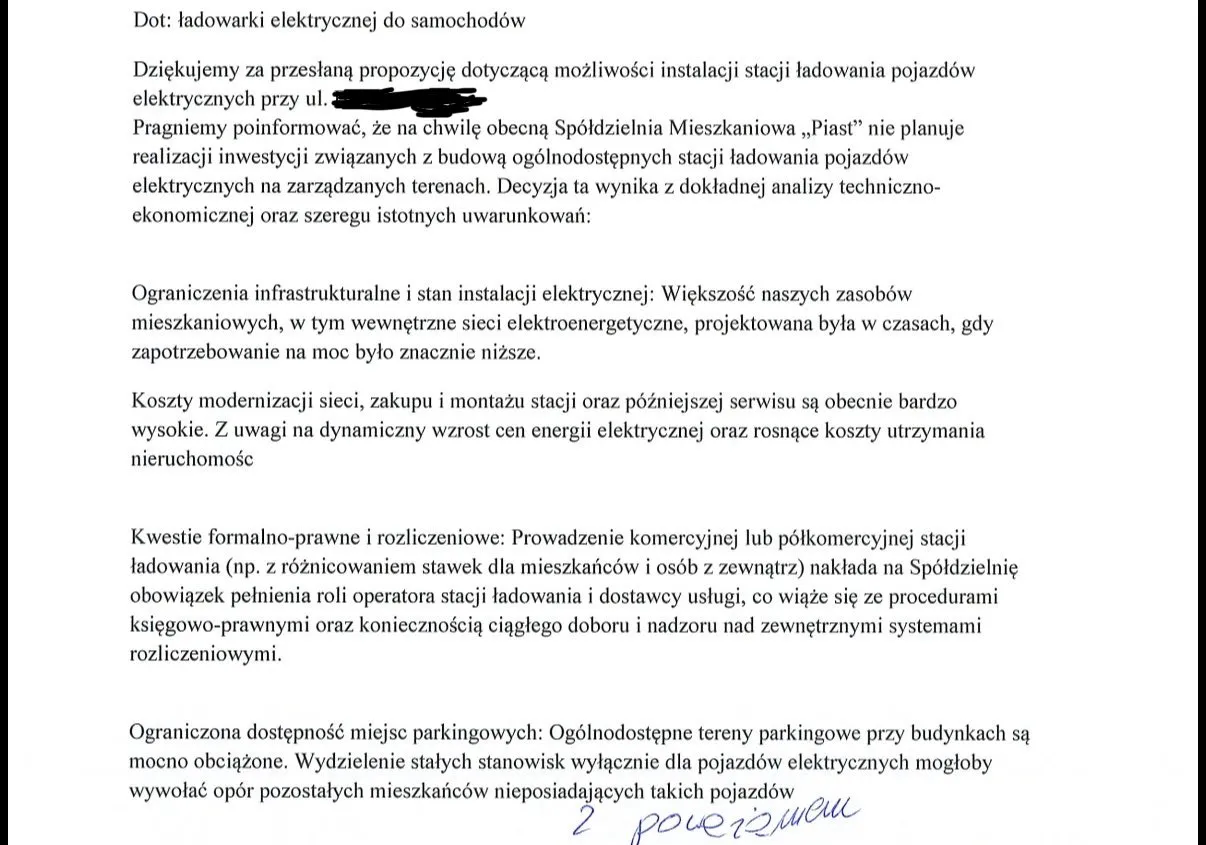
The ministry admits outright that infrastructure at public parking lots, residential complexes, and multi-family buildings is needed, as residents there often lack the means to install their own charging stations. This sounds reasonable and aligns with the real problems in Poland’s market. A house with solar panels is one thing; an apartment building with a shared parking lot is quite another.
For now, the statement only says that introducing new support measures will depend on available funds. NFOŚiGW is examining the possibility of supporting infrastructure, including for public buildings, communities, and housing cooperatives, but no date, budget, or application process has been specified.
In short: the problem has been identified, but no funds have been committed yet.
What local governments can do right now
In response, several practical guidelines were provided for municipalities. First, the local government should identify locations with actual demand, such as multi-family residential areas, public parking lots, and spots for longer-term parking. Second, it can make municipal land available to operators without killing the project through excessively high fees or overly short contracts.
This is indeed an important detail. In small and medium-sized cities, an AC charger cannot survive with exorbitant rent and a temporary contract. The operator needs time to connect the service and recoup their costs.
The ministry also advises municipalities to discuss the connection capacity and potential timeline for installation with OSD in advance. This is sensible, as otherwise it’s easy to select a “great location” that remains unusable for two years afterward.
There is still a systemic thread. The Ministry of Energy is now responsible for the law on electromobility, and on March 3, 2026, a Task Force for the Development of Electromobility was established. Its role is to analyze legal, technical, and organizational barriers and prepare recommendations for changes, including in administrative and connection procedures.
It sounds good, but this is still at the stage of a task force and recommendations. There is no program with a start date yet.
A new EU perspective for 2028-2034 is also emerging within the framework of work on the PPKR. The issue is that we are even earlier here than with the NFOŚiGW analyses. First, goals and priorities, then the allocation of funds.
One thing is clear from all this: the government already knows that charging under buildings is a weak point in electric mobility in Poland, especially outside large cities. Now it’s necessary to move from the “monitoring and analyzing” phase to the “here are the funding, budget, and rules” phase. What do you think would help boost EV adoption in smaller towns more: neighborhood AC chargers of 11-22 kW or more affordable DC chargers near supermarkets and city parking lots?
LovEV Newsletter
Want more content like this?
Sign up — we’ll send you a weekly summary once the newsletter starts.