
Rome turns one of its busiest toll roads into a solar farm: 466 panels for nearly 80,000 vehicles per day
22/09/2026 12:00
Updated to
22/09/2026 12:00
Highways are often associated with high energy consumption, but they also provide vast areas that have so far been underutilized for electricity generation. Italy has just demonstrated this by using an infrastructure that sees tens of thousands of vehicles pass through daily.
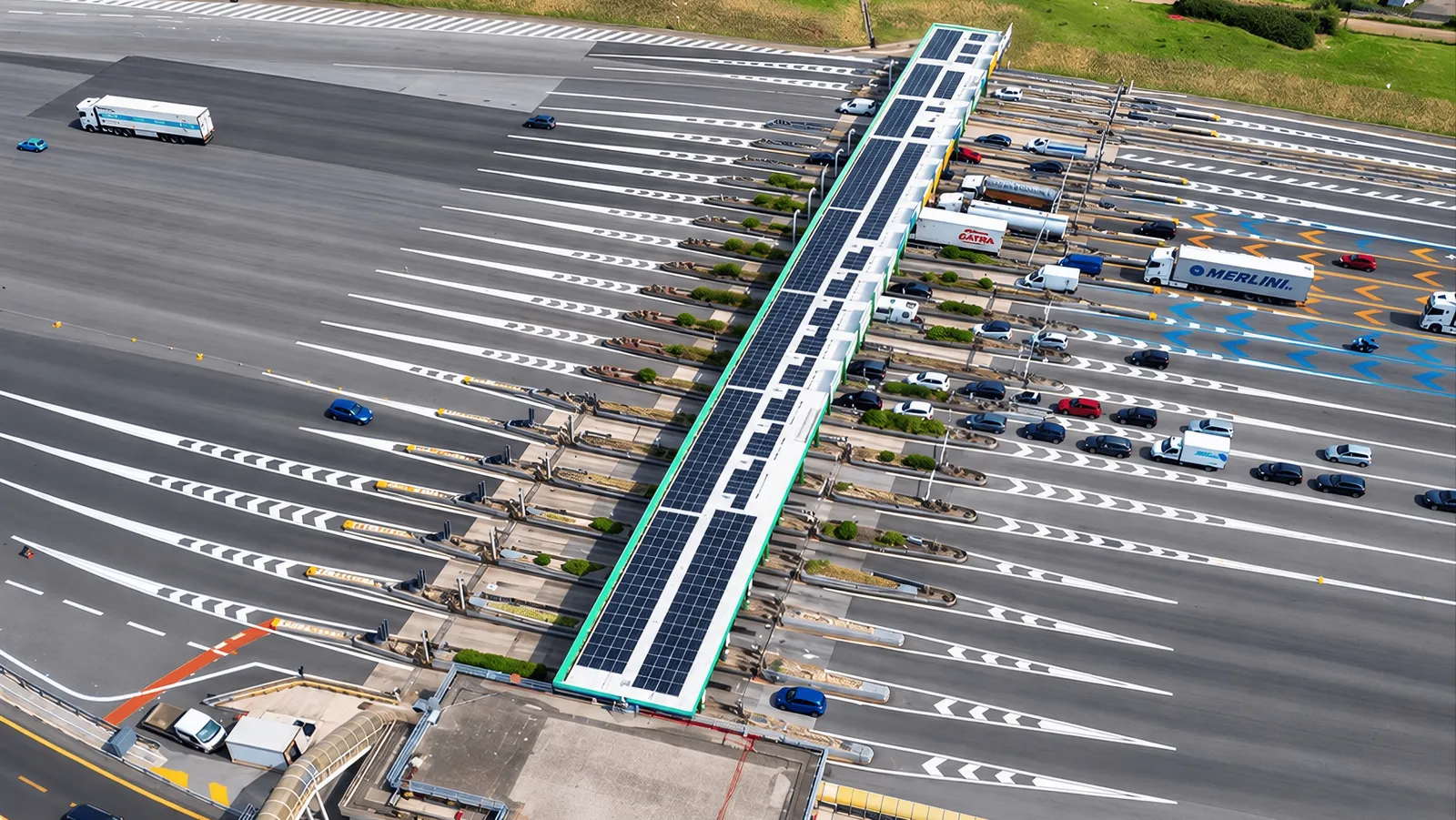
The Roma Est toll booth, located at kilometer 8.1 of the A24 highway, now has a photovoltaic installation consisting of 466 solar panels. All of these panels were installed on existing structures, so the project did not require any new land.
210 kW installed on a toll booth that never stopped operating
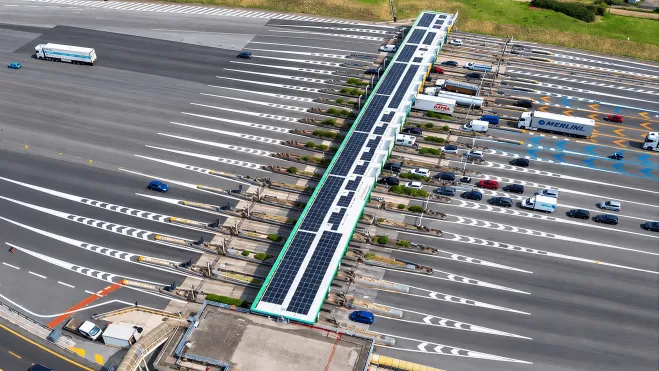
The panels are mainly located on the large canopy of the toll booth cabins, a structure approximately 135 meters long and 12 meters wide, as well as another canopy over the parking lot at Lunghezza station.
Together they achieve a capacity of 210 kW, a figure that Strada dei Parchi compares to roughly 70 residential photovoltaic systems. The company estimates that a facility of this size in central Italy can generate approximately 250,000–280,000 kWh per year, though the actual output depends on factors such as solar radiation, module inclination, and shading.
The project began on June 8th last year, and the system officially went into operation on August 24, 2026. The entire installation was completed without shutting down the toll booth, which is particularly notable given the traffic volume on this infrastructure.
Nearly 80,000 vehicles pass under the panels daily
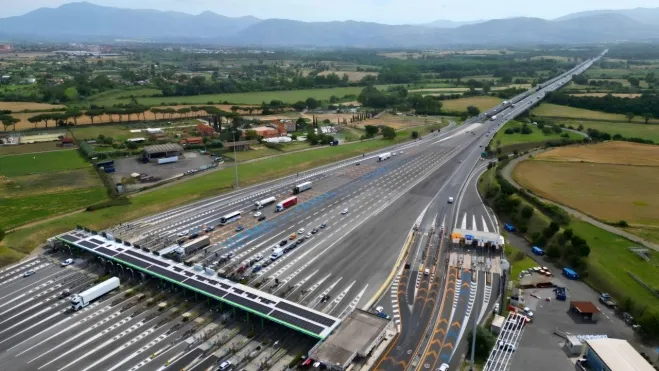
Strada dei Parchi states that around 40,000 vehicles per direction pass through this barrier daily. This results in an approximate flow of 80,000 vehicles per day passing under an installation that now also functions as a small power generation plant.
The complexity of the project lay in installing the modules several meters above a fully operational highway. The work had to proceed alongside traffic and the toll road’s own electrical systems during the final installation stages. But perhaps the most interesting aspect isn’t their power output, rather where the panels are located. Instead of building a solar plant on open land, two rooftops that were already part of the infrastructure were utilized.
For now, the installation operates independently of the national electrical grid. This means that all energy generated by the panels is consumed directly at Roma Est and not fed into the grid. The electricity powers the lighting, toll collection systems, technical equipment, and surveillance and monitoring systems at the station, which operate around the clock.
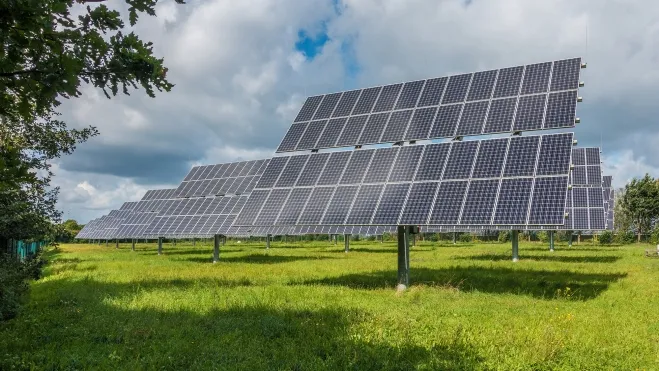
This setup allows energy to be generated exactly where it is needed. Additionally, it reduces losses associated with electricity transmission and helps offset some of the energy costs for an infrastructure that remains active continuously.
No Extra Square Meter of Land
The 466 panels are mounted on steel structures fixed directly to the existing rooftops. According to the concessionaire, the project has not required using even one extra square meter of land. It is precisely this feature that makes the project particularly interesting. Highways already have canopies, service buildings, parking lots, and other built-up areas that could potentially be used to generate renewable energy without conflicting with agricultural land or natural spaces.
Strada dei Parchi considers Roma Est to be a first example of a strategy that could be replicated in other sections of the A24 and A25 highways, where there are other covered structures and buildings with similar characteristics. Before installing new systems, it would be necessary to examine factors such as orientation, structural strength, and available electrical power at each location.
The Italian project thus offers a very different approach to the controversial covered roads directly fitted with photovoltaic cells: instead of turning the asphalt itself into a solar panel, it makes use of the infrastructure already surrounding the road.