
Save 850 euros per year if you switch to an electric car
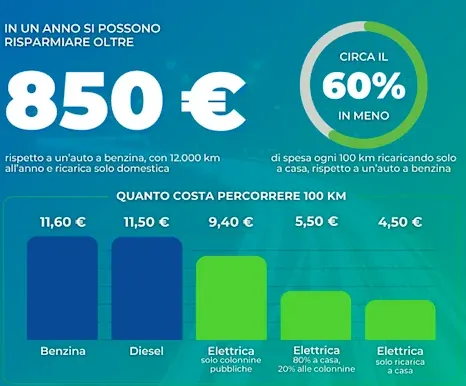
You can save 850 euros per year by switching from a gasoline car to an electric one. Motus-e has done the calculations. And the number of charging stations has exceeded 88,000.
Save 850 euros (and even more if you charge only at home)
Motus-e took as an example a driver who charges 80% of their vehicle at home and 20% at public charging stations. Driving 100 kilometers costs an electric car approximately 5.50 euros on average, compared to 11.60 euros for a similar gasoline car and 11.50 euros for a diesel car. This figure does not include subscriptions, packages, or offers from charging service providers. The advantage increases further if charging occurs only at home, dropping to around 4.5 euros per 100 kilometers—about 60% less than gasoline. What if there is no parking space for charging at home or at work? The economic benefit over gasoline and diesel decreases but remains significant, with costs averaging around 9.4 euros per 100 kilometers (19% less than gasoline, 18% less than diesel). For those who drive 12,000 kilometers per year, the savings compared to a gasoline car can exceed 85.
0 euros.Experts say: “It’s no longer just a sustainability choice…”
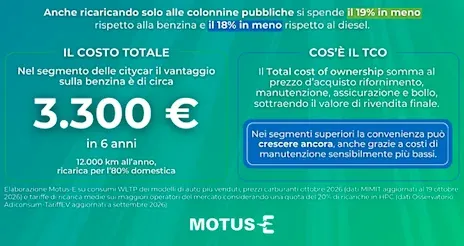
The affordability increases further when considering the true total cost of a vehicle, known as the Total Cost of Ownership. This TCO includes the purchase price of the car plus all related expenses such as fuel, maintenance, insurance, and registration fees, minus the final resale value. For city cars, TCO analysis shows savings of around 3,300 euros over 6 years compared to gasoline vehicles. Even with a higher purchase price, assuming an annual mileage of 12,000 km and 80% home charging, affordability can even rise in higher-end segments due to significantly lower maintenance costs for electric vehicles. “The numbers show that electric mobility is not just an option for environmental sustainability. It’s also a real opportunity for savings for families and businesses,” notes the president of Motus-
And Fabio Pressi.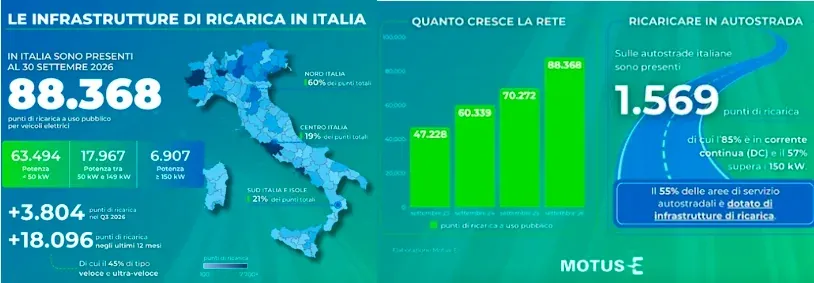
Meanwhile, the charging network continues to expand, becoming increasingly widespread. As of September 30, there were 88,368 public charging stations installed on the Peninsula, an increase of 18,096 units over the past 12 months. Nearly 30% of those installed in the last year are fast and ultra-fast chargers. The proportion of charging stations already installed but awaiting connection from local providers is 12.3%, down from the average of 14.9% in 2025. On highways, there are 1,569 charging units, of which 85% are fast DC chargers and 57% have a power output exceeding 150 kW. More than half of highway service areas are equipped with charging stations. Among regions, Lombardy still leads in public charging stations (18,866), followed by Piedmont (9,557), Veneto (8,646), Lazio (8,161), and Emilia-Romagna (6,951). Among provinces, Milan is first (7,710), followed by Rome (6,243), Turin (4,688), and Naples (3
.550) and Brescia (2.588).Previous Article
An electric sofa for walking around in Charlotte
Next Article
Orders are pouring in, but batteries are lacking for ID.Polo and Raval