
Power grids: The EU can save 10.6 billion through smart charging

The growth of electric vehicles will require new investments in Europe’s distribution electricity grids, but smart charging management could significantly reduce costs. According to a study conducted by Siemens for EIT Urban Mobility, ChargeUp Europe, and ACEA, 24.7 billion euros will be needed by 2030 to adapt grids to the spread of electric vehicles. With EV Load Management, this requirement could drop to 14.1 billion euros, resulting in a potential savings of 10.6 billion euros. For Italy, the model estimates that battery electric vehicles will account for 4.6% of the total vehicle fleet by 2030, compared to a much higher share already projected in other major European markets.
In Italy, 4.6% of vehicles will be electric by 2030
The most interesting figure for the Italian market is likely that related to the size of the BEV fleet by 2030. The model developed by Siemens estimates that fully electric vehicles will account for 4.6% of Italy’s vehicle fleet.
This percentage is significantly lower than the estimates for Sweden (27.3%) and Germany (15.7%), while it is roughly on par with Spain (4.5%) and higher than Poland (2.5%). However, compared to 2024, the number of BEVs expected in Italy is set to increase by 3.4 to 5.3 times, depending on the scenario considered.
It should be noted that 4.6% is an estimate included in Siemens’ study, based on the growth model used for analysis, and not an official figure regarding the future size of Italy’s vehicle fleet.
The electric grid needs more than just upgrades
The core focus of the study is the relationship between the spread of electric vehicles and the capacity of distribution networks. In fact, rising consumption for charging does not mean that all new demand must be met by immediately building new infrastructure.
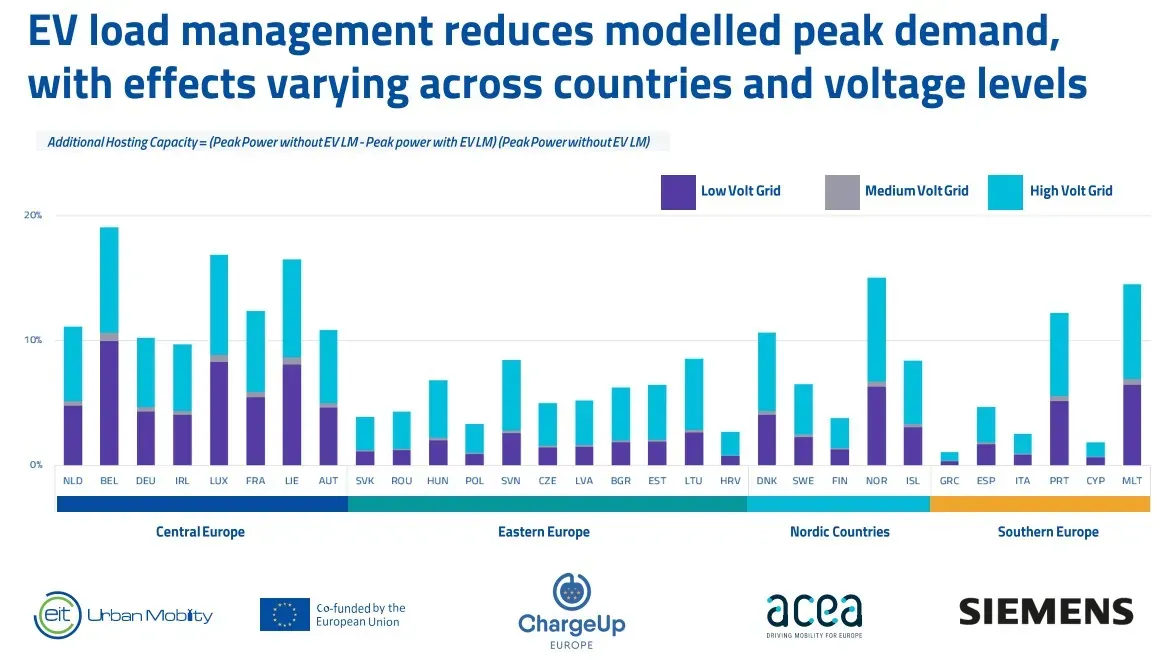
The suggested solution is EV Load Management, which involves nearly real-time control of the power allocated for charging. The goal is to prevent many vehicles from starting to charge at the same time during periods when the local grid is under the greatest strain.
Charging can therefore be scheduled over time or adjusted based on available capacity. This approach, combined with network digitization and measurement and communication systems, allows for better utilization of infrastructure that otherwise might require upgrades.
10.6 billion in investments that can be avoided
The economic impact is significant. Without intelligent load management, the study estimates 24.7 billion euros in investments needed by 2030 to adapt Europe’s distribution networks to the growth of electric mobility.
By applying EV Load Management, the required investment drops to 14.1 billion euros. The difference of 10.6 billion euros represents investments that can be avoided by making more efficient use of existing network capacity.
However, this does not mean that digitization can completely replace infrastructure upgrades. The study actually shows that physical enhancements to the networks will remain necessary, especially in areas where local demand is expected to grow the most.
The issue of home charging
The distribution of charging facilities will be crucial. In the 64 urban areas analyzed, between 55% and 62% of electric vehicle owners are expected to have access to home charging by 2030.
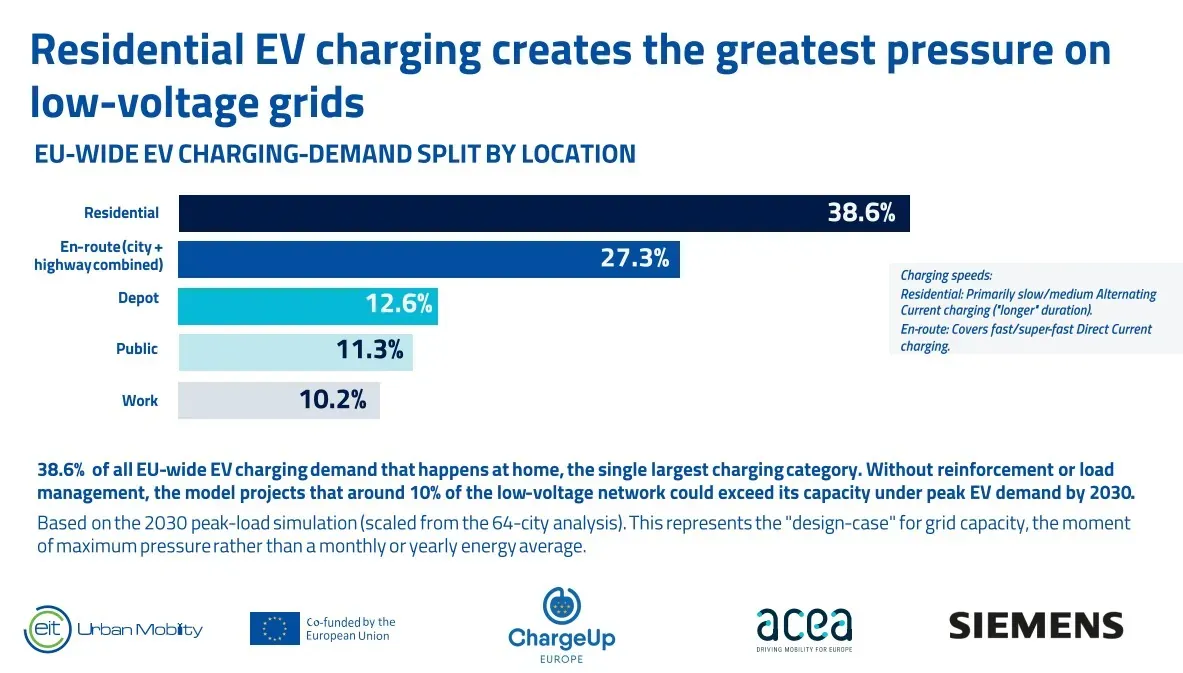
It is a particularly important element for low-voltage networks, which account for 77.7% of the physical investments outlined in the study. Home charging can indeed become a significant component of local demand, especially during hours when many families return home and connect their cars to the grid simultaneously.
In areas where private charging options are more limited, the role of public infrastructure will increase, thereby raising the need to coordinate the installation of charging stations and network planning.
Electric mobility and the grid must be planned together
The analysis considers various charging models, from home charging to workplace charging, public stations, on-the-go charging, and commercial vehicle depots.
This latter area may become increasingly important: electrifying commercial fleets will require centralized charging capabilities at depots, with consumption patterns that differ from those of private cars.
For Europe, the challenge is not simply to build more charging stations or power lines. It is necessary to integrate mobility, charging infrastructure, networks, and digital systems so that investments are directed where they are truly needed, and to leverage the flexibility of charging to reduce demand peaks.
READ ALSO: E.ON bets: “Electric cars will become batteries for the grid” and watch the VIDEO