
Renault Twingo E-Tech vs BYD Dolphin Surf: Which is more recommended to buy in 2026
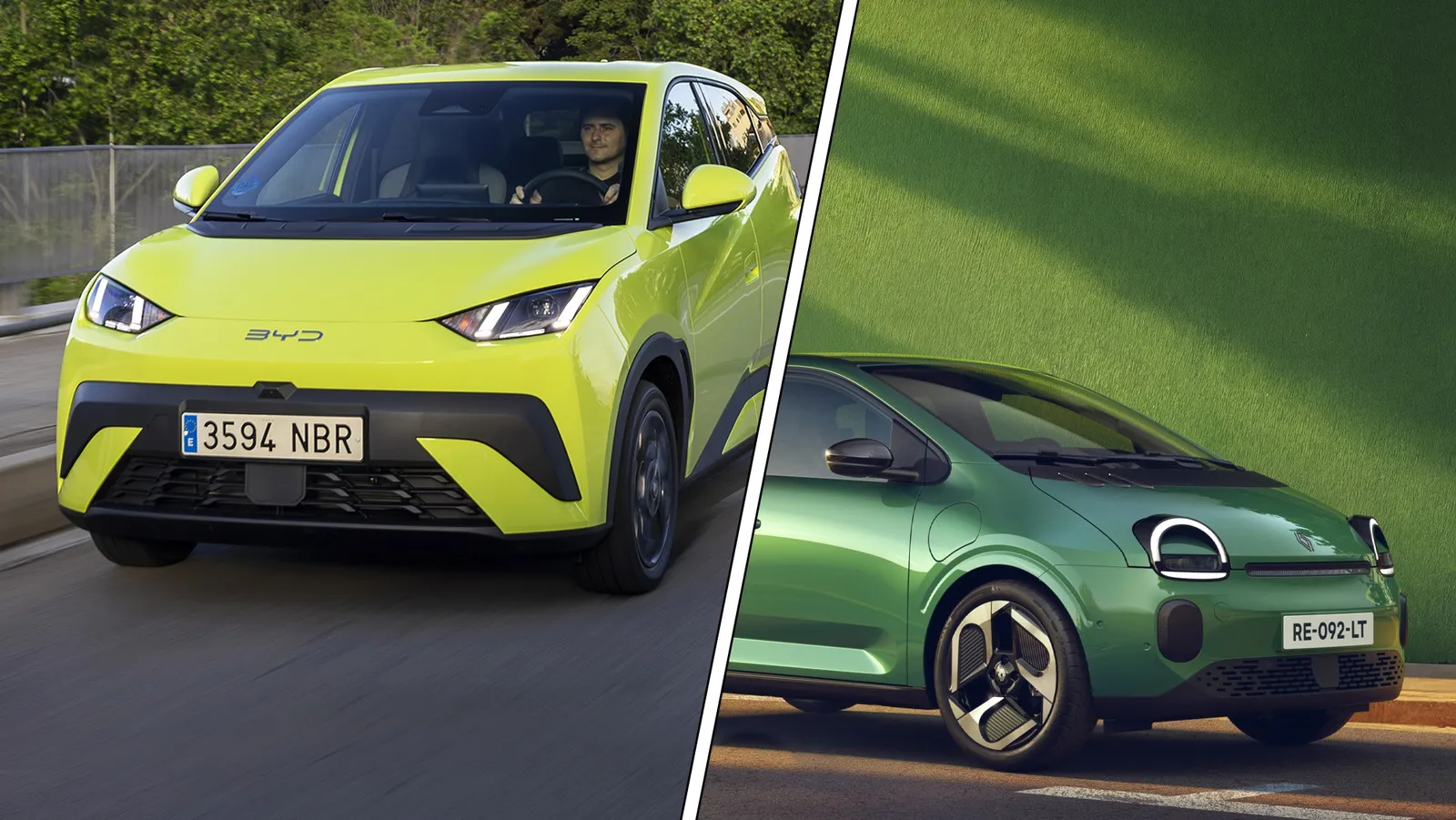
The segment of urban electric cars is undergoing a real revolution. More and more brands are focusing on compact, affordable models designed primarily for city driving, without sacrificing performance and range sufficient to handle intercity trips with complete ease. In this context, the Renault Twingo E-Tech and the BYD Dolphin Surf represent two options with very different philosophies, but sharing the same goal of becoming leaders among the most affordable electric cars on the market.
The Renault Twingo E-Tech marks the return of one of Renault’s most popular names in recent history. The new generation completely abandons internal combustion engines to become a 100% electric urban vehicle developed specifically for Europe. It retains a casual design inspired by the original Twingo from the 1990s and offers a highly competitive price, aiming to make electric mobility accessible to more people and become one of the most affordable electric cars on the continent.
Opposite it is the BYD Dolphin Surf, a model that has made a strong impact on the Spanish market thanks to its excellent balance of price, features, and range. This small electric vehicle from the Chinese brand stands out for offering a spacious interior, a very comprehensive suite of technologies, and performance that exceeds what’s typical for its class. In fact, numerous specialized reviews and comparisons consider it one of the best urban electric cars on the market today due to its balance of efficiency, build quality, and value for money.
Comparison: Renault Twingo E-Tech vs BYD Dolphin Surf
Renault Twingo E-Tech
BYD Dolphin Surf
Vehicle Type
Urban
Urban
Dimensions
3,750 / 1,710 / 1,491 mm
3,990 / 1,720 / 1,590 mm
Weight
1,275 kg
1,390 kg
Battery capacity
27.5 kWh
30 kWh
Total power/torque
82 HP / 175 Nm
88 HP / 175 Nm
WLTP fuel consumption
13 kWh/100 km
15.5 kWh/100 km
DGT rating
Zero
Zero
Acceleration (0 to 100 km/h)
12.1 seconds
11.1 seconds
Emissions
0 g/km
0 g/km
WLTP electric range
263 km
220 km
Trunk space
305 / 966 liters
308 / 1,037 liters
Information and entertainment
Instrument cluster: 7 inches
Multimedia: 10.1 inches
Apple CarPlay / Android Auto
Instrument cluster: 7 inches
Multimedia: 10.1 inches
Apple CarPlay / Android Auto
Price in Spain
Starting at 17,463 euros
Starting at 19,990 euros
Key differences between the Renault Twingo E-Tech and the BYD Dolphin Surf
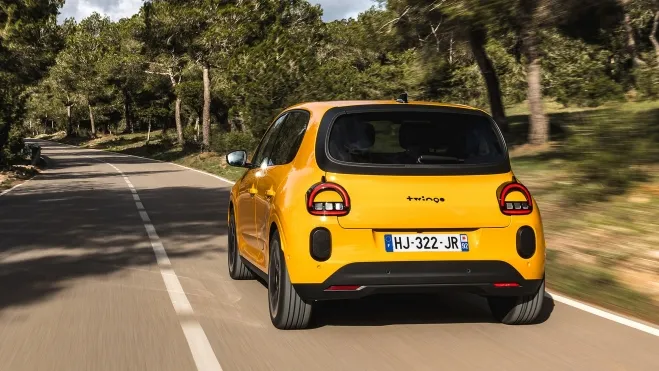
The Renault Twingo E-Tech and the BYD Dolphin Surf are two of the most interesting options for those looking for a small and relatively affordable electric car. Both belong to the A segment, have five doors, and are designed primarily for urban driving. However, their approaches differ. Renault emphasizes efficiency, simplicity, and space optimization, while BYD offers a larger, more powerful vehicle better suited for frequent trips outside the city limits.
The Twingo E-Tech is only 3,790 mm long and comes equipped with a small battery of 27.5 kWh. Its single motor delivers 80 horsepower and offers a range of up to 263 km with an excellent fuel efficiency of 12.2 kWh/100 km. The Dolphin Surf is 3,990 mm long and allows users to choose between batteries of 30 and 43.2 kWh, motors of 88 and 156 horsepower, with ranges ranging from 220 to 322 km. In other words, the BYD can offer significantly more power and range, but the Renault requires considerably less energy to move.
The interior philosophy also changes significantly. Renault restores the charm and versatility that made the original Twingo famous, featuring two independent rear seats that can move longitudinally. BYD opts for a more conventional interior but one that is highly equipped for its price, with a 10.1-inch swiveling central screen, mobile connectivity, and numerous features that were hard to find in an urban vehicle just a few years ago.
Price and current range in Spain
The Renault Twingo E-Tech is currently available in two trims with a single mechanical configuration of 80 HP and a 27.5 kWh battery. The Evolution starts at 17,463 euros in the Spanish configurator, while the Techno begins at 18,959 euros. These prices already reflect Renault’s current pricing policy, so they should be distinguished from the initially announced prices of 19,500 and 21,100 euros respectively before discounts and subsidies.
The Evolution comes standard with a 10.1-inch central screen, rear parking sensors, and interesting independent, sliding, and foldable rear seats. The Techno adds the integrated Google openR link system, six speakers, a digital rear camera, automatic climate control, and four regen levels via levers, including a One Pedal function.
BYD offers a wider range of models. The Dolphin Surf Active costs officially 19,990 euros and features a 30 kWh battery paired with an 88 HP engine. The Boost version is priced at 23,990 euros, retaining the same 88 HP engine but equipped with a 43.2 kWh battery, while the Comfort model costs 26,490 euros and combines that same battery with a significantly more powerful 156 HP engine. Promotions and current government subsidies can substantially reduce these prices.
The Twingo thus proves particularly competitive for those looking to spend as little as possible. BYD responds with a much more varied range: the Active directly competes with the Renault, the Boost focuses on range, and the Comfort adds features that are uncommon among urban electric cars.
Charging times and power
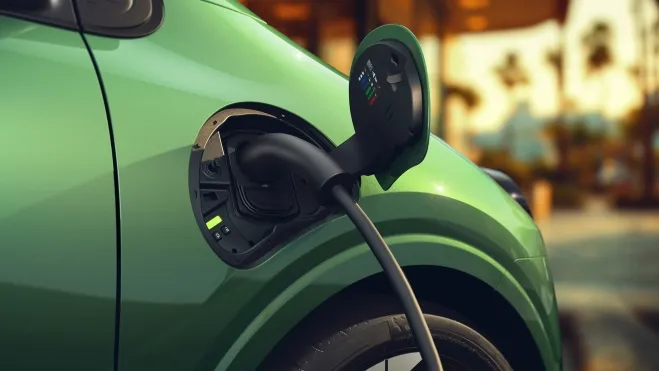
Charging is one of the areas where there are the most differences. The Twingo comes standard with a 6.6 kW AC charger, sufficient to go from 10% to 100% in just over four hours. Renault offers the Advanced Charge package as an option, which increases the AC power to 11 kW and adds 50 kW DC fast charging. With this, the manufacturer claims it takes about 28 minutes to go from 15% to 80%.
The Dolphin Surf comes better equipped out of the box. All versions support 11 kW on three-phase alternating current, while the Active model reaches 65 kW on direct current, and the Boost and Comfort versions reach up to 85 kW. BYD claims a 10-80% charge in approximately 30 minutes regardless of the battery chosen. Full charging on alternating current takes about 3.5 hours with the Active model and five hours with the 43.2 kWh variants.
BYD therefore has an advantage when used frequently with public charging infrastructure. The Twingo can charge fast enough given its small battery, but the appropriate package must be installed to access direct current. For a owner who charges almost always at home at night, this difference will be much less significant.
Range and Real-World Consumption
A curious situation arises here. The Twingo has only a 27.5 kWh battery, but it achieves an official range of up to 263 km thanks to its fuel consumption of 12.2 kWh/100 km. The Dolphin Surf Active, despite having a 30 kWh battery, has a range of only 220 km with a fuel consumption of 15.5 kWh/100 km. With its 43.2 kWh battery, the BYD increases its range to a maximum of 322 km, though its fuel consumption is around 16 kWh/100 km.
In real-world conditions, range will depend heavily on usage. Both models benefit significantly in urban areas, where lower speeds and regenerative braking allow them to approach their best figures much more closely, while highways particularly disadvantage small cars like these. The Twingo stands out for requiring very little energy; in contrast, the Dolphin Surf Boost is more suitable if you need extra range for frequent intercity trips.
The conclusion is quite simple: for primarily urban use, the Renault’s 263 km of range is more than sufficient, and its efficiency is outstanding. For those who need to travel on the road regularly, the Dolphin Surf’s 322 km of range and 85 kW charging capacity with a larger battery provide greater peace of mind.
Interior and trunk
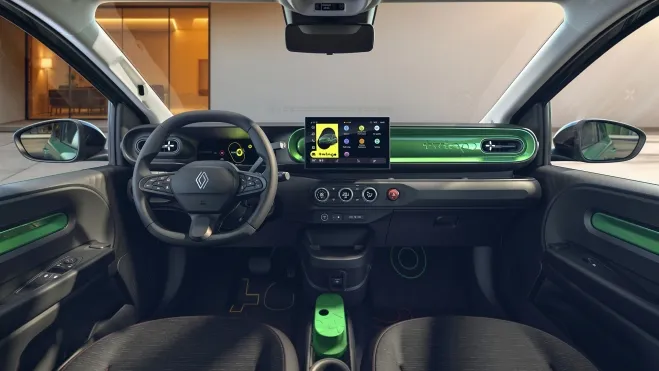
Renault has aimed to keep the new Twingo one of the key strengths of the original model: making the most of its very compact exterior dimensions. With a wheelbase of 2,493 mm, the four seats are arranged in a cabin that is surprisingly spacious for a car that is only 3,790 mm long. Particularly interesting are the two separate rear seats, which can move longitudinally and be folded down individually.
The dashboard combines a 7-inch digital display with a 10.1-inch multimedia screen. The Evolution model features wireless phone mirroring, while the Techno version includes openR link with integrated Google services, Google Maps, and various apps. The design is simple and colorful, consistent with the car’s character, without attempting to convey a luxury feel that isn’t warranted by its price.
The modular design also affects the trunk capacity. Renault claims up to 360 liters when the rear seats are moved forward. With the backrests folded down, the capacity reaches up to 1,110 liters, and by folding the passenger seat back in the Techno model as well, items up to approximately two meters in length can be transported.
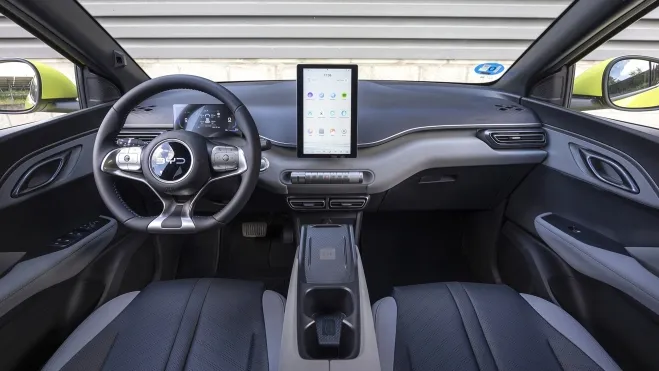
The Dolphin Surf is 200 mm longer, giving it a total length of 2,500 mm. This difference in length is particularly noticeable in the overall car feel and available space. The cabin is designed for four occupants and features a more conventional layout, though BYD tries to differentiate itself through its equipment offerings.
The star feature on the dashboard is once again BYD’s well-known rotary touchscreen, which in this model is 10.1 inches large and compatible with Android Auto and Apple CarPlay. The Active version also includes features that are uncommon at this price point, such as adaptive cruise control, NFC access, a rear camera, and V2L functionality. The Boost version adds comfort features, while the Comfort version includes a 360-degree camera, heated front seats, and wireless phone charging.
The trunk holds 308 liters with the seats in the normal position and reaches 1,037 liters when the seats are folded down. The Twingo offers greater flexibility thanks to its sliding seats, whereas the BYD provides a more conventional and predictable loading space. Neither model has a front trunk.
Driving and Comfort
The Twingo E-Tech is designed primarily for city driving. Its 80 horsepower and 175 Nm of torque may seem modest, but the electric motor provides immediate response, allowing it to reach 50 km/h from a standstill in 3.8 seconds. It weighs around 1,200 kg, is less than 3,800 mm long, and has a turning radius of only 9.87 meters—three features that greatly assist with maneuvering and navigating through traffic.
Outside the city, its limitations become more apparent. It takes 12.1 seconds to reach 100 km/h, and its top speed is limited to 130 km/h. It can drive well on highways, but that isn’t where it performs best. The Techno version also includes four levels of regenerative braking and one-pedal driving, which is particularly convenient in urban traffic.
The Dolphin Surf delivers a stronger sense of being a versatile car, especially in the Comfort version. The Active and Boost trims produce 88 horsepower, with acceleration times of 11.1 and 12.1 seconds from 0 to 100 km/h respectively. The Comfort version significantly alters the car’s character thanks to its 156 horsepower and 220 Nm of torque, enabling it to complete the same acceleration in 9.1 seconds. All versions can reach 150 km/h.
This makes the BYD the most suitable option for combining city driving with highway use, while the Renault proves more compelling for higher urban usage rates. The Twingo is smaller, lighter, and more maneuverable; the Dolphin Surf offers greater power reserves and a slightly larger driving footprint. Neither is designed as a long-distance traveler, but the BYD with its 43.2 kWh battery handles occasional longer trips better.
Which one should you choose based on your preferences
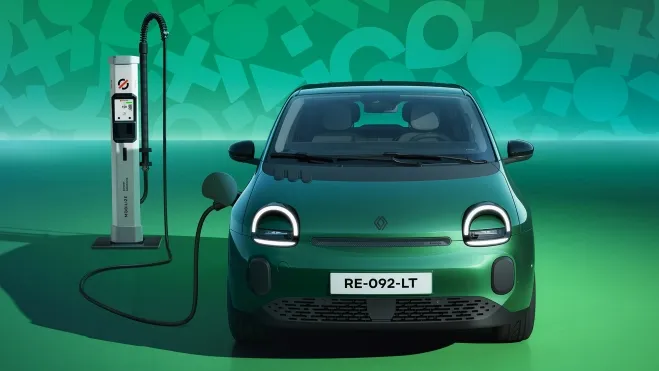
Choose the Renault Twingo E-Tech if you mainly need a second car for home use, live in a large city, or have a small garage space. Its 3,790 mm length, excellent maneuverability, and low fuel consumption are clear advantages. It is also the most logical choice if you drive few kilometers per day and can charge at home regularly, as paying for a much larger battery offers little benefit in such situations.
Choose the BYD Dolphin Surf if you need your compact electric vehicle to do more. The Boost version is particularly interesting for a family that wants to use it as their only car and make occasional intercity trips, as it offers 322 km of range with a 43.2 kWh battery and 85 kW charging speed. If performance is also important, the 156 CV Comfort version has virtually no direct competitors in this lineup.
For pure city use, I would go with the Twingo. For combining city driving, highway travel, and occasional excursions, the Dolphin Surf is more comprehensive. It should be noted, however, that the BYD is 200 mm longer, and the price difference increases significantly when moving from the Active version to those with a larger battery.
As an economical and primarily urban car, Renault likely offers the smartest solution. As the only vehicle for a couple or small family that doesn’t want to be too constrained by type of journey, the BYD provides more flexibility in usage.
Key rivals to the Renault Twingo E-Tech and BYD Dolphin Surf
The most obvious rival to the Twingo E-Tech is the Dacia Spring, another electric car designed around simplicity and price, although Renault offers a considerably more modern approach. The Leapmotor T03 also competes directly in terms of size and cost, while the FIAT 500e serves as a slightly more sophisticated alternative for those who value design and image above all else.
The Dolphin Surf overlaps with these same models in their more affordable versions, but the Boost and Comfort trims target cars that are slightly higher end. The Hyundai Ioniq is likely its most serious competitor in terms of range, space, and technology, while models like the Citroën ë-C3 may appeal to those who prefer a slightly larger body size and a more road-oriented design.
There’s also an important distinction: the Twingo and Dolphin Surf are only direct rivals to a certain extent. The Renault takes the concept of a small, efficient urban electric car further; BYD tries to offer, for slightly more money, some features typical of the immediate higher segment. It’s this difference that should determine the choice.
And that brings us to the end of our guide to help you decide between the Tesla Model 3 and BYD Seal.