
Renault brings the legendary R8 Gordini back to life as an electric concept car
For several years now, Renault has drawn on its history to bring back models that defined their era through electric concept cars. Following the restomodded R17 by designer Ora-ïto, here is the R8 Gordini presented by Alexandre Malval’s team, head of design at Renault.
The Sixties Icon
For those who have driven or traveled as a passenger in older Renault 8 models, it holds many memories. This car was received differently depending on its characteristics. With its rear-mounted engine layout, its handling could be problematic on slippery roads.
Many drivers placed bags of sand or cement in the front trunk to restore the vehicle’s balance. Shifting gears wasn’t always easy with the thin gear lever, unless one preferred the rare automatic version with buttons on the dashboard, which wasn’t available on the R8 Gordini.
The various weaknesses of this sedan, which also served as the basis for the unusual R10, didn’t stop the genius Amédée Gordini from turning it into a high-performance car for both racetracks and roads by 1964. A cylinder head replacement allowed it to produce 95 or 110 horsepower (starting in 1966, the engine’s displacement increased to 1,300 cm3), powered by a 4- or 5-speed gearbox depending on the version.
The vehicle was thus capable of reaching speeds of 170 to 175 km/h. Figures that seem laughable when compared to the 270 hp engine (roughly 200 kW) of today’s electric concept cars. This engine is also mounted at the back of the blue car with white stripes.
Today’s coupe versus yesterday’s sedan
Does the Renault 8 Gordini Concept from the side also remind you of the Peugeot e-Legend from 2018? Yet neither Nicolas Brissonneau nor Matthias Hossann nor Gilles Vidal was involved in its creation. This impression also stems from its two-door coupe design, which doesn’t match the sharply angular lines of the four-door sedan.
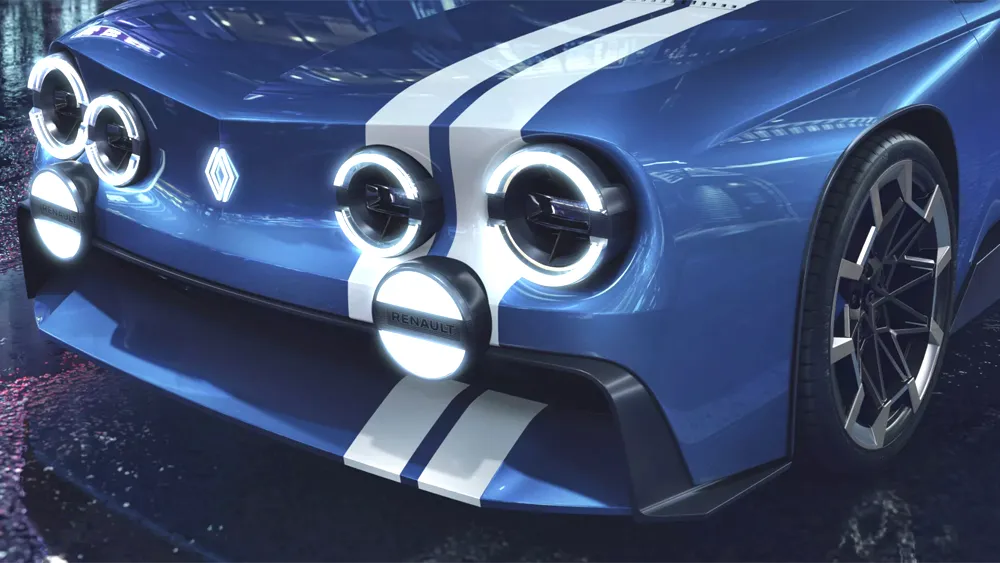
The resemblance to the 60s Gorde is most striking at the front, thanks to the central ridge running along the length of the hood as well as the four headlights at the front, with the two inner ones being smaller. However, its shape is more elongated and slender, giving the concept a better visual stance.
This is easily explained by the adjustments made to its dimensions. The original model had a ground clearance of 4.00 x 1.49 meters and a height of 1.37 meters. The concept version is 10 cm shorter (1.27 m) but nearly 40 cm wider (1.88 m). In length, it is only 12 cm longer (4.12 m).
"The distinctive almost symmetrical silhouette of the Renault 8, with its front and rear halves balanced, has been reinterpreted and made more dynamic by grounding the vehicle with a smoother cabin, wider tracks, prominent fenders, and wheel sizes reaching 19 inches at the front and 20 inches at the rear," explains Alexandre Malval.
Compared to the 15-inch wheels used last century: "Choosing larger wheels at the rear rather than the front creates a visually dynamic effect, paying homage to the ‘all-back’ design philosophy that defined the playful driving character of the original model."
Appealing Interior
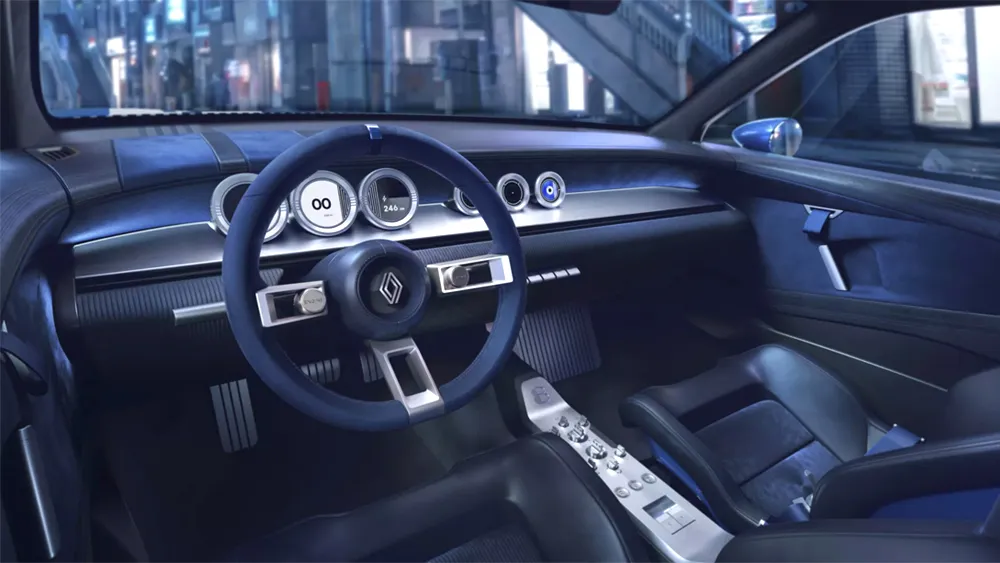
The dashboard of the 2026 concept car cannot be called a faithful copy of those from the 1960s. Yet it serves as a good homage with a three-spoke steering wheel, the shape of the hood, the use of brushed aluminum, and a relatively minimalist style.
"We drew inspiration from the original dashboard of the Renault 8, taking its classic elements and then reinterpreting them. The traditional metal panel with round dials is positioned flat here to support and highlight a series of perfectly aligned circular screens," explained Stéphane Maiore, head of interior design at Renault.
The console that separates the front seats is instead a pure creation that fits in perfectly here. “Inside the cabin, the number of components is limited, and each one is particularly well-crafted and minimalist. They serve both as part of the structure and the interior design. There’s nothing superfluous,” emphasizes Robin Biondi, interior designer.
The result is appealing, and one can easily imagine sitting in the driver’s bucket seat, starting the engine, and experiencing the track performance with this electric concept car. The velvet upholstery and alcantara accents on the door panels and dashboard add a level of sophistication not seen in its much more spartan predecessor.