
R3 Lithium launches lithium recycling facility in Georgia
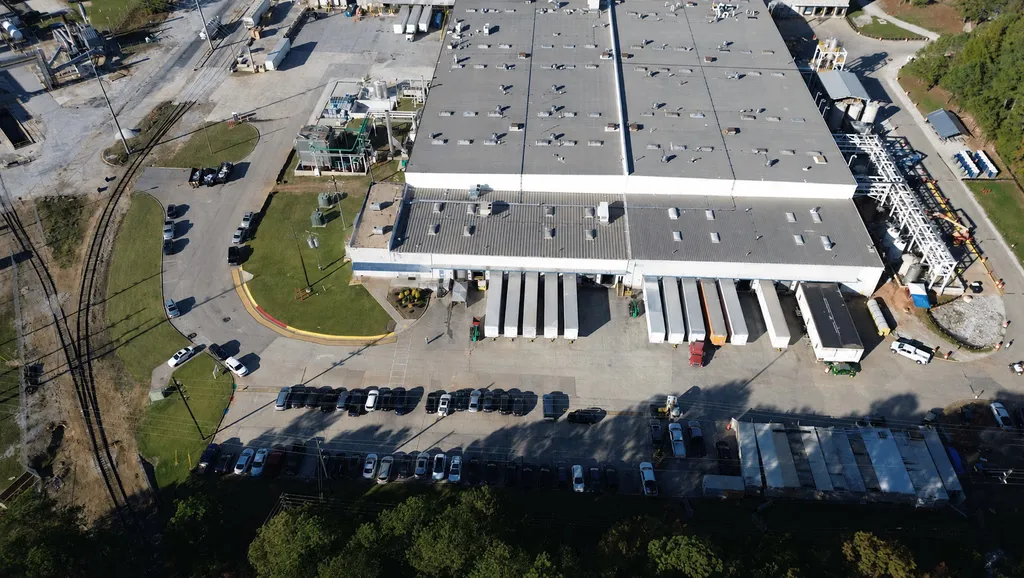
R3 Lithium has started producing lithium carbonate from recycled battery materials in the US state of Georgia. The existing plant is designed for 2,500 tons per year and is now being transitioned to continuous commercial operation.
The plant in Covington is designed to produce 2,500 tons of lithium carbonate annually.
Image: R3 Lithium
R3 Lithium took over the approximately 14,300 square metre facility in Covington only in July 2026. The previous owner – the insolvent company Ascend Elements – had, according to the company, invested around $150 million in the site. As early as 2025, lithium carbonate with a purity of 99 per cent was produced there entirely from recycled feedstock. R3 therefore describes Covington as the first commercially proven facility of its kind in North America.
The site combines several recycling stages. The shredding plants have an annual capacity of 30,000 tonnes and process production scrap and end-of-life batteries into black mass. From this, R3 recovers the lithium on-site using a calcination-based crystallisation and water-based precipitation process. The remaining concentrate of nickel, cobalt, manganese and graphite is to be marketed separately.
The existing line can produce 2,500 tonnes of lithium carbonate annually. Space for a second line of the same size is already planned, but R3 has not specified a timeline for the possible doubling. Initially, $15 million dollars from a Series A financing round will be invested in upgrading the facility for continuous commercial operation.
R3 to expand lithium carbonate production
On the sales side, R3 points to signed offtake agreements worth around one billion dollars, including with the commodity trader Trafigura. However, the company does not disclose quantities, durations or prices, making it difficult to assess the contract value.
By 2027, R3 aims to account for more than half of the lithium carbonate produced in the USA, according to its own forecast. However, given the existing annual capacity of 2,500 tonnes, this forecast also highlights how low domestic production has been to date. Other US projects are still under construction: for example, LG Energy Solution has secured 8,000 tonnes of lithium carbonate annually from the planned South West Arkansas Project of Smackover Lithium starting in 2029. Trafigura also intends to offtake the same annual volume long-term. The project is initially expected to reach 22,500 tonnes per year.
While Smackover Lithium aims to extract new lithium from brine, R3 focuses on existing material from the battery supply chain. The challenge now lies in continuous operation. Black mass can vary significantly depending on cell chemistry, age and origin of the batteries. R3 must therefore demonstrate that different input materials can be reliably processed into lithium carbonate with the specified purity.
In the long term, R3 plans additional facilities in North America and Europe. For the Covington site, however, the focus is initially on ramping up production. It has already been demonstrated that lithium carbonate can be produced from recycled material. Whether the process can also function continuously and economically on a commercial scale remains to be seen. R3 has not yet provided details on yield or production costs.