
How much actual savings does an electric car get from charging at home?
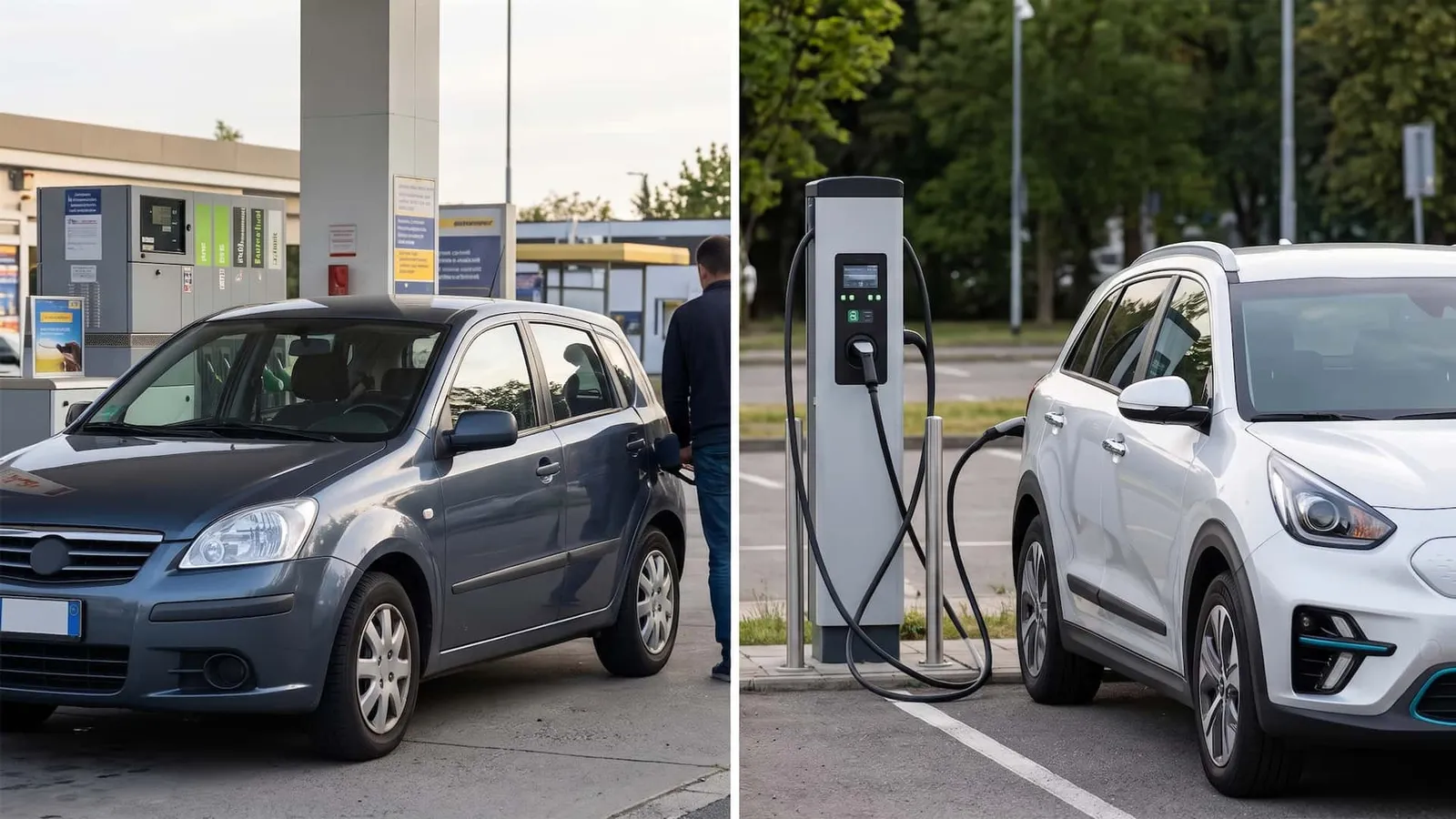
Filling up with gasoline costs an average of 11.60 euros per 100 kilometers. With an electric car, the same distance costs around 5.50 euros, less than half. This is confirmed by the latest findings from Motus-E, the association that brings together industry players in the electric sector, which also monitors the status of Italy’s public charging network. The savings vary depending on where you charge, but they remain substantial even for those without a garage.
In the meantime, the number of public charging stations on the Italian Peninsula has risen to 88,368, an increase of over 18,000 units in one year.
How much can you save with an electric car?
The calculation for Motus-E is based on real-world habits: 80% of charging occurs at home, while 20% happens at public charging stations. In this mixed scenario, driving 100 km with an electric vehicle costs 5.50 euros, compared to 11.60 euros for gasoline and 11.50 euros for diesel, not including any more favorable subscription plans offered by service providers.
Those who charge exclusively at home see an average cost of 4.5 euros per 100 km, which is about 60% less than gasoline. Without a parking space to install a home charging outlet, the advantage decreases but doesn’t disappear: the cost rises to 9.4 euros per 100 km, still 19% less than gasoline and 18% less than diesel.
On an annual mileage of 12,000 km, the savings compared to a gasoline car can exceed 850 euros per year. The figure changes further when considering the total cost of ownership, or TCO (the sum of purchase price, fuel, maintenance, insurance, and taxes, minus the resale value): in the city car segment, which is most common in Italy, savings rise to about 3,300 euros over six years despite the higher list price, mainly due to lower maintenance costs.
"The numbers show that electric mobility is not just an option for environmental sustainability, but a real opportunity for savings for families and businesses," says Fabio Pressi, president of Motus-E. "It’s an opportunity that’s becoming increasingly accessible to everyone thanks to a public charging network that continues to grow with the efforts of charging service providers."
The charging network approaches 90,000 stations
As of September 30, there were 88,368 public charging stations installed in Italy, an increase of 18,096 units over the previous twelve months. Nearly 30% of the stations added in the last year are fast or ultra-fast chargers. This indicates that the network is expanding not only in quantity but also in charging speed.
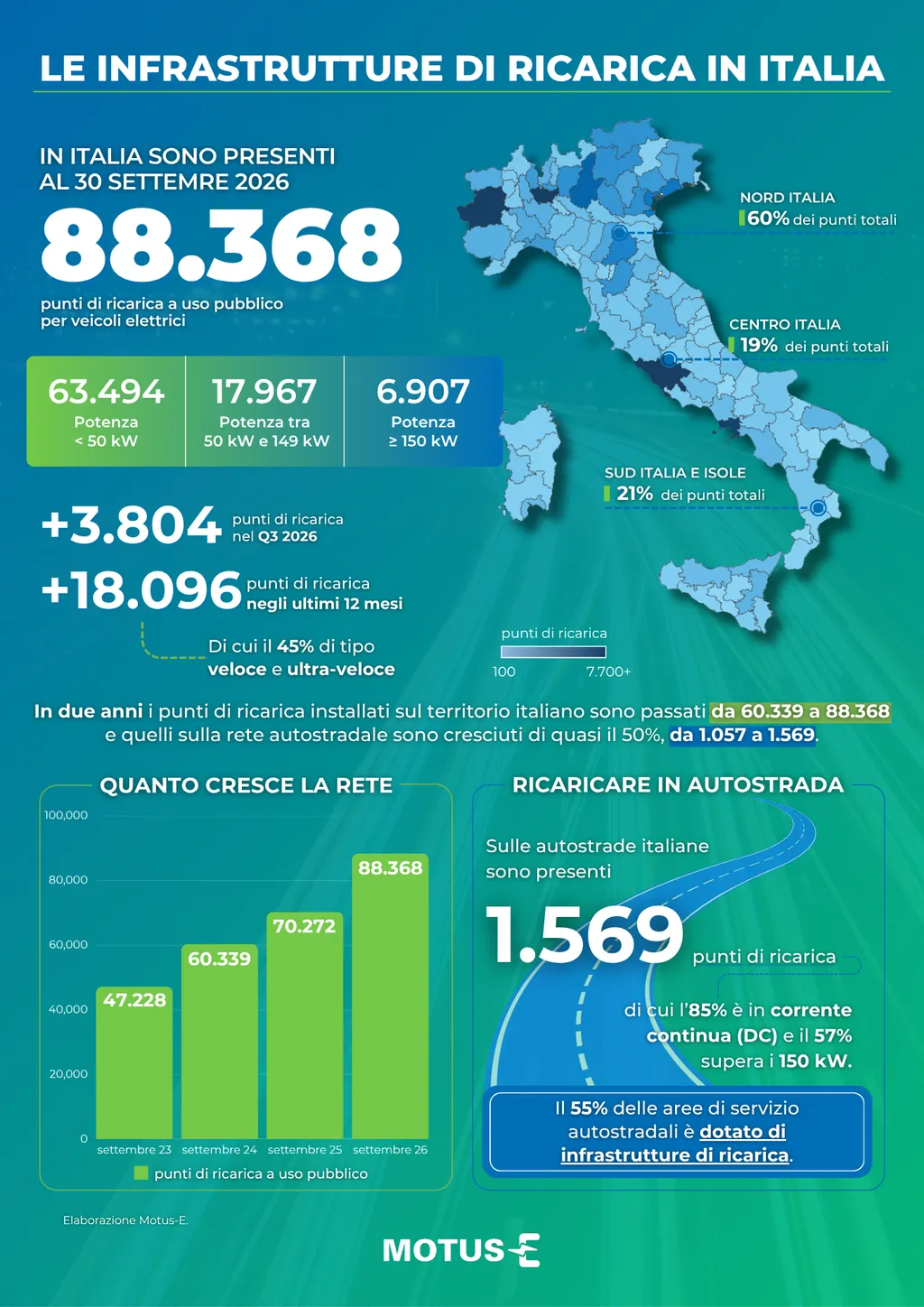
Charging stations in Italy as of October 2026
Photo by: Motus-E
On highways, the number of charging stations has risen to 1,569, up from 1,274 in September 2025 and 1,057 in September 2024. 85% of these are fast DC chargers, and 57% have a power output of over 150 kW: more than half of highway service areas now have at least one charging station. On the other hand, the proportion of chargers installed but still awaiting connection by local distributors has dropped to 12.3% from an average of 14.9% in 2025.
Where are the chargers located in Italy
Lombardy remains the region with the most charging stations, totaling 18,866, with 4,624 new installations in the past year. Followed by Piedmont (9,557, +2,780), Veneto (8,646, +2,238), Lazio (8,161, +714), and Emilia-Romagna (6,951, +1,462).
Among the provinces, Milan leads with 7,710 points and 2,740 new installations in twelve months, ahead of Rome (6,243, +362), Turin (4,688, +1,613), Naples (3,550, +430), and Brescia (2,588, +745).
The distribution remains uneven and concentrated in the most populous areas, an issue related to the charging anxiety still common among electric vehicle drivers, which a more extensive and faster charging network can gradually reduce over time.
Read also