
Hyundai Ioniq 3 autonomy test at 120 km/h
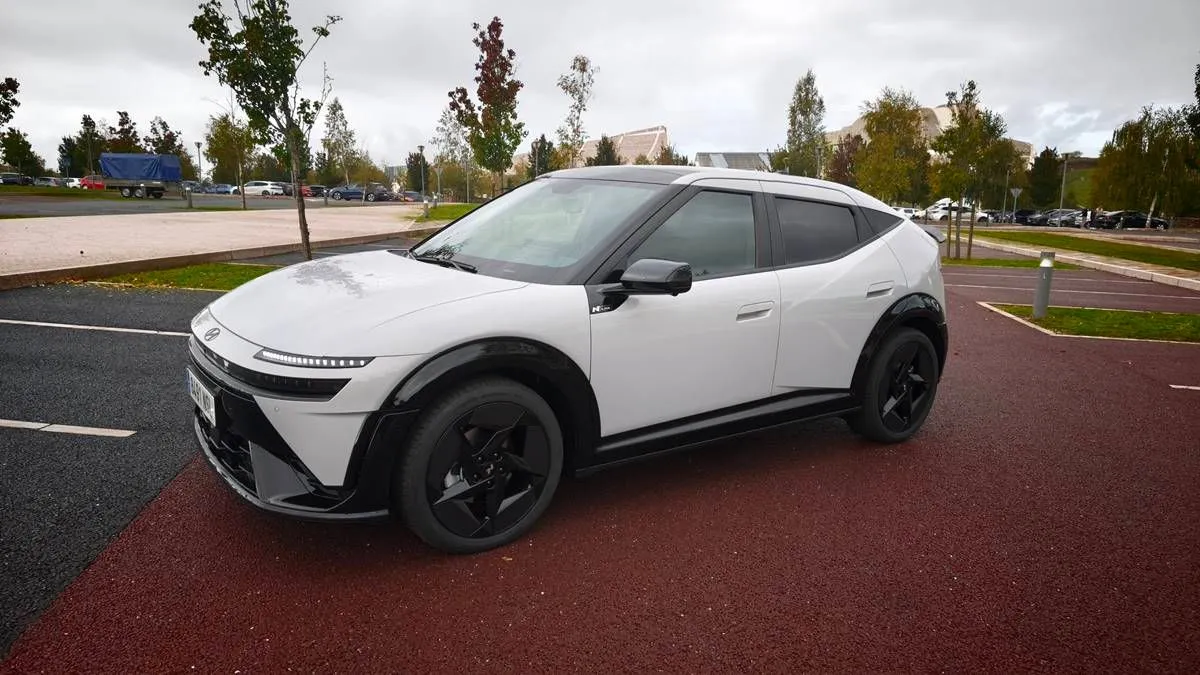
The Hyundai Ioniq 3 enters a segment where it’s increasingly difficult to stand out. It’s no longer enough to offer a small, easy-to-park electric car: it also needs to perform well on road trips, accommodate passengers, and handle heavy loads. Additionally, it must be visually appealing. Hyundai’s approach aims for exactly this balance, with a design that breaks away from convention and two battery options to suit different needs.
Within this range, it occupies the space between the Inster and the electric Kona. It represents an interesting middle ground for those who find the former too small but don’t need to upgrade to the latter. Competing models include the Renault 5, Volkswagen ID. Polo, and Cupra Raval, as well as higher-end options like the Kia EV2 and Skoda Epiq. As we can see, competition is intensifying, not to mention the Chinese manufacturers who will make things even more complicated in the compact segment.
The design plays a significant role in this comparison. While Renault leans on nostalgia, Hyundai opts for a more futuristic look, featuring a luminous signature of small rectangular elements and a silhouette defined by the sloping rear end. It measures 4.15 meters in length, 1.80 meters in width, and approximately 1.51 meters in height. Note that it has a wheelbase of 2,680 mm, a key figure in its design that we’ll discuss later and which can be compared to the 2,592 mm of the ID. Polo and Cupra Raval, or the 2,540 mm of the Renault 5.
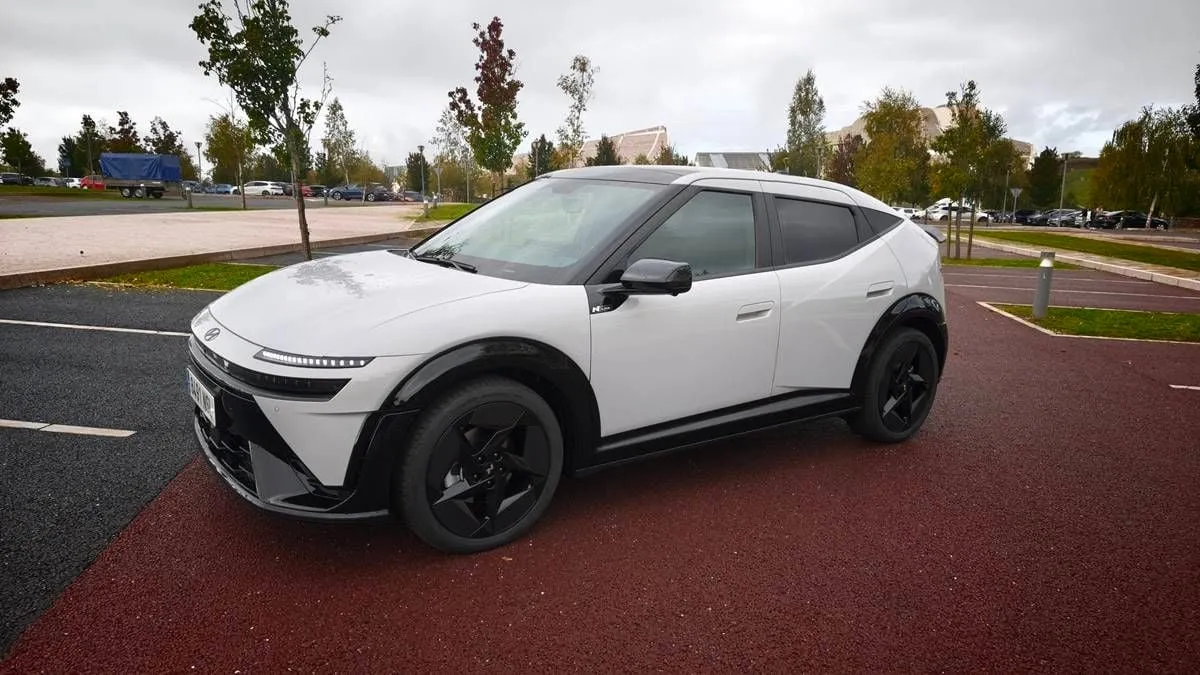
Undoubtedly, design is one of the main strengths of the Ioniq 3. It’s a car that catches attention wherever it goes. It’s one of those models that look even better in person than in photos. Its sharp front end, dominated by a set of LED lights, is already a compelling feature for those seeking a futuristic appearance. Additionally, it has an aerodynamic coefficient of 0.26.
But the rear isn’t far behind by any means. It features a very sporty design, which in this N Line version appears even more enhanced, giving the impression of a much more sporty car than it actually is.
Interior of the Hyundai Ioniq 3
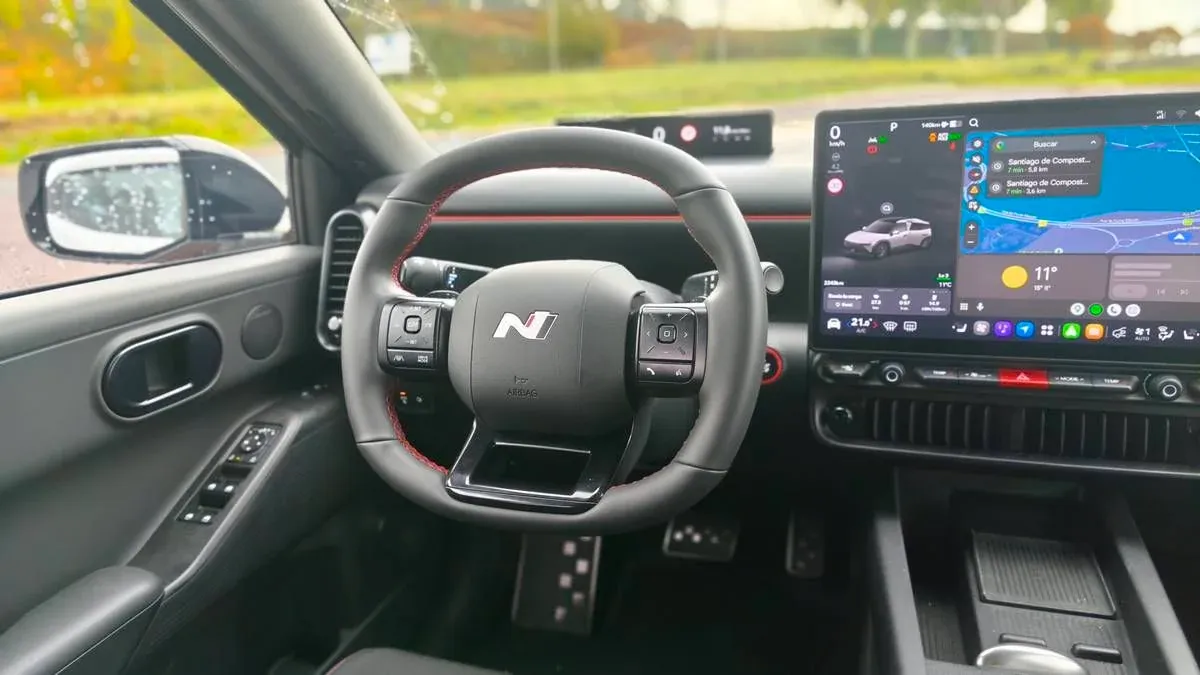
Inside, we find very favorable features. In this case, Hyundai didn’t experiment with unusual approaches and opted for a configuration that works well. The base model comes equipped with a 12.9-inch central screen, along with a 9.9-inch front screen, while ours features a 14.6-inch central display.
The multimedia system uses Android Automotive as the foundation for the brand’s software platform, called Pleos OS. The result is exceptional smoothness, on par with the best in the market. The layout is also very familiar, featuring a left side for visual elements such as what the driver sees outside, along with a screen for entertainment, while the right side is dedicated to the navigation. Additionally, Hyundai has added a series of physical buttons that offer the best of both worlds: screens and buttons. This way, each driver can choose what they prefer.
The sense of quality is impeccable, as is typical of Hyundai, with well-assembled materials and everything finely finished. This version boasts a hidden feature in its interior: an electric sunshade for the roof, which is invaluable in summer to shield us from the intense sunlight.
Among the rest of the equipment, the driving assistance system stands out, performing more than adequately by keeping the car centered in its lane with few issues. As a result, we can travel or navigate through traffic comfortably, as the system helps maintain a safe distance from the vehicle ahead, always under our control.
I mentioned the wheelbase earlier. Hyundai has done an excellent job with the 4.15 meters in length of the Ioniq 3, maximizing interior space thanks to a well-designed platform. The 2,680 mm wheelbase allows us to enjoy a compact vehicle with more space than many sedans. In this case, there’s no need to choose between rear passenger space and trunk space—we have it all.
With the driver’s seat adjusted to my height of nearly 1.70 meters, I have more than two fists’ worth of space in the back seat from the front seat backrest. I can even cross my legs and sit like in a large sedan. This is something families with children and large car seats will appreciate.
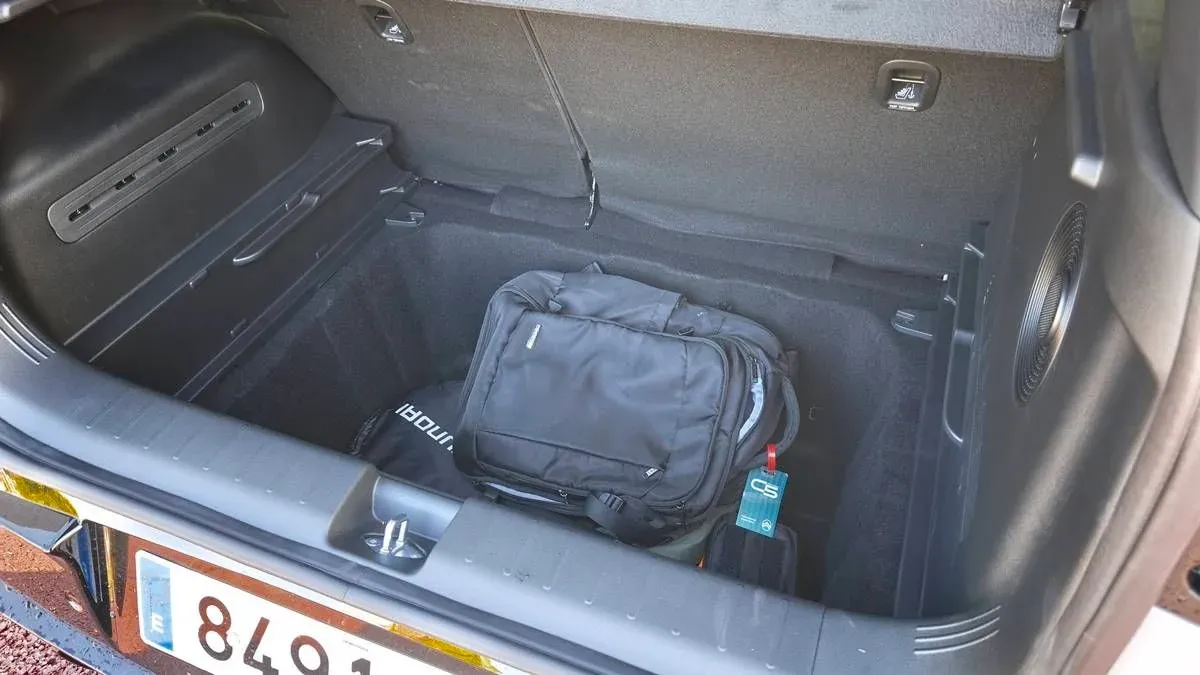
But the big surprise, to put it mildly, is in the trunk. Hyundai has managed to design a trunk that reaches 440 liters, including a massive dual floor system that redefines what “dual floor” means. It’s almost like a triple floor. Placing the propulsion system in the front axle has freed up space in the back, creating a space where you can even enter and sit comfortably. It’s truly impressive for a car of this size.
Driving the Hyundai Ioniq 3
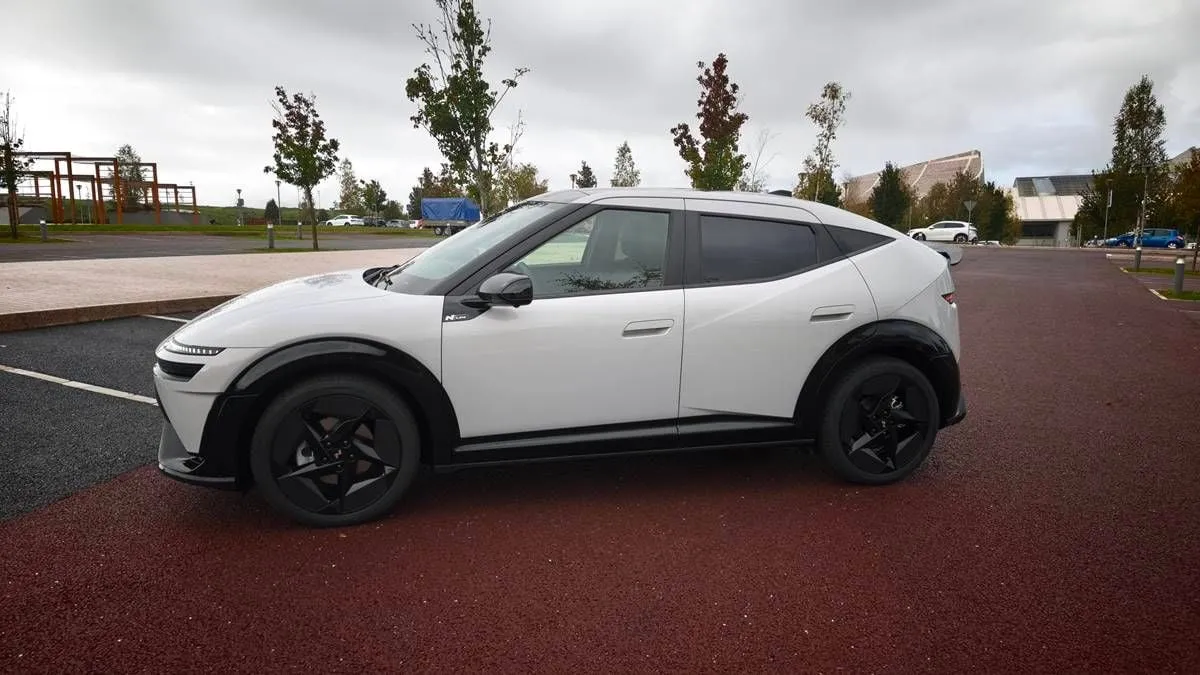
Despite its obvious lack of power, driving the Ioniq 3 is actually quite enjoyable. It’s not a powerful or lightweight car (1,555 kg), but it strikes a very good balance between performance and comfort. Inside, the high seat position and excellent visibility give the impression of being in a larger vehicle. The cabin’s superior sound insulation and the suspension’s shock absorption also help, ensuring comfortable driving even on poorly paved roads. And this is all despite the 19-inch tires, which not only reduce efficiency but also don’t do much to cushion impacts from potholes.
The Ioniq 3’s chassis is highly tuned and capable of handling curves without losing stability. It’s not very fast, as we’ll see, but the combination of its suspension and chassis, along with highly precise steering, makes driving it always very pleasant. Additionally, the Ioniq 3 features an element that I personally really like: levers on the steering wheel for controlling the intensity of regenerative braking.
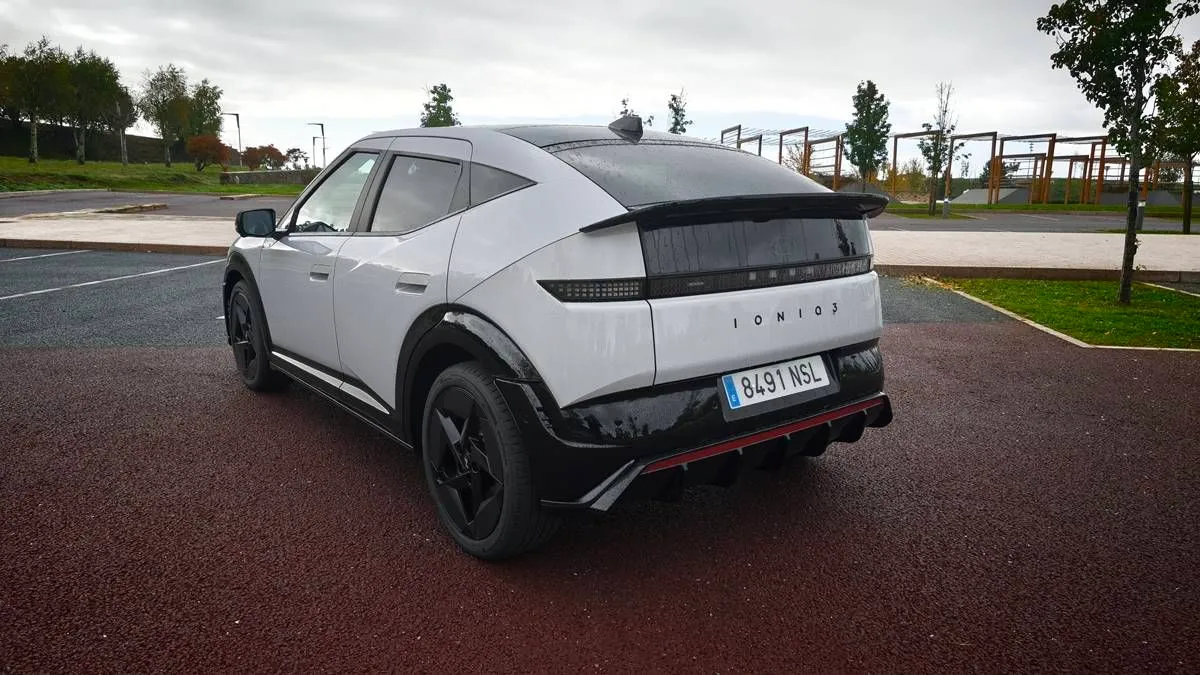
This means the base version accelerates from 0 to 100 km/h in 8.8 seconds, while the more expensive model with a larger battery takes 9.5 seconds. These are quite modest figures, especially for the latter when compared to its competitors such as the Renault 5 with 150 HP or the ID. Polo with 210 HP. It’s a somewhat risky way to cut costs in terms of horsepower, which could result in lost sales. And that’s assuming higher maximum power doesn’t necessarily mean greater fuel consumption in normal use.
The range offers two battery options, with the higher-capacity version claiming a WLTP range of up to 497 km. Then there’s the issue of tires, which manufacturers should reconsider, as it makes no sense to offer test models like this with 19-inch tires suitable for a two-segment higher-class sedan than the Ioniq.
Hyundai Ioniq 3’s 120 km/h Range Test
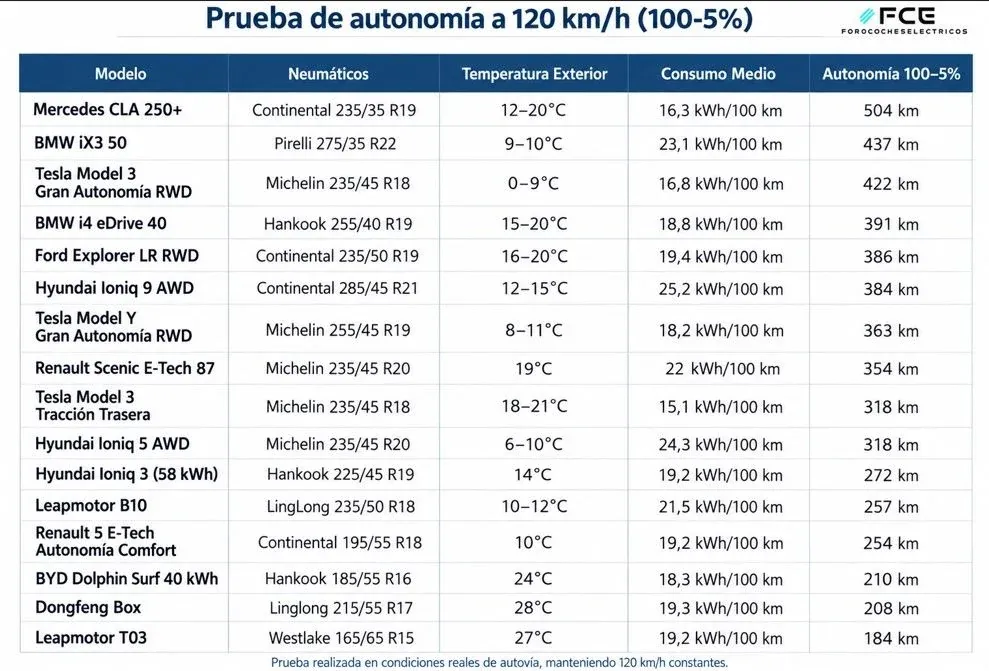
But let’s talk about range. What is the actual range of the Ioniq 3? To find out, we put it through our range test at 120 km/h with the battery starting at 100% and dropping to 5%. It’s a very demanding test involving constant uphill and downhill sections, conducted over a 66 km stretch of highway that we drove repeatedly until the battery reached 5%.
In this case, conditions remained favorable: 14 degrees outside the test area, a climate-controlled battery, little wind, and dry asphalt. We conducted the test with the air conditioner set at 21 degrees.
The result was that the Ioniq 3 managed to travel 272 km before its battery dropped to 5%, with an average consumption of 19.2 kWh/100 km according to the display. This puts it above the modest 257 km range of the Leapmotor B10 but below that of the Hyundai Ioniq 5 AWD.
Regarding fast charging, the Ioniq 3 has a peak power of 110 kW. At a charging station with 400 kW capacity, starting with the battery at 7%, it took us 36 minutes to reach 80%. In total, the station delivered 48 kWh during that charging session. This makes longer trips possible with the Ioniq 3 without issues, though some patience is required. The model also features a battery pre-conditioning system that can be activated manually—an essential feature that all electric cars should have these days.
Hyundai Ioniq 3: Prices and Conclusion
In Spain, the 147 HP Ioniq 3 Select model, with a WLTP range of 335 km, starts at 29,995 euros, before any subsidies or promotions. With the discounts available in the configuration tool in Spain, the price drops to 21,985 euros if financed. Of course, there’s a discount with quite small print that needs to be considered if we decide to buy the car.
The version with a larger battery capacity starts at 33,995 euros, again before any subsidies or promotions. As for the model tested, the 135 HP Ioniq 3 N Line starts at 39,995 euros.
The prices can be compared to those of some of its main competitors, though before comparing the offers it’s necessary to check whether they include financing, promotions, or subsidies. For example, the Volkswagen ID. Polo. The announced range features engines with 115 and 135 horsepower paired with a 37 kWh battery, offering up to 329 km of WLTP range. There’s also a higher-powered version with 210 horsepower and a 52 kWh battery, providing up to 455 km of WLTP range, with prices starting at 29,270 euros for the 37 kWh version and 35,475 euros for the 52 kWh version.
The Renault 5 starts at 28,065 euros for its version with 120 horsepower and a 40 kWh battery, delivering 321 km of WLTP range, while the version with 150 horsepower and a 52 kWh battery, offering 431 km of WLTP range, costs 31,085 euros.
Which one would you choose? Things get quite tight with three very different options available. The Renault 5 is smaller and more iconic in design, but it has shorter range; however, it’s cheaper. The Polo competes in the entry-level version, but its higher-capacity model, along with the Ioniq, offers ranges that are far beyond what’s typical for a compact car.
In the end, it depends on each person weighing the pros and cons of these three very distinct options that are shaping the electric B-segment market in Spain.
Comparison: Prices before subsidies or promotions
Position
Model
Version
Battery
Power
WLTP Range
Official Price (MSRP / Without Offers)
1st
Renault 5
Evolution
40 kWh
120 HP
321 km
28,065 €
2nd
Volkswagen ID.Polo
Match
37 kWh
115 HP
329 km
29.270 €
3rd
Hyundai Ioniq 3
Select
42 kWh
147 HP
335 km
29.995 €
4th
Renault 5
Evolution
52 kWh
150 HP
431 km
31.085 €
5th
Hyundai Ioniq 3
Select
58 kWh
135 HP
497 km
33.995 €
6th
Volkswagen ID.Polo
Style
52 kWh
210 HP
455 km
35.475 €
7th
Hyundai Ioniq 3
N Line
61 kWh
135 HP
497 km
39.995 €