
eMobiGrid project: Two-way power flows in container format
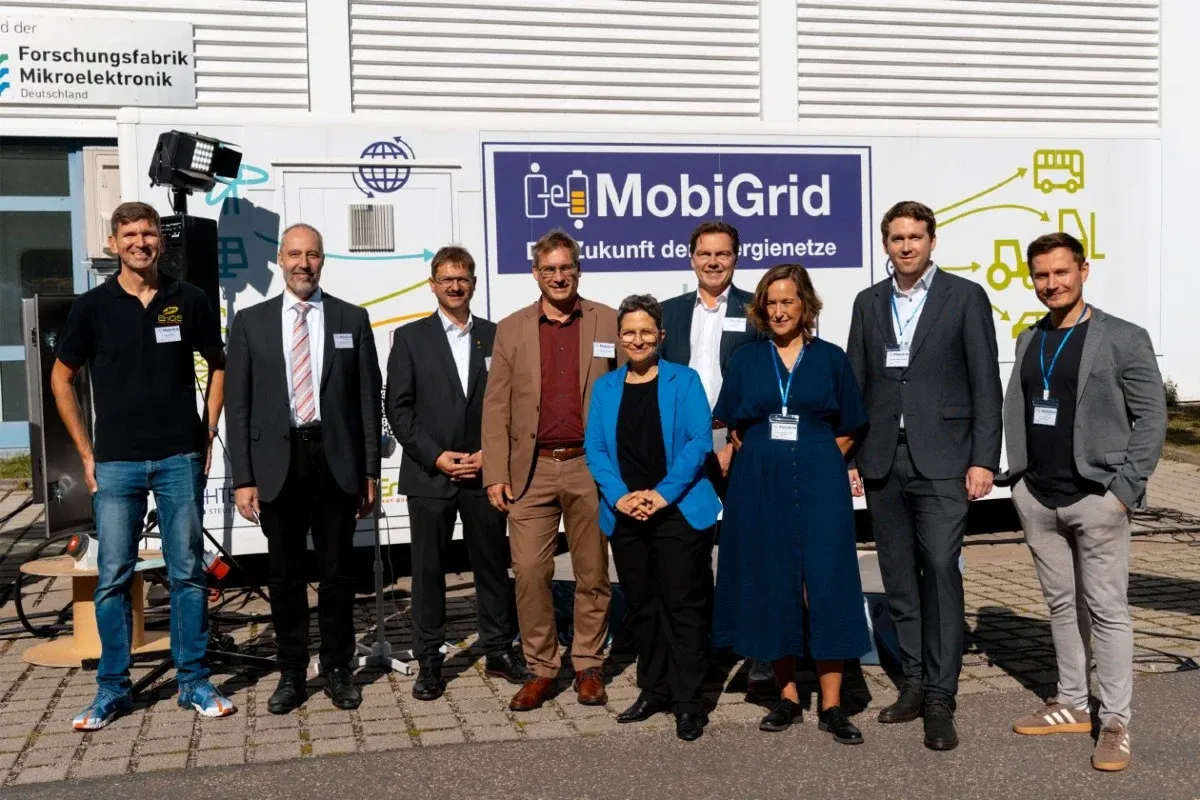
The partners of the Bidi project, eMobiGrid, have presented their results. At the core of their development is a container-based energy system that connects electric vehicles, battery storage, and renewable energy sources through an interconnected direct current network.
The project team at the closing event in Erlangen.
Image: mohr GmbH
The collaborative project eMobiGrid (“Development of a flexible DC network for electromobility”) has come to an end after nearly three years of research and development, with a public closing event held at the Fraunhofer Institute for Integrated Systems and Component Technology IISB in Erlangen. During this time, the focus was on establishing and testing an intelligent, bidirectional charging and energy infrastructure. The project team aimed to support the rollout and network integration of electromobility through a powerful bidirectional connection between the electricity and transportation sectors, as well as to increase the share of renewable energy by charging and discharging electric vehicles.
To achieve this, the consortium developed and tested a scalable charging and energy infrastructure designed specifically for commercial, municipal, and industrial applications. At its core is a container-based energy system to which the participants contributed numerous technical components. These include “power electronics with semiconductor-based isolation, intelligent measurement systems, model predictive control strategies for local DC grids, and predictive control of energy flows,” according to Fraunhofer IISB.
Furthermore, according to the initiators, eMobiGrid integrated a forecasting method to improve the utilization of volatile sources and explored their integration into grid-oriented operational strategies. “These developments enable more efficient use of existing grid capacity in conjunction with local generators, storage systems, and consumers such as photovoltaic installations and electric commercial vehicles,” states a accompanying statement.
The highlight of the closing event was the presentation of the so-called eMobiGrid container. This integrated solution, housed in a standardized rolling container, controls bidirectional energy flows based on various application scenarios. Attendees watched live, among other things, as a minibus—previously used for shuttle services between Erlangen Station and Fraunhofer IISB—and a forklift drew electrical energy using the established CCS charging standard and then supplied it back. The demo also demonstrated the feeding of energy from vehicle batteries into a stationary storage system and the use of that stored energy within the overall system.
To improve visibility, the project partners visualized the energy flows between the DC grid and the storage systems or consumers on a large screen, thereby making the basic functioning of a sector-connected energy system understandable. For the initiators, it is important that bidirectional energy concepts need not be limited to passenger cars “but are also highly suitable for commercial and industrial applications.” In their view, these results open up new possibilities for corporate fleets, logistics sites, or municipal applications.
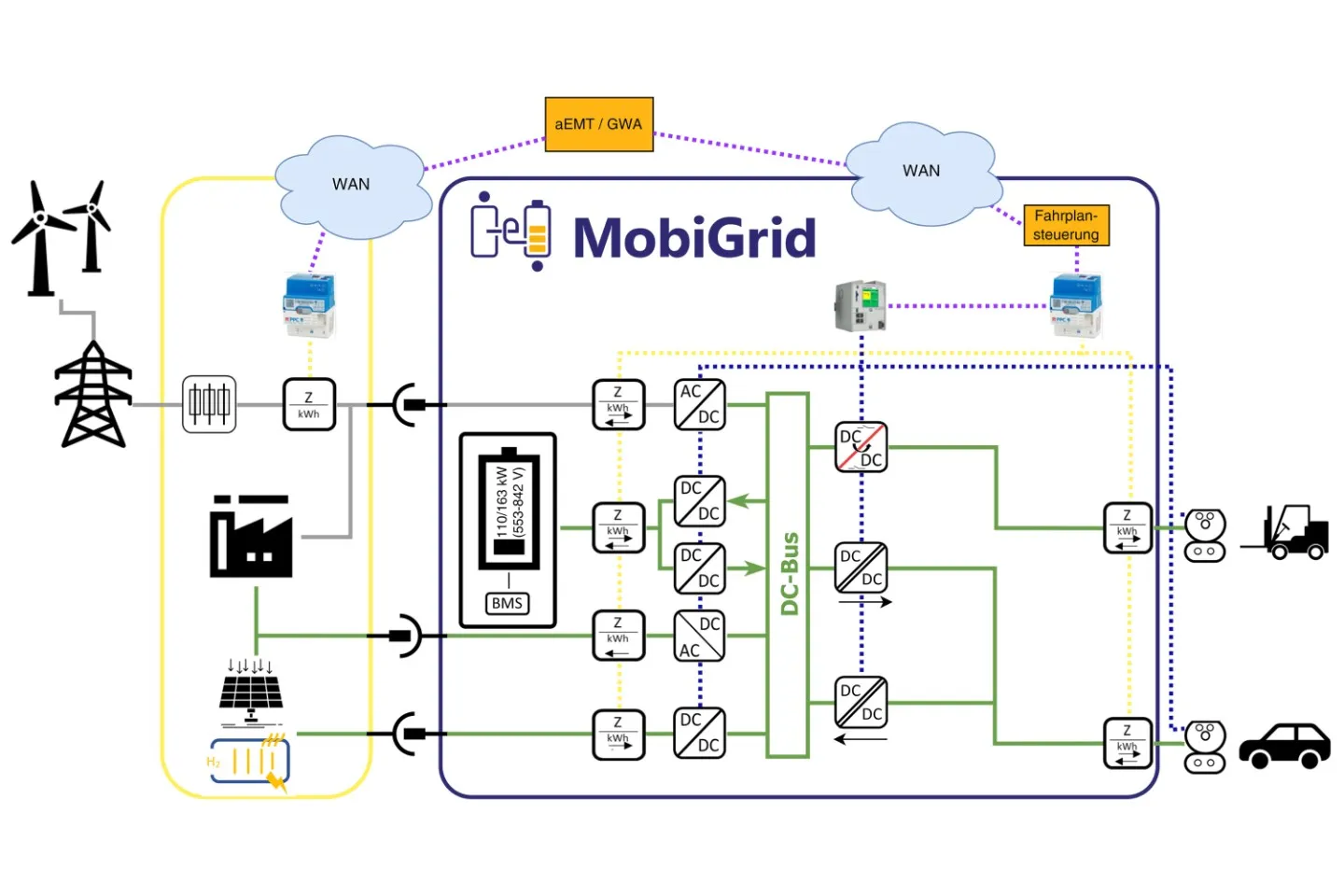
The project partners also emphasize the potential of mobile energy systems, especially for applications outside traditional charging infrastructure: “The eMobiGrid container enables rapid and flexible setup of energy and charging supply exactly where there is short-term or structurally low-threshold demand.” They cite potential use cases such as commercial businesses with limited grid infrastructure, construction sites with high power demands, large-scale events, or powering critical systems. This is because: “Thanks to islanding capability and a rooftop-mounted PV system, the container can operate autonomously in remote areas or during power outages, and be supplied locally through mobile energy sources such as bidirectionally usable electric vehicles, hydrogen trucks, or local generation units.”
The project consortium included Richter R&W Steuerungstechnik GmbH as the lead partner, the Chair of Measurement and Control Technology (MRT) at Bayreuth University, Fraunhofer IISB, EnQS GmbH, and eCharge Hardy Barth GmbH. The project was funded under the Federal Ministry of Transport’s (BMV) Electromobility Funding Guidelines.
Bernd Zeilmann, CEO of the leading partner Richter R&W GmbH, commented: “With our team, we have achieved in just three years what Europe otherwise often takes a decade to accomplish. Given geopolitical and climate challenges, time is running out — that’s why electrification and resilience in the electricity, transportation, and heating sectors must be accelerated decisively now!”
Dr. Claudia Elif Stutz, State Secretary at the Federal Ministry of Transport, emphasizes: “eMobiGrid demonstrates how we can advance charging infrastructure even in areas where network capacity is limited. With intelligent solutions, existing infrastructure can be utilized more effectively, enabling electric mobility to be reliably integrated into daily life. The Federal Ministry of Transport supported the project with around three million euros. The results clearly show what is possible when science and industry work together to develop new solutions and put them into practice.”
