
Hydrogen production: another failure and abandonment
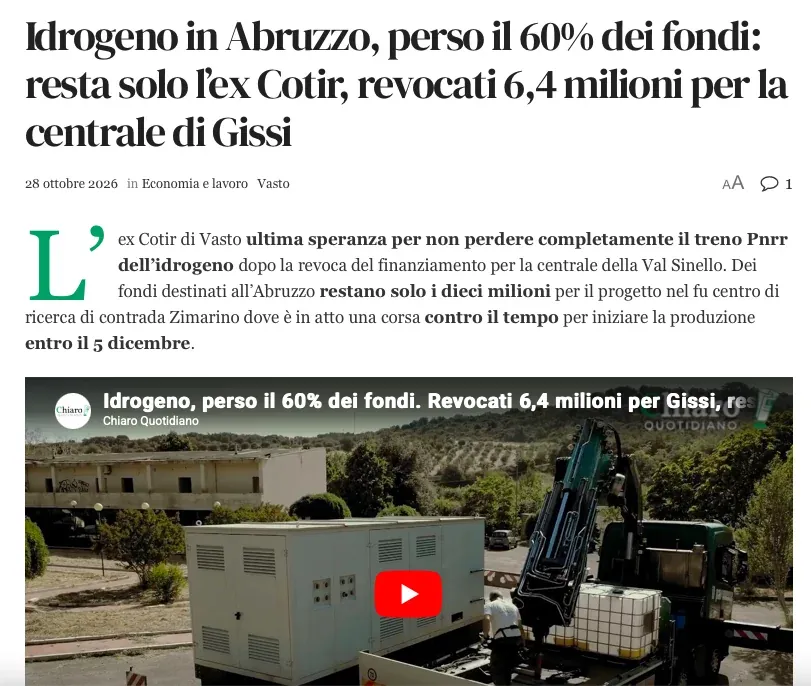
Hydrogen production: cuts and abandonments here as well. In addition to the failed projects related to distribution, there are difficulties at the production stage. The case of Abruzzo, a region that had placed heavy bets on green hydrogen, illustrates this issue.
Hydrogen production: several failed projects in Abruzzo
A detailed (and grim) overview of the situation was provided by the Chiaro Quotidiano website in a report titled dramatically: “Hydrogen in Abruzzo: 60% of funds lost—only the former Cotir remains; 6.4 million revoked for the Gissi plant.” At this point, the last hope of not losing all PNRR funds lies with the former Cotir in Vasto, following the cancellation of the project for the Val Sinello plant. However, time is running out even for the former Cotir as well: production must begin within a few weeks, by December 5. The goal is to produce 410 tons of green hydrogen per year for use in transportation. According to Chiaro Quotidiano, the project costs 17 million euros, with a solar farm supplying power to the facilities. The project is managed by Arap, whose general director explained that “work is being carried out continuously” to complete the project on time.
Race against time for the only remaining plant
The Abruzzo-based website then discusses the many failed projects. They were intended to convert abandoned industrial areas into new types of production. It all began in 2022, when the government allocated 25 million from the PNRR to green hydrogen production. Through a 2023 call for proposals, another 20 million were allocated:
6.4 million to Konia srl in Gissi for the Hydrogen Valley Gissi project;
10 million to Arap for the conversion of the former Cotir plant;
3.7 million to BluSolar Rosciano in Popoli for production at the former Dreher facility.
But as early as 2024, BluSolar gave up on the project. Two months ago, the same fate befell the plant in Gissi. Only Arap remains, racing against time to save at least the last project. Hopefully it will succeed, so that we can finally see a production plant in operation and verify its usefulness on the ground.
Previous Article
Obstacles to electricity? The challenges of digitalization plus prices
Next Article
Electric Golf project halted: another cut by Volkswagen