
We tested the new Mazda6e: now with a single 78 kWh battery, 560 km of range, and upgrades to improve performance
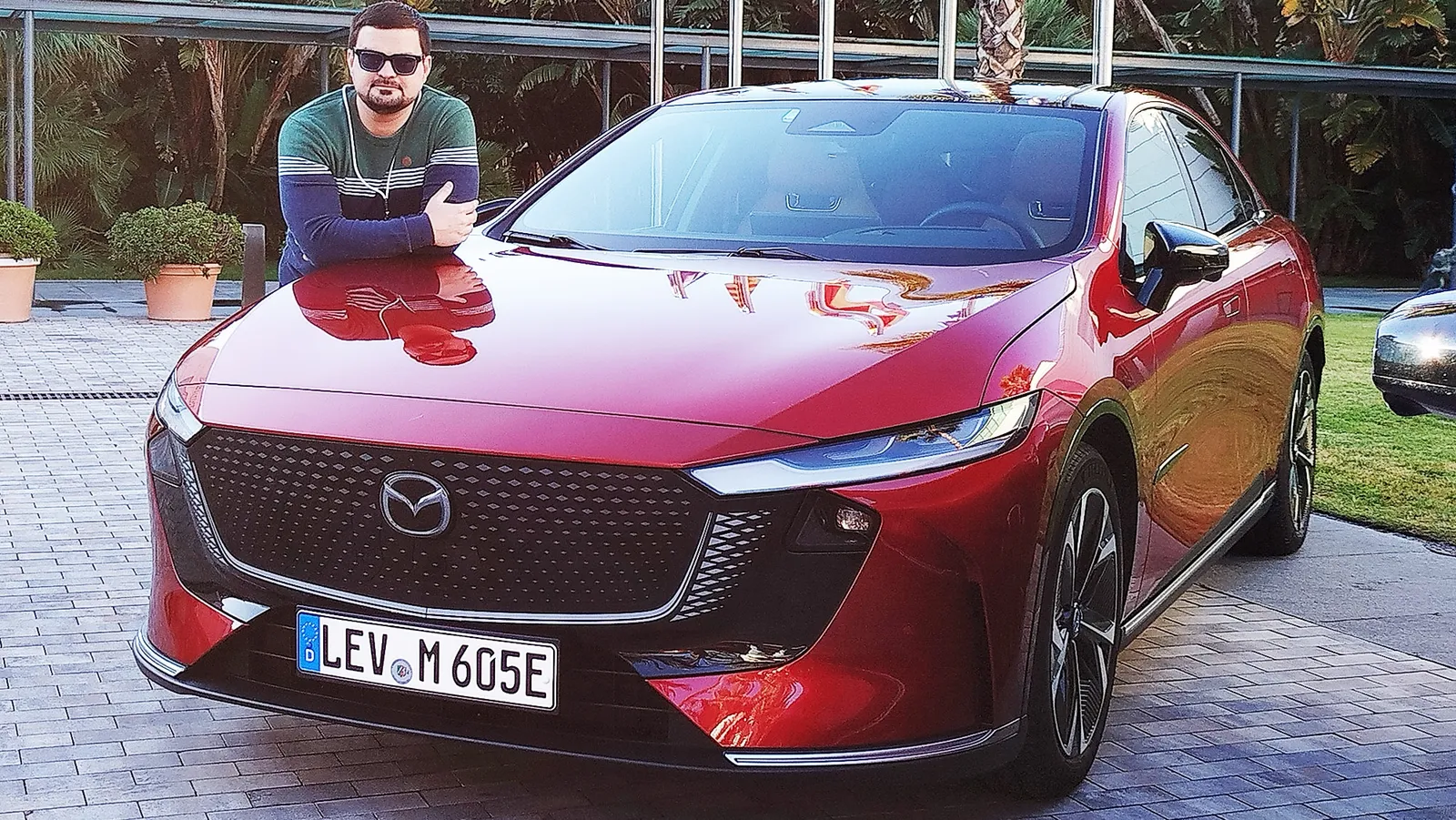
The Mazda6e has only been on the European market for a year, but it already receives a significant update to address some of the limitations of its first version. This Japanese electric sedan features a new 78 kWh LFP battery that provides 560 kilometers of WLTP range and supports faster charging, thereby solving one of its main drawbacks. Mazda has also taken the opportunity to revise the suspension, stiffen the springs, and recalibrate the steering and accelerator. These changes are intended to improve its road performance without sacrificing the comfort that defines this 258 CV Japanese sedan.
A new 78 kWh battery that solves the charging issue
The main innovation of the 2027 Mazda6e lies in its battery. Until now, the lineup offered two options: an LFP battery with 68.8 kWh capacity, 258 horsepower, and a charging speed of up to 165 kW, and an NMC battery with 80 kWh capacity, 245 horsepower, whose charging speed was limited to 90 kW. The latter was particularly uncompetitive compared to rivals such as the Tesla Model 3, Hyundai Ioniq 6, or Volkswagen ID.7.
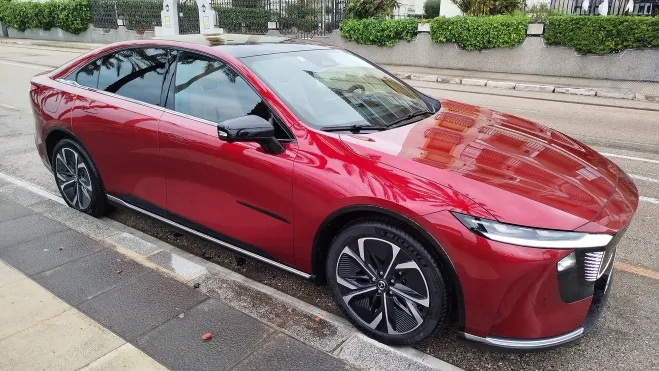
Mazda has decided to simplify its offerings by sticking to a single configuration that combines the advantages of both versions: a 258-horsepower engine and a 78 kWh LFP battery capable of achieving 200 kW of charging power.
Under favorable conditions, it can go from 10% to 80% in 24 minutes. It also supports AC charging at 11 kW, requiring about 7.9 hours to restore its full capacity.
The certified range reaches 560 kilometers WLTP, eight more than the previous version with the longest range. Fuel consumption also improves, dropping from 16.6 to 16.1 kWh/100 km.
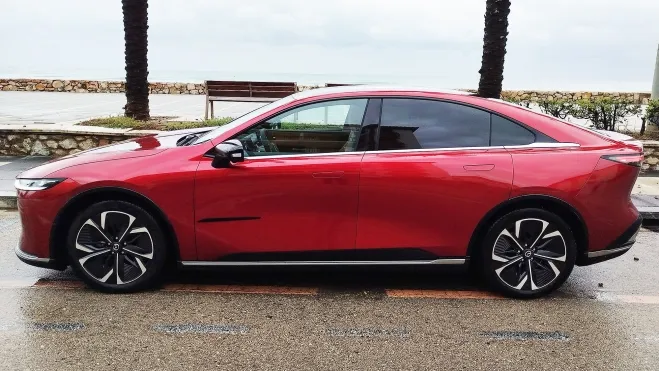
A stiffer suspension to improve road performance
Another major innovation in the Mazda6e lies in its chassis. Although its focus remains clearly on comfort, Japanese and European engineers have worked to improve precision and better control the body’s movements.
The update features stiffer springs and shock absorbers with a revised setup, particularly to reduce vertical oscillations of the rear axle.
The goal is to improve stability at high speeds and achieve a more direct response in corners and during weight shifts.
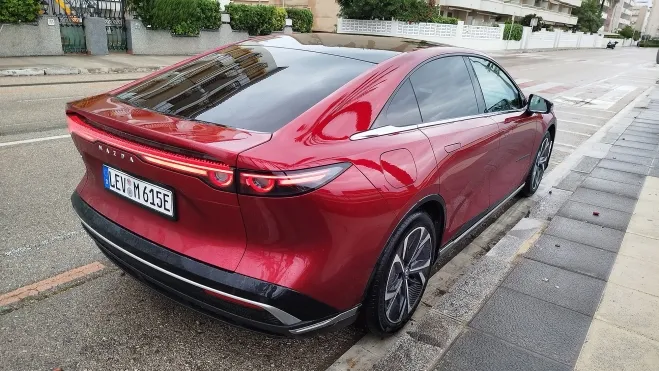
The electric power steering has also been recalibrated to offer greater precision and a more natural connection between the driver and the vehicle, in line with Mazda’s Jinba Ittai philosophy.
The sedan retains rear-wheel drive, a multi-link rear suspension, and a weight distribution of 47% at the front and 53% at the back. These features contribute to balanced handling, though its weight of over two tons reminds us that it is an electric car of considerable size. Regardless, it delivers strong low-end torque for smooth acceleration.
This review is not intended to turn the Mazda6e into a sports car. It remains a sedan designed primarily for commuting, with tuning aimed at combining comfort, stability, and more precise response.
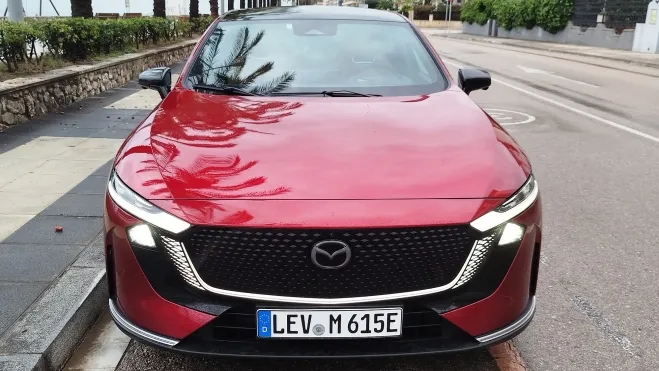
258 horsepower and more immediate acceleration response
The engine retains its 190 kW, equivalent to 258 horsepower, and a maximum torque of 290 Nm. With this configuration, the Mazda6e accelerates from 0 to 100 km/h in 7.3 seconds, three tenths faster than the previous 68.8 kWh version. Its top speed remains electronically limited to 175 km/h.
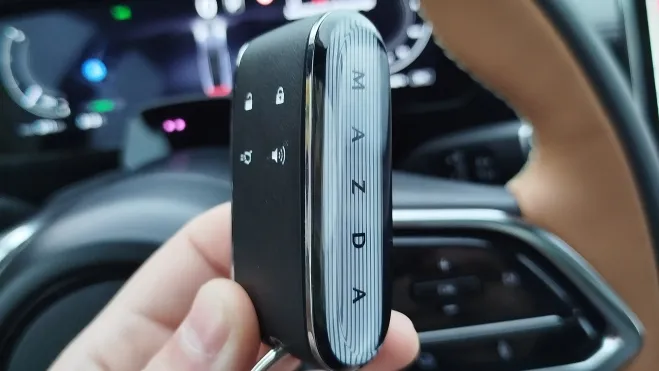
The changes also affect the accelerator response, which has been recalibrated to provide a more immediate and predictable power delivery. The driver has three driving modes: Normal, Sport, and Individual. The Individual mode allows adjusting the engine response, choosing between two steering resistance settings, and selecting four levels of regenerative braking.
Mazda has increased the maximum energy recovery capacity and improved the transition between regenerative braking and conventional brakes. The braking feel isn’t particularly to my liking, but the response is adequate.
Improvements to driving aids and a familiar interior
The update also includes changes to the assistance systems, especially the lane-keeping system and the traffic and cruise assist, which can now operate at up to 160 km/h, up from 130 km/h before.
The exterior design remains largely unchanged, retaining its 4.92 meters in length and practical five-door body style. It keeps the attractive rear spoiler that can be deployed manually or automatically at speeds of 90 kilometers per hour. The trunk offers 466 liters of space up to the roof, with an additional 72 liters under the front hood (frunk).
Inside, it retains the 14.6-inch central display and a spacious, well-designed cabin with high-quality materials. Its main area for improvement remains its excessive reliance on touch controls to manage numerous functions.
The price range in Spain starts at 44,725 euros, before any promotions or possible subsidies. The available finishes are the well-known Takumi and Takumi Plus, along with the new Homura Plus, which aims to add an even more premium touch to these finishes, which already offer a high perceived quality even in their entry-level versions. The wheels are 19 inches in size in all cases.
The 2027 Mazda6e thus gains advantages in competing with other electric sedans. The new battery addresses a significant limitation of the previous version, while chassis modifications aim to improve its handling without sacrificing its main strength: ride comfort.
In addition, the Japanese brand continues to occupy its distinctive niche: a fine line between mass-market brands and more premium ones.