
Portugal will pay up to 15,000 euros to electricians. This is one of the highest subsidies in Europe.
In the article:
- Portugal plans subsidies for electric cars up to 15,000 euros.
- The program aims to help families for whom the car price is a barrier.
- Europe continues to support electromobility through subsidies and tax incentives.
Portugal will even subsidize up to 90 percent of the price of an electric car!
Purchasing a new car, especially an electric one, remains a costly expense for many European families. However, Portugal intends to significantly lower this entry barrier. Environment Minister Maria da Graça Carvalho announced a new support program for low-income households, under which the government could cover 70 to 90 percent of the cost of a qualifying electric vehicle.
The maximum amount of support is expected to be 15,000 euros. The minister emphasized that the detailed terms of the program are still being developed, and the final level of assistance will depend on the eligibility criteria. Experts cited by Bloomberg estimate that if the proposals are implemented in their proposed form, this Iberian country will rank among the top in Europe in terms of direct support for purchasing electric vehicles.
Price remains the biggest obstacle
Although the operating costs of electric cars are often lower than those of gasoline or diesel vehicles, the purchase price remains the most commonly cited barrier to entry. The Portuguese government aims to address this issue directly. As Essential Business notes, “a subsidy covering a significant portion of the vehicle’s price could make transformation accessible to consumers who previously could not even consider buying a new electric car.”
This is particularly important in countries where a large number of drivers still use older combustion engines. Even growing environmental awareness and lower operating costs do not always offset the high initial expense.
Incentives are necessary
Given the above, the significance of the Portuguese initiative becomes even more apparent in the context of European residents' incomes. According to a report based on data from Numbeo as of October 2026, the average monthly net salary in Portugal is approximately 5,116 zł, whereas in Poland it is 6,261 zł.
This means that Portuguese households have, on average, lower incomes than those in Poland, even though electric cars cost almost the same in the European market. In practice, purchasing a new electric car represents an even greater financial burden for many Portuguese people compared to residents of Central Europe.
Therefore, from this perspective, a subsidy of up to 15,000 euros can play a key role in increasing the accessibility of electric mobility for lower-income families.
On the other hand, the Portuguese example also demonstrates that the pace of transportation electrification depends not only on the level of societal wealth but also on the scale and effectiveness of public support programs. For comparison, Poland, despite higher average net incomes, still has one of the lowest proportions of electric vehicles among new registrations in the European Union – 16,479 new electric vehicles were registered in Poland in the first half of 2026, representing a 15.6 percent year-on-year increase.
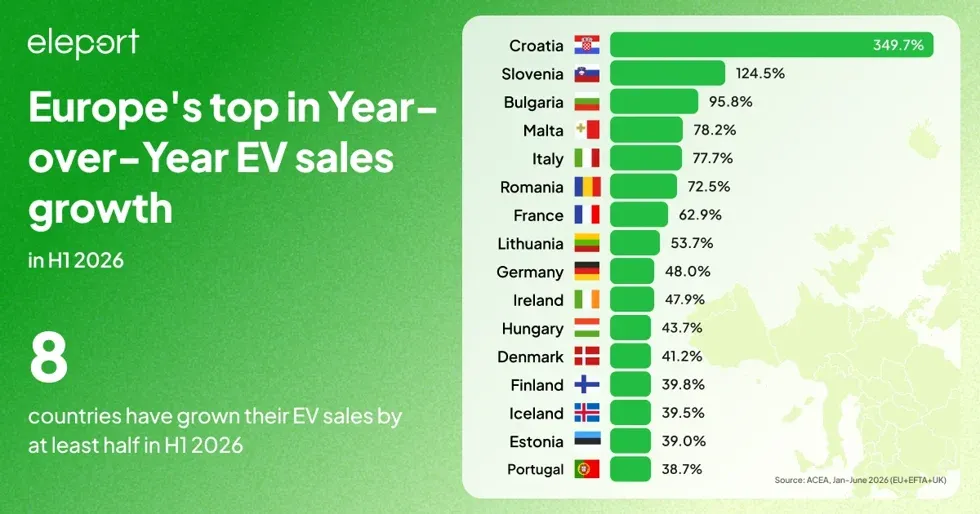
The share of battery cars in the new car market increased only from 5.0% to 5.3%. For comparison, across Europe, over 1.6 million new electric cars were registered from January to June, a 35.1% increase from the previous year. For the first time in history, the number of electric car registrations exceeded that of gasoline cars on a half-year basis, according to the latest data from Eleport.
Electric cars are already gaining ground in the Portuguese market
The announcement of new subsidies comes at a time when electric cars are gaining rapid popularity in Portugal. Data from the Portuguese Automobile Association ACAP, cited by agency Lusa, shows that between January and October, fully electric vehicles accounted for over 30 percent of new passenger car registrations. October is even more impressive, with battery-powered cars making up 45 percent of registrations. Meanwhile, the overall automotive market is growing. ACAP reported that 241,293 new vehicles were registered in the first ten months of the year, an increase of about 9.9 percent compared to the previous year.
Experts note, however, that registrations of new cars still do not reflect the overall structure of the vehicle fleet, as the rate of vehicle replacement remains dependent on households’ financial situations, the availability of models, and the development of charging infrastructure.
How does Portugal compare to Europe?
Portugal’s plans are impressive but fit within a consistent trend — many European countries continue to support electric mobility through subsidies, tax incentives, or preferences for electric vehicle owners. How? According to analyses from Voldt.eu and data from the European Alternative Fuels Observatory, as of the end of September 2026, programs offering subsidies for purchasing electric cars were in place in countries such as Germany, France, Spain, Sweden, and the United Kingdom.

In Germany, for example, buyers can receive support of 3,000 to 6,000 euros when purchasing a new electric vehicle, while in France it ranges from 3,500 to 5,700 euros. Additionally, France’s system provides a bonus of up to 2,000 euros for vehicles equipped with European batteries.
Spain offers a maximum subsidy of 4,500 euros, while in the UK the support amounts to 3,750 pounds for cars costing no more than 37,000 pounds. Sweden has adopted a different approach, providing monthly subsidies for low-income residents in rural areas. Against this backdrop, Portugal’s proposal appears particularly ambitious, as its maximum subsidy of 15,000 euros far exceeds the level of direct grants currently available in most European countries.
It is also worth mentioning Poland in this context. Recall that at the beginning of this year, the funds for the “NaszEauto” program were exhausted, and it was closed to new applications once the available budget was depleted. NFOŚIGW decided to increase the budget by an additional 82 million zł, bringing the total amount to over 1.26 billion zł. According to the fund, this will enable financing for all applicants whose applications are approved and meet the program’s requirements.
The lack of a planned successor program means that, despite declarations of continuing the project, private buyers of electric vehicles currently lack a nationwide subsidy system, which may limit the further growth of the market.
Success lies in the details
Despite the attractive promises, experts emphasize that the program’s effectiveness will depend on its final terms. Key factors will be income criteria, price limits for vehicles, the availability of cheaper electric models, and efficient administrative procedures. As Essential Business notes, the current information should be viewed as a political statement rather than a finalized program available to all interested parties.
It will be the publication of detailed rules that will show how many Portuguese people will be able to benefit from this record-level support. And if the program proceeds as planned, it could indeed become one of Europe’s most interesting experiments in supporting electromobility, which may dramatically accelerate the replacement of older gasoline vehicles with emission-free alternatives.
Oskar Włostowski