
Porsche has made cathodes from recycled batteries of its own vehicles. Testing is ongoing, with production starting in 2028.
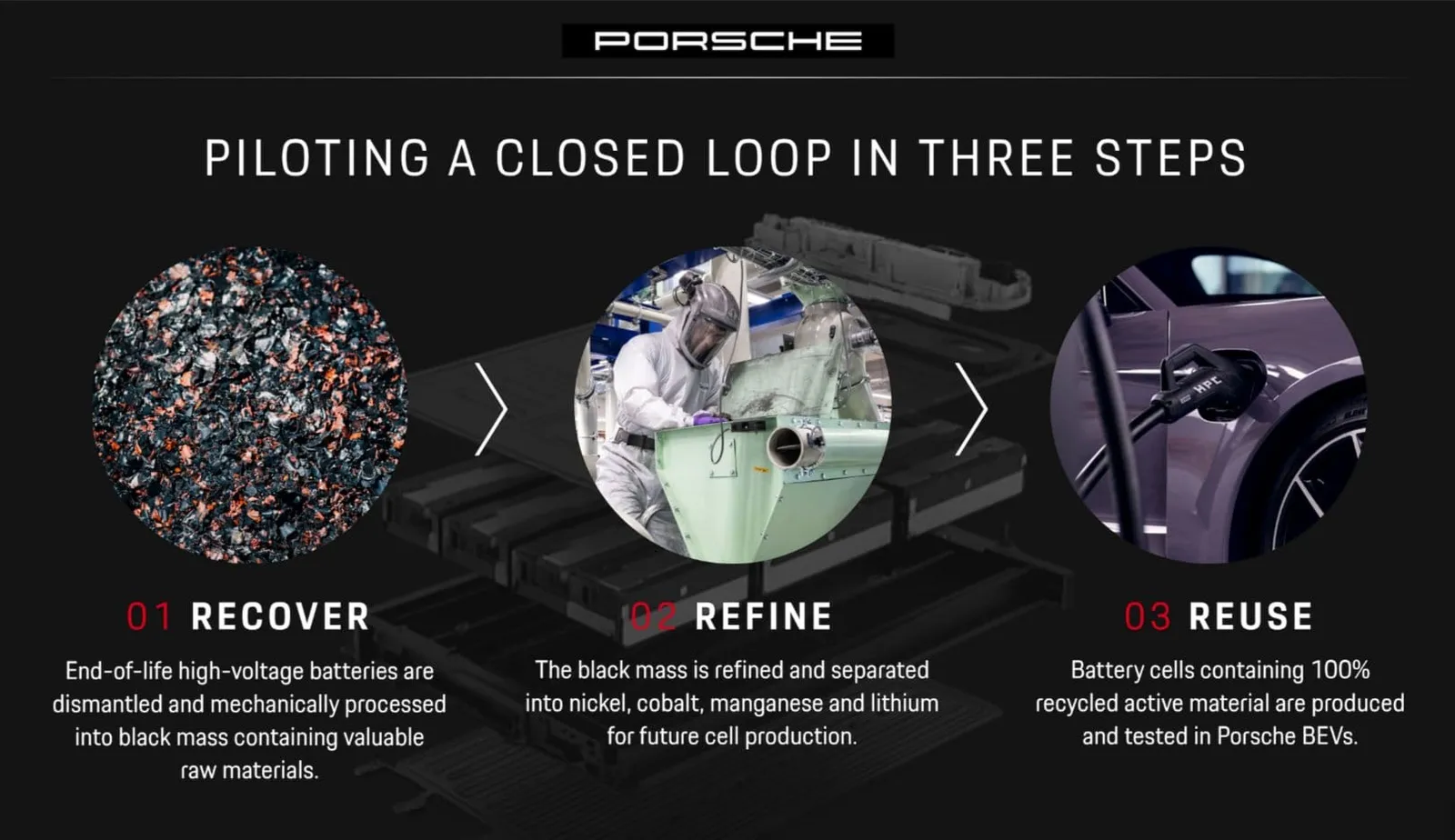
Porsche announced that it has produced cells for the first time, with the cathode active material coming 100 percent from recycled materials sourced from its own high-voltage batteries. The project, developed in collaboration with German startup Cylib, has now entered its third phase, and the new cells will be used in test vehicles.
For EV drivers, this is not yet a “factory-battery.” But finally we have something more than just a slide on closed-loop recycling.
Three phases of the project and now the first real test
Porsche hinted at this direction last year when it launched a pilot project with Cylib from Aachen. The manufacturer invested in this startup in 2024.
The project is divided into three phases. First, used or retired high-voltage batteries from Porsche’s development vehicles were mechanically crushed into what is known as black mass, a mixture containing elements such as nickel, cobalt, manganese, and lithium. Then the black mass was purified and separated into raw materials needed to produce new traction batteries.
Phase three has now begun. Porsche, along with partners including Cylib, has produced batteries whose cathode active material is 100 percent made from recycled lithium, nickel, cobalt, and manganese sourced from batteries from their own vehicles. These batteries are set to be tested in Porsche’s test vehicles.
The manufacturer claims that initial tests have already shown the technical viability of this approach. Further results are expected by 2026. If everything goes well, the pilot project is intended to serve as a basis for using recycled materials in mass-produced cells.
Joachim Scharnagl, Porsche’s head of procurement, described this as a “significant technological milestone” and emphasized resource resilience and improved efficiency. That’s true, though at this stage we’re still talking about a trial rather than a production Taycan using “own” cobalt.
Germany is already recycling these batteries, with recycled materials set to be available starting in 2028
Cylib claims to close the loop from used batteries to recovered materials. The company’s co-founder and Co-CEO, Dr. Lilian Schwich, said the project with Porsche demonstrates the practical feasibility of the process and offers an opportunity for battery materials from their first life cycle to be reused in high-performance Porsche batteries.
Things get more interesting here. Initial findings from the pilot program are already being integrated into Porsche’s regular battery recycling process at its centers in Germany. Starting in May 2026, batteries will be processed there using an innovative water-based method. Cylib records the recovered materials in its material ledger, with them set to be available for Porsche and selected partners to use in cell production starting in 2028.
This is the concrete detail that is often missing from recycling announcements. The date when materials enter production makes a significant difference.
The second topic is broader and less marketing-focused. Europe still relies heavily on supply chains outside the continent, especially from China, for lithium, nickel, cobalt, and their processing. Recycling won’t solve everything, but it can recover some of the raw materials already present in Europe and treat used batteries as a local source of material.
Regulations add to this challenge. The Critical Raw Materials Act and the EU Battery Regulation require higher levels of recycling as well as minimum proportions of recycled materials. Porsche with Cylib is simply trying to bring something to market that will soon stop being a “nice-to-have” option.
The most interesting part of this news isn’t the 100 percent claim, but rather the date of 2028. If the recovered materials truly make their way into mass-produced cells by then, we can talk about something beyond just a pilot project. Do you think premium brands like Porsche will push recycling into series production faster than mass-market brands?
LovEV Newsletter
Want more content like this?
Sign up — we’ll send you a weekly summary once the newsletter starts.