
The police are launching a major operation on roads. Reflectors, lights, and vehicle condition are under scrutiny.
In short:
From October 1st to the end of the year, a nationwide police campaign titled “Set an Example – Wear Reflectives” will be underway across the country.
The police will focus not only on pedestrians but also on the lighting conditions of vehicles.
According to ITS data, as much as 80 percent of them may be driving with improperly adjusted lights.
Poor visibility remains one of the biggest threats on Polish roads.
Today, the Police launched “National Police Day of Reflectives,” simultaneously starting a nationwide educational campaign called “Set an Example – Wear Reflectives.” The campaign will run until the end of the year and aims to remind pedestrians, especially seniors, of the importance of reflectives and safe road behavior.
The timing of the campaign launch is not arbitrary, as autumn brings shorter days, earlier darkness, frequent precipitation, and fog. Under such conditions, visibility drops sharply, increasing the risk of hitting pedestrians. As the Police Headquarters emphasizes, even a small reflective element can save lives by giving drivers valuable seconds to react.
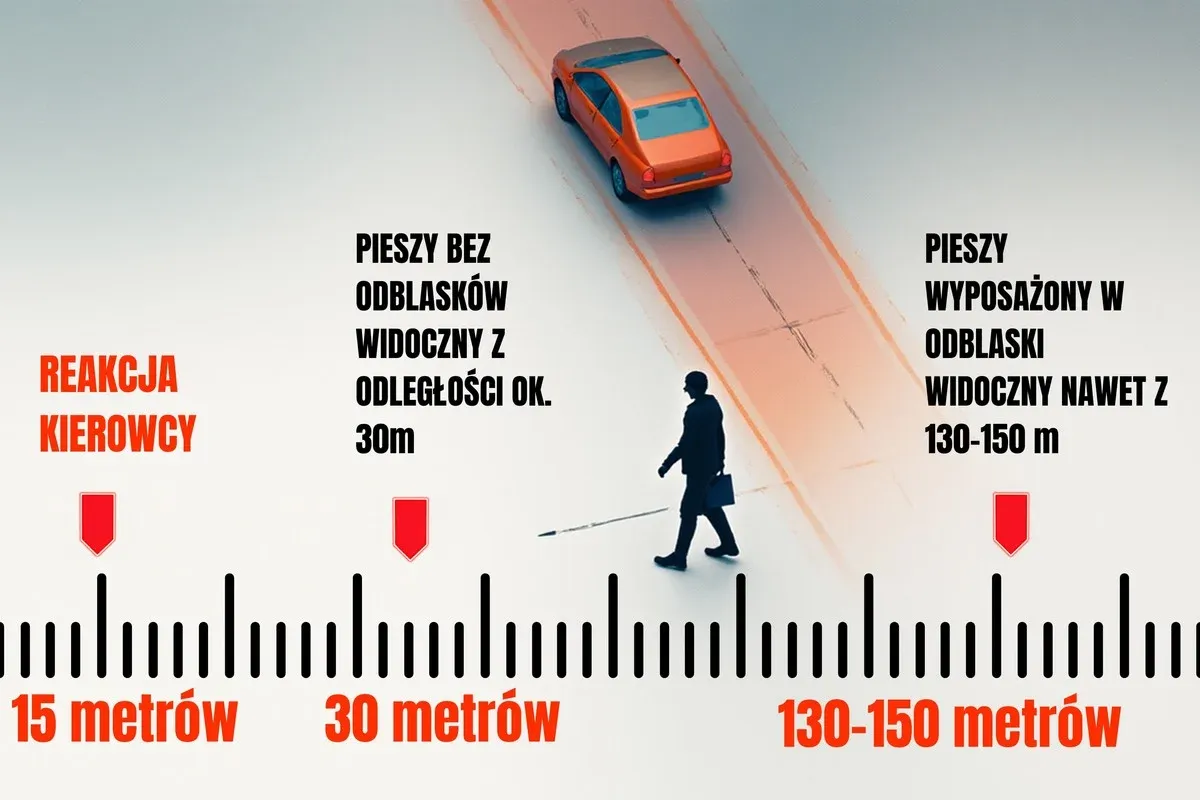
According to experts from the Institute of Road Transport, a pedestrian without reflective devices is visible to drivers only from a distance of about 20-30 meters. A person equipped with a reflective element can be noticed from as far away as 150-200 meters!
This is precisely why regulations require pedestrians walking at night outside built-up areas to use reflective devices. Officers remind that these reflectors should be within the vehicle’s light range and visible to drivers approaching from both directions.
As Robert Opas, an assistant inspector from the KGP Traffic Bureau, said, “Difficult weather conditions and earlier darkness make pedestrians on the road hard to see.” The officer also noted that “even a small reflector can save a life by giving drivers time to slow down and safely pass the pedestrian.”
Not all of them save lives!
It is also worth noting here that not all reflective elements will fulfill their function, so it is necessary to choose certified ones, as a lack of knowledge and access to proper reflectors can have the opposite effect of what was intended.
– Visibility is a key factor determining reaction time and braking distance. According to the ‘Innovative Pole’ report, as many as 85 percent of Poles agree that clear reflective markings on roads and vehicles positively impact safety. Similar roles should be played by reflective materials used by pedestrians. There is much talk about the necessity of having reflectors, but little attention is paid to their quality. The market offers many reflectors produced by various companies, both domestic and foreign. A large portion of these are made from materials that do not meet reflectivity standards, emphasized Bogumiła Styś from 3M’s Occupational Safety Department.
It’s important to note that “an uninformed consumer, by purchasing a low-quality reflective device, may not even be aware of it and travel on roads believing they have the proper signage, which paradoxically increases the likelihood of them being involved in a traffic accident,” added Dr. Piotr Kaźmierczak from the Institute of Road Transport.
It’s not just reflective devices. Traffic police will also check drivers
Although the campaign focuses mainly on pedestrian safety, the inspections will cover a much broader range of activities. Officers will also check drivers’ sobriety, their psychological and physical condition, the proper transportation of passengers and children, the use of seat belts, and the technical condition of vehicles.

Police will pay special attention to vehicle lighting. This is not accidental. According to data from ITS, as high as 98 percent of drivers report being blinded by other vehicles. The main cause of this problem are illegal light source replacements installed in headlights, which 70 percent of respondents cited.
The institute also estimates that as much as 80 percent of vehicles may be operating with improperly set lights. Only about 30 percent of cars have headlights set correctly or acceptably, while around 20 percent of lighting components require immediate replacement.
“The problem becomes particularly significant in autumn, when days get shorter and visibility is reduced by unfavorable weather conditions,” emphasized Mikołaj Krupiński from the Institute of Road Transport. The expert noted that the proper functioning of lights depends not only on their technical condition but also on the correct height setting, accurate distribution of the light and shadow zones, and appropriate intensity of the emitted beam.
Fines for pedestrians and drivers
The police remind that failing to have required reflectors outside built-up areas carries a fine of 100 zł. However, the consequences can be much more serious if a pedestrian’s behavior creates a threat to road traffic.
As Deputy Inspector Robert Opas explained, Article 97 of the Code of Administrative Offenses stipulates a fine of up to 3000 zł or a reprimand for road users who violate the provisions of the Road Traffic Act. This applies to situations where negligence on the part of pedestrians, cyclists, or scooter users contributes to creating a dangerous situation on the road.
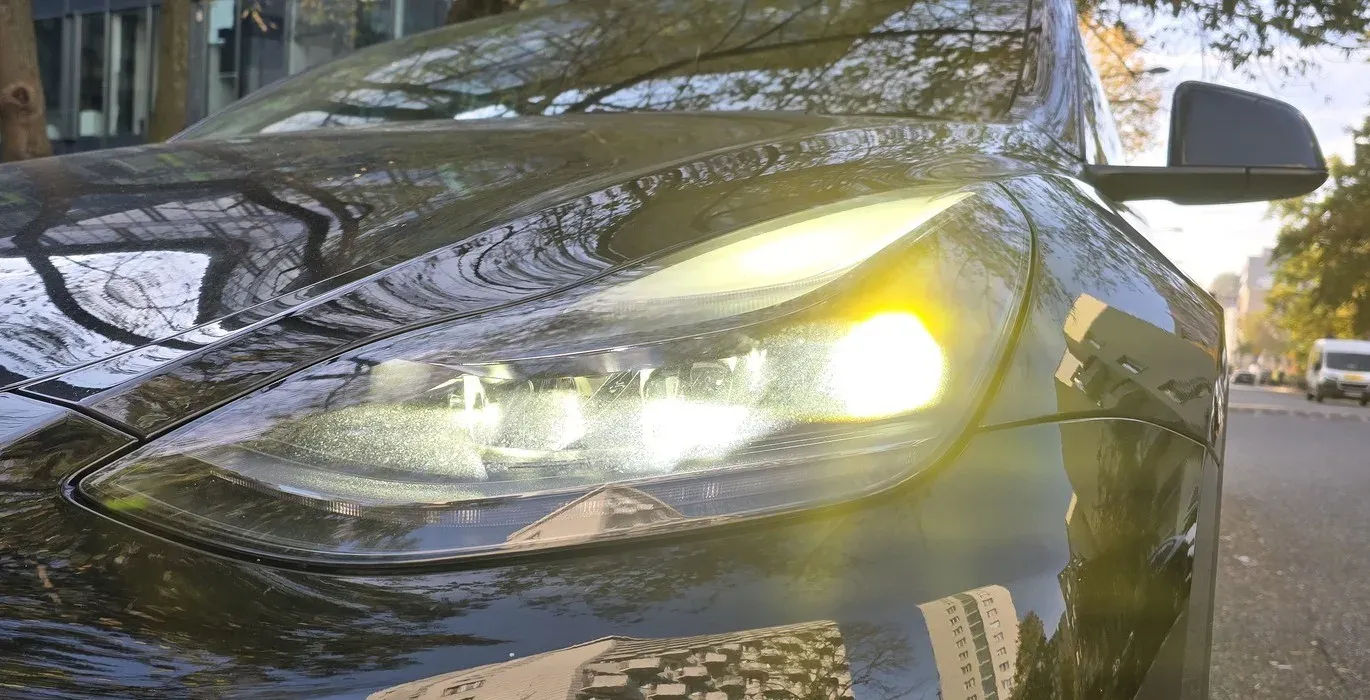
Drivers also have to face consequences. Recall that Poland requires drivers to keep their lights on at all times. Driving without lights during the day results in a fine of 100 zł and 2 demerit points. After dark, the penalty increases to 300 zł and 6 demerit points. Even higher sanctions may apply if the lighting is faulty or improperly installed. In such cases, the fine can range from 20 to as much as 3000 zł, and officers may also seize the vehicle’s registration document during inspections.
LEDs are tempting for drivers, but….
The topic of lighting also comes up in connection with the increasingly popular LED retrofits installed to replace traditional halogen bulbs. This solution is gaining popularity especially in older cars, whose original headlights often no longer provide satisfactory visibility.
Experts say that modern LED light sources provide whiter light, better side lighting, and a longer lifespan. However, approval regulations remain an issue.
According to the Ministry of Infrastructure, work is currently underway on new UN regulations regarding the approval of light sources used in vehicles. As Rafał Jaśkowski, director of the ministry’s communications office — cited by Dziennik.pl — explained, the goal is to create regulations that allow for the legal use of certain LED replacements that meet international standards.
According to Dr. Ing. Piotr Kaźmierczak from the Institute of Road Transport, the new solutions are intended to provide manufacturers with clear technical guidelines and users with greater legal certainty. The current schedule calls for the implementation of regulations for fog lights in 2026, headlight regulations in 2027, and passing light regulations in 2028 — notes the ITS expert.
Until then, drivers using unapproved LED replacements in headlights not designed for such light sources must be prepared to face fines and the suspension of their vehicle registration.
Time for a light and reflector inspection?
Let us remember that for driving safety, the condition of all lighting components—bulbs, lamps, and high-beam settings—is crucial. “Four out of the ten most common reasons for negative vehicle inspection results relate to external lighting,” explains Dr. Paweł Dziedziak from the Institute of Road Transport. “These include cracked lenses, water in headlights, improperly installed bulbs, burned-out or unapproved light sources, as well as unauthorized modifications to a vehicle’s external lighting components, which can also cause glare for drivers coming from the opposite direction.”
Thus, the Police’s autumn campaign is proof that what truly matters is not just the vehicle’s equipment, but its proper functioning. Well-functioning and correctly adjusted lights, along with making pedestrians visible at dusk, remain some of the simplest yet most effective ways to reduce the number of tragic road accidents during this time of year.
Oskar Włostowski
