
Pilot brings smart charging to Gelderland’s public charge points
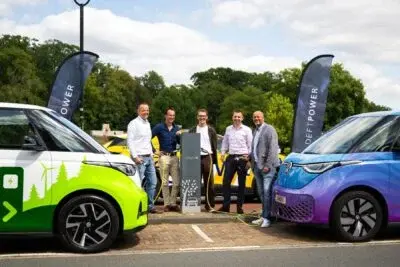
A pilot project involving 12,000 public charging points is launching in the Dutch province of Gelderland to reward EV drivers for charging at grid-friendly times. The six project partners aim to assess whether financial incentives for flexible charging behaviour can help reduce peak loads on the electricity grid.
The rapid growth of electric vehicles is placing increasing pressure on Europe’s electricity grids, particularly during evening peak periods. While many EVs remain plugged in overnight, public distribution networks are increasingly approaching their capacity limits. To help reduce these peak loads, Dutch distribution system operator Liander has launched a smart charging pilot in the province of Gelderland together with technology provider Deftpower, charge point operators Vattenfall and Allego, and e-mobility service providers (eMSPs) ANWB and Athlon.
The field trial will run until January 2027 and covers around 12,000 public charging points. It allows EV drivers to actively support grid stability by shifting their charging sessions to less congested periods. Instead of relying on regulatory restrictions or automatically reducing charging power, the project uses a financial incentive: participants receive a partial refund on their charging costs if they agree to delay charging until a grid-friendly time that still meets their planned departure time.
Participants use the existing apps of the participating e-mobility service providers (eMSPs) to enter their planned departure time and desired battery level. Smart algorithms then shift charging sessions to grid-friendly time windows. As 97 per cent of all public charging sessions are initiated via the eMSPs’ charging cards and apps, these platforms provide a natural route to scale the project.
Through a one-time system authorisation, Deftpower combines real-time vehicle data with energy market and grid status data. This allows the system to ensure that the vehicle reaches the requested state of charge by the planned departure time without compromising driver convenience.
In return for this flexibility, participating EV drivers receive a financial reward worth an average of 10 per cent of their charging costs, paid out or credited directly through the app. “We need to use flexibility where it is available, not where it compromises reliability,” said Marc Diks, COO at Deftpower.
The system responds in real time to local grid conditions, the availability of renewable energy and the individual charging requirements of each driver.
For the companies involved and policymakers, the pilot serves as a reference project for the wider European market. Since July 2026, Dutch grid operators have no longer received automatic priority for new grid connections in congested regions, increasing the importance of software-based solutions to ease pressure on the electricity grid.
The project is designed to generate data on users’ willingness to adapt their charging behaviour and on how distributed flexibility can be integrated reliably into the energy market.
“More and more people are charging their cars in public spaces. If some of these charging sessions are shifted to off-peak hours, we can use the power grid more intelligently without compromising user convenience,” said Gilbert de Graaf, Director of Market Services at Liander.
The project partners expect the pilot to lead to an industry-wide guideline that could serve as a blueprint for future flexibility markets. These virtual marketplaces allow energy suppliers and distribution system operators, such as Liander, to temporarily adjust electricity consumption or feed-in to help stabilise the grid. One example is delaying EV charging during periods of peak demand, which the pilot is designed to test.
deftpower.com, liander.nl (in Dutch)