
Peugeot E-208 GTi review: Raw talent
4OUT OF 5
The verdict
Hot to trot
Peugeot’s first all-electric hot hatch does its GTi forefathers proud with pace, sharp handling and understated style
★★★★★
GTi. Three small letters, a whole heap of history and expectation for the Peugeot E-208 GTi.
Lots of brands have used the GTi label over the years but there are only a couple that truly resonate – that lot from Wolfsburg, and Peugeot.
With cars like the 205 GTi, the 390 GTi and the 306 GTi-6, the French brand proved itself a master of the hot hatch and set certain standards for the name.
But it’s been a bit quiet in recent years. The Peugeot GTi badge was retired in 2020, with Peugeot launching the Peugeot Sport Engineered brand for its electrified performance range. However, as VW has also found, sometimes the old ideas are the best. So for its first proper electric hot hatch, Peugeot has gone back to GTi.
The Peugeot E-208 GTi arrives just as the segment hots up. We’ve got sporty electric superminis from Spain, the UK, Germany and France already on the scene. But Peugeot is hoping that its heritage and expertise will help make the E-208 GTi stand out as a worthy successor to the famous 205 in the compact hot hatch market.
Design and interior
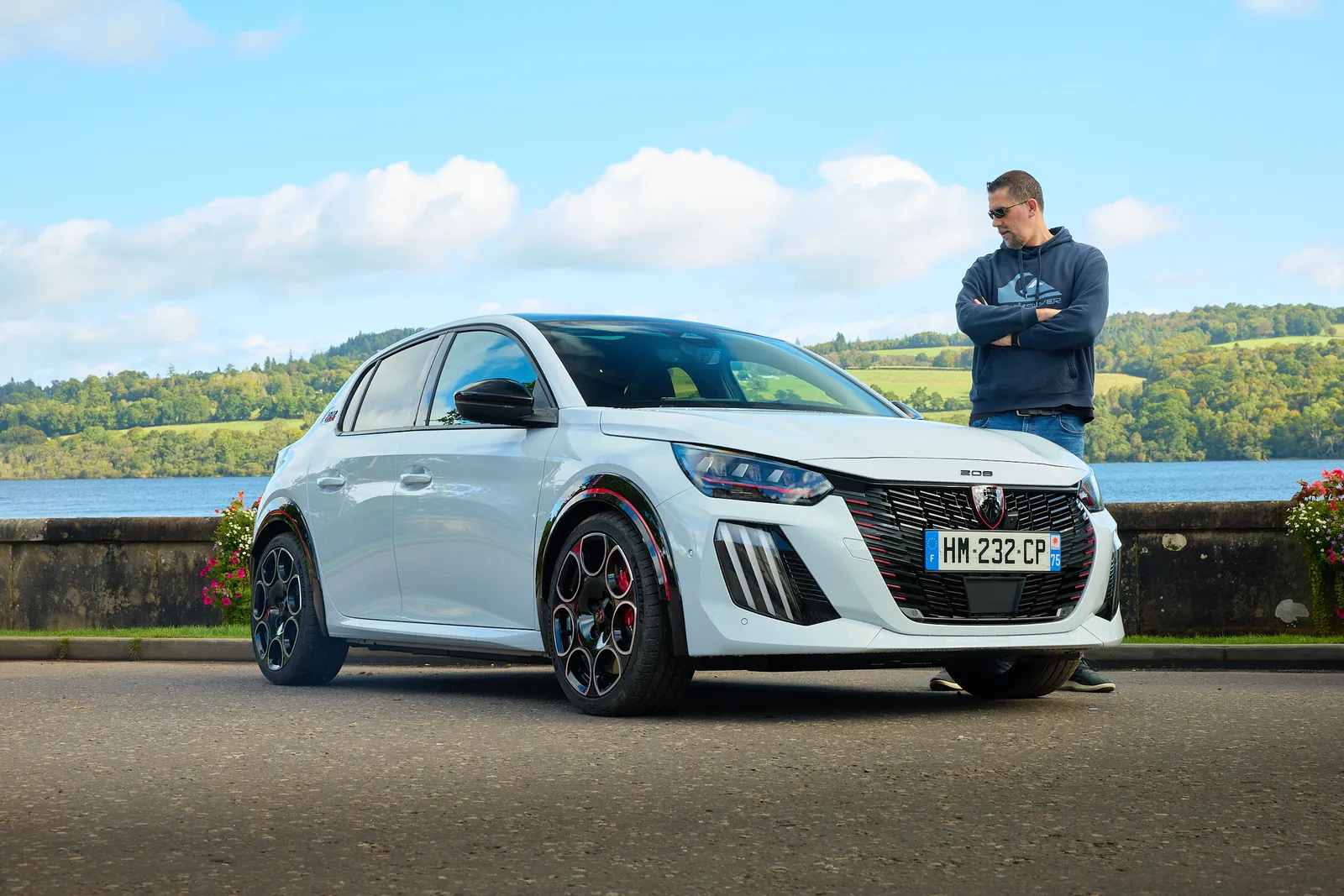
The Peugeot E-208 has been around for seven years now, but still manages to cut a sharp and attractive profile on the road. Its stocky proportions already had a sporty attitude before the GTi’s design team got to work.
To give it a true GTi appearance, the regular car is lower and wider than the standard model. A 25mm drop and 56mm wider front track (28mm at the rear) instantly give a more aggressive stance, aided by flared wheel arches with gloss black highlights, a deeper front bumper and gloss black rear diffuser.
Smaller touches include red detailing around the grille, arches and headlights, and subtle GTi badges – Peugeot want this to be sporty but not too showy. And it works. It’s reminiscent of the days when performance cars could subtly hint at their chops via slightly bigger wheels and some slimline trim, not acres of carbon fibre and comical body kits.
The 18-inch Belchamp alloys design is inspired by wheels from the 205 GTi, as is the red and black two-section finish on the Alcantara-covered sports seats. The red theme continues elsewhere inside, with magnificently bright carpets, floor mats and seatbelts all calling back to the eye-catching design of the old 205.
Even the seats nod back to the 208’s heritage with their boxy ‘80s profile, but they’re also impressively grippy and supportive. They are quite narrow, however, so the fuller-figured driver may find them snug.
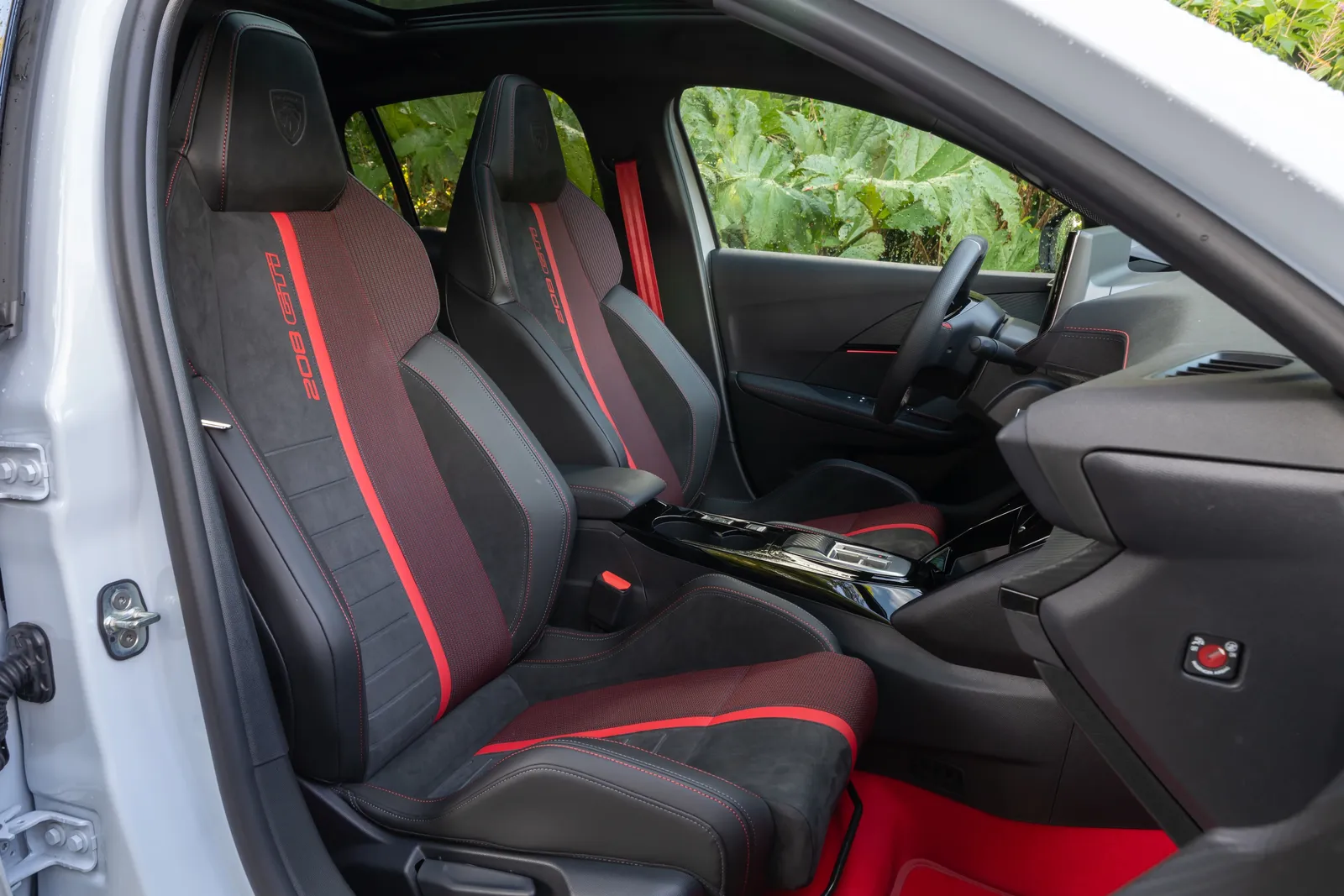
Apart from the GTi-themed touches, including a carbon fibre-effect dashboard finish, the E-208 GTi’s interior is largely the same as any regular 208. The design is seven years old now but manages to still feel fresh and modern, which is quite an achievement in the fast moving world of motors. The biggest clues to its age are the old-school physical i-Toggle switches for certain functions and the copious use of piano black plastic. There are a lot of shared Stellantis parts but the overall fit and finish is pretty good.
The E-208 GTi is a supermini, so space was never going to be its strong point. Front room is adequate, but the i-Cockpit setup with the wheel set below the dials is still an opinion splitter and I found the steering wheel brushing my knees at times. In the back, it’s even tighter. Young children will be okay, but average-sized adults will find it cosy. That said, it’s still better than a Mini and on a par with an Alpine, but for practicality, the Cupra Raval has it whipped. That goes for boot space as well, which is a stingy 309 litres in the E-208.
Technology and equipment
As mentioned, the E-208’s interior hasn’t seen much in the way of updates in recent years and that’s true of its onboard technology. Ahead of the driver is an 10-inch digital instrument screen encased in a bold winged binnacle. The dials feature a neat 3D effect and customisable menus that still work perfectly well, even if they’re not as advanced as some rivals.
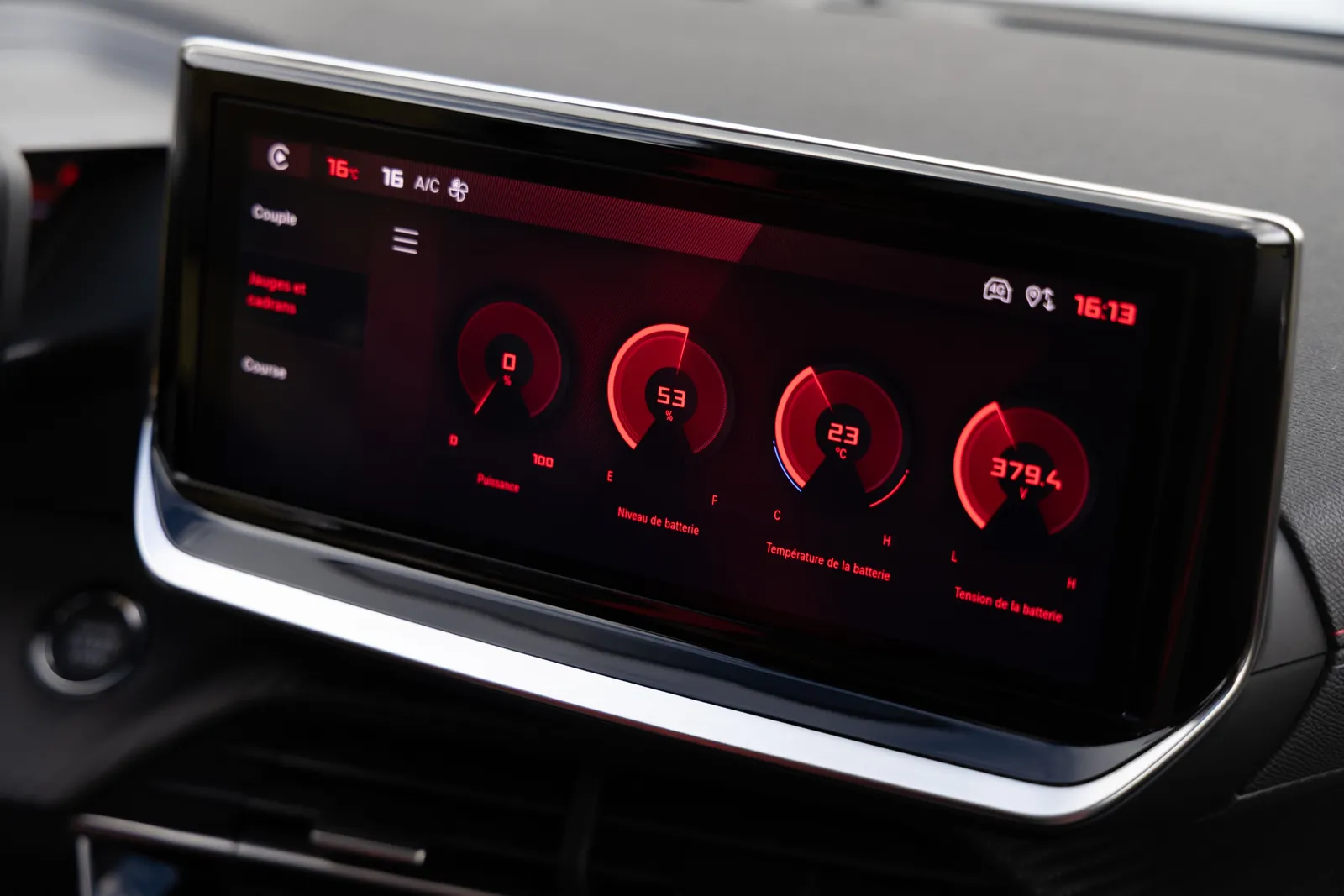
At the centre of the dash is the same 10-inch screen as in the rest of the range. The E208- GTi does get some GTi-specific functions, including telemetry read-outs, a lap timer and bespoke graphics, but the rest of the system remains untouched. That means a fairly small screen running an awkward and sluggish operating system that can’t match modern rivals. Positively, there’s wireless Android and Apple mirroring, and the dreaded ADAS systems can be silenced via a single haptic button on the dashboard.
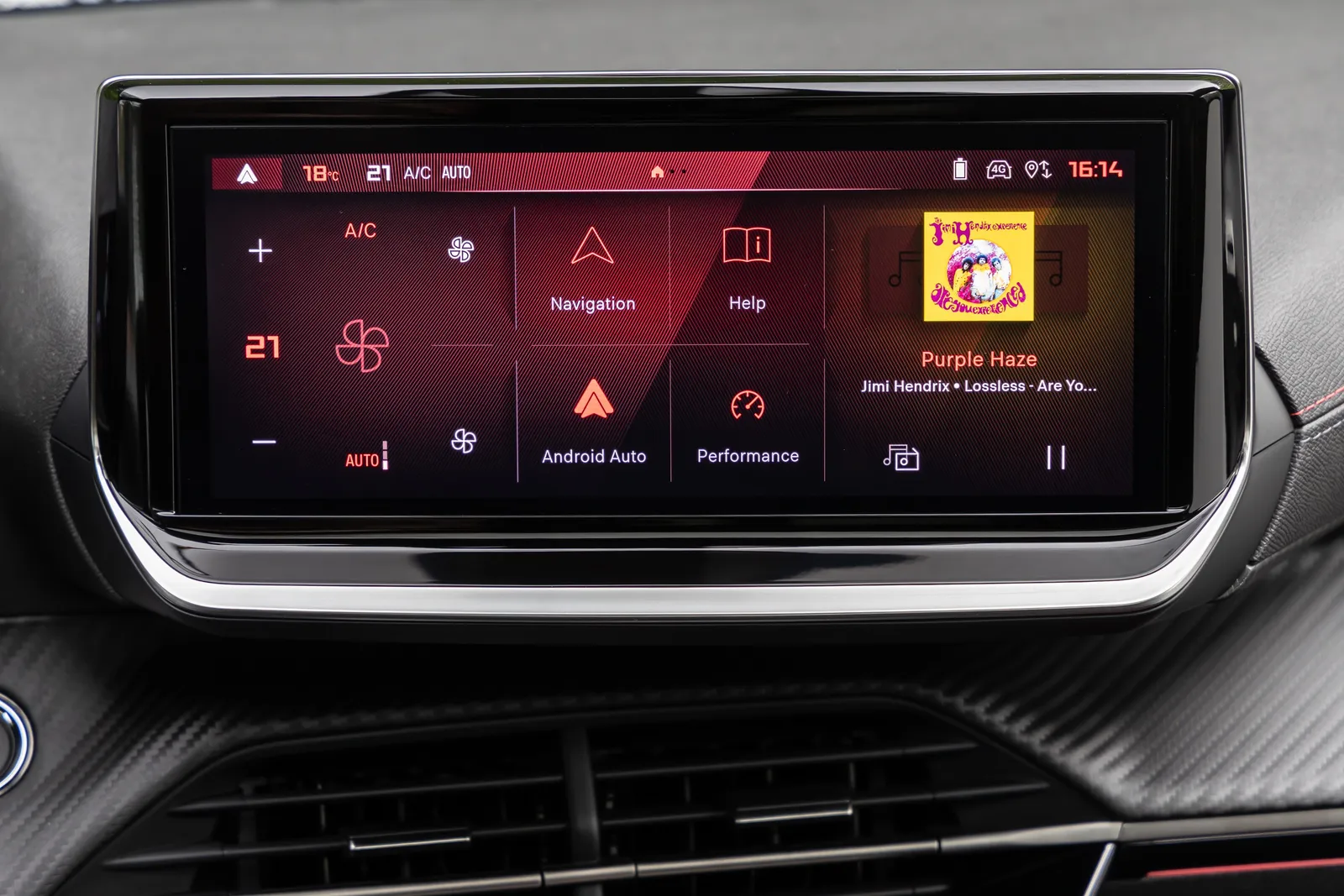
As the top-spec car, the GTi gets all the high-tech touches Peugeot can offer. That includes adaptive LED headlights, vehicle-to-load ability, wireless phone mirroring and charging, keyless entry, and a full driver assistance suite. This features adaptive cruise control with stop/go function, lane position and lane keep assist, autonomous emergency braking with pedestrian and cyclist detection and low-light function.
Range, battery and charging
The Peugeot E-208 GTi comes with just one powertrain. A 277bhp motor powered by a 51kWh battery with a claimed 239 miles of range and efficiency of up to 3.9m/kWh.
On a pretty demanding route testing its hot hatch credentials on Scottish B-roads, I saw a real-world range of around 150 miles and efficiency of 2.9m/kWh.
Its official range puts it directly in line with the Cupra Raval, just behind the Mini and just ahead of the Alpine. Its real world performance does similar.
Like most key rivals, the E-208 GTi offers peak charging of 100kW, which should replenish the battery from 20-80% in 27 minutes in ideal conditions. It also comes with 11kW AC charging as standard and features vehicle-to-load capability for powering small appliances.
Performance and driving
Its 277bhp instantly puts the Peugeot’s performance ahead of most of its rivals (the identical Corsa GSE being the exception). It’s got 20bhp on the Mini JCW, more than 50bhp over the Alpine and Cupra, and weighing 1,535kg, the best power-to-weight ratio in its class.
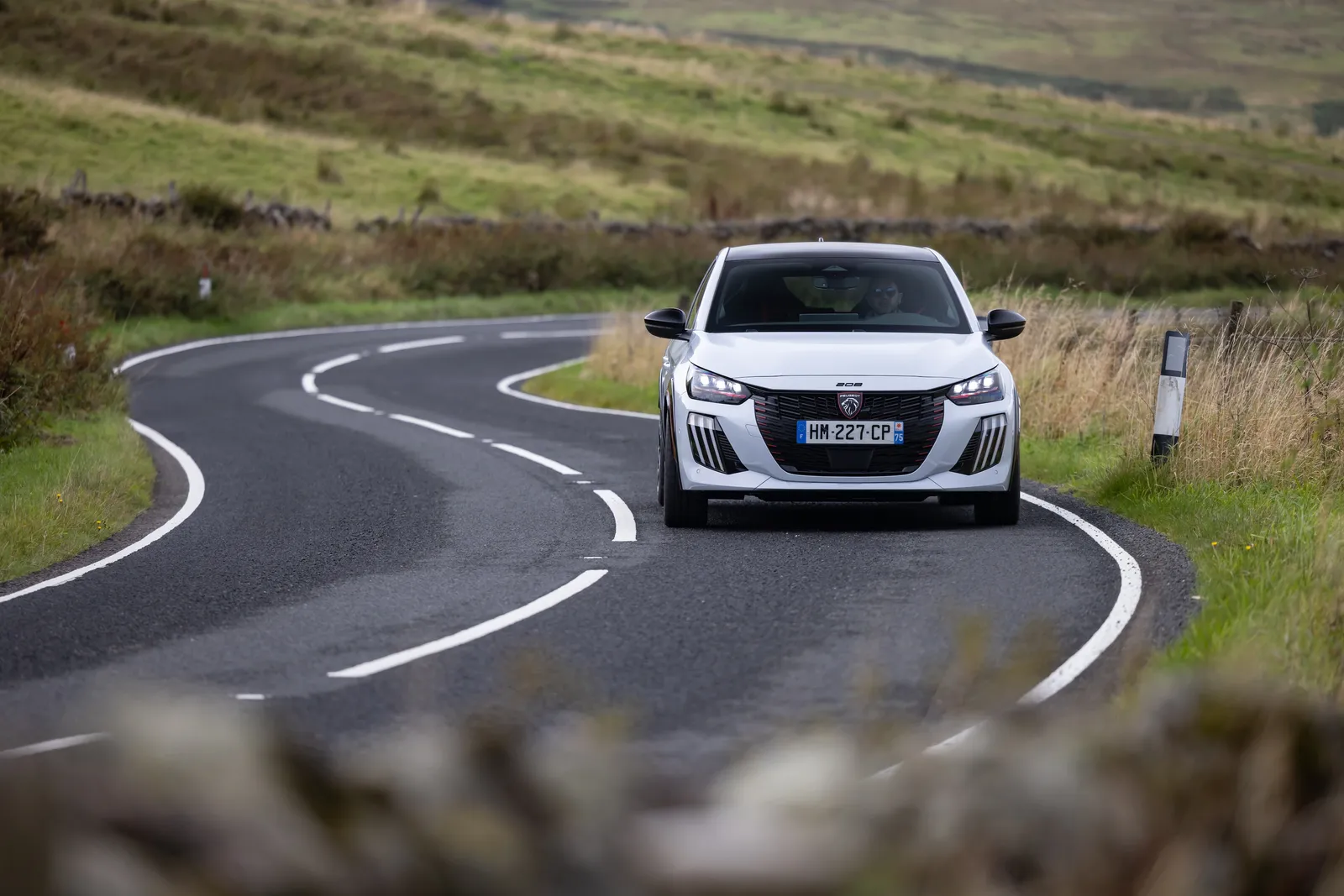
So it’s no surprise that it’s the quickest in its class in a straight line. The power and 254lb ft of torque allow the Peugeot E-208 GTi to get from 0-62mph in just 5.5 seconds. From standstill that pace is instantly apparent with immediate throttle response. In dry conditions it throws you up the road with remarkable force. In less than ideal conditions, it leads to a healthy armful of old-fashioned torque steer as well.
Slowing down again, 355mm four-piston front brakes tuned by Peugeot Sport help bring things to a halt. In Sport mode, the car’s one-stage braking regeneration is completely deactivated to allow a more natural stopping feel. It works well enough and the brakes are powerful, but compared with the sharpness of the rest of the package, the brakes feel a little soft.
But there’s more to the Peugeot E-208 GTi than just a punchy motor and big brakes. Peugeot Sport’s engineers have got the spanners out to retune the springs and dampers and add hydraulic bump stops to, apparently, balance stability with comfort. They’ve also added a rear anti-roll bar and the same Torsen mechanical limited-slip differential that helps bring so much fun to the Abarth 600e, Alfa Romeo Junior Veloce and Vauxhall Corsa GSE.
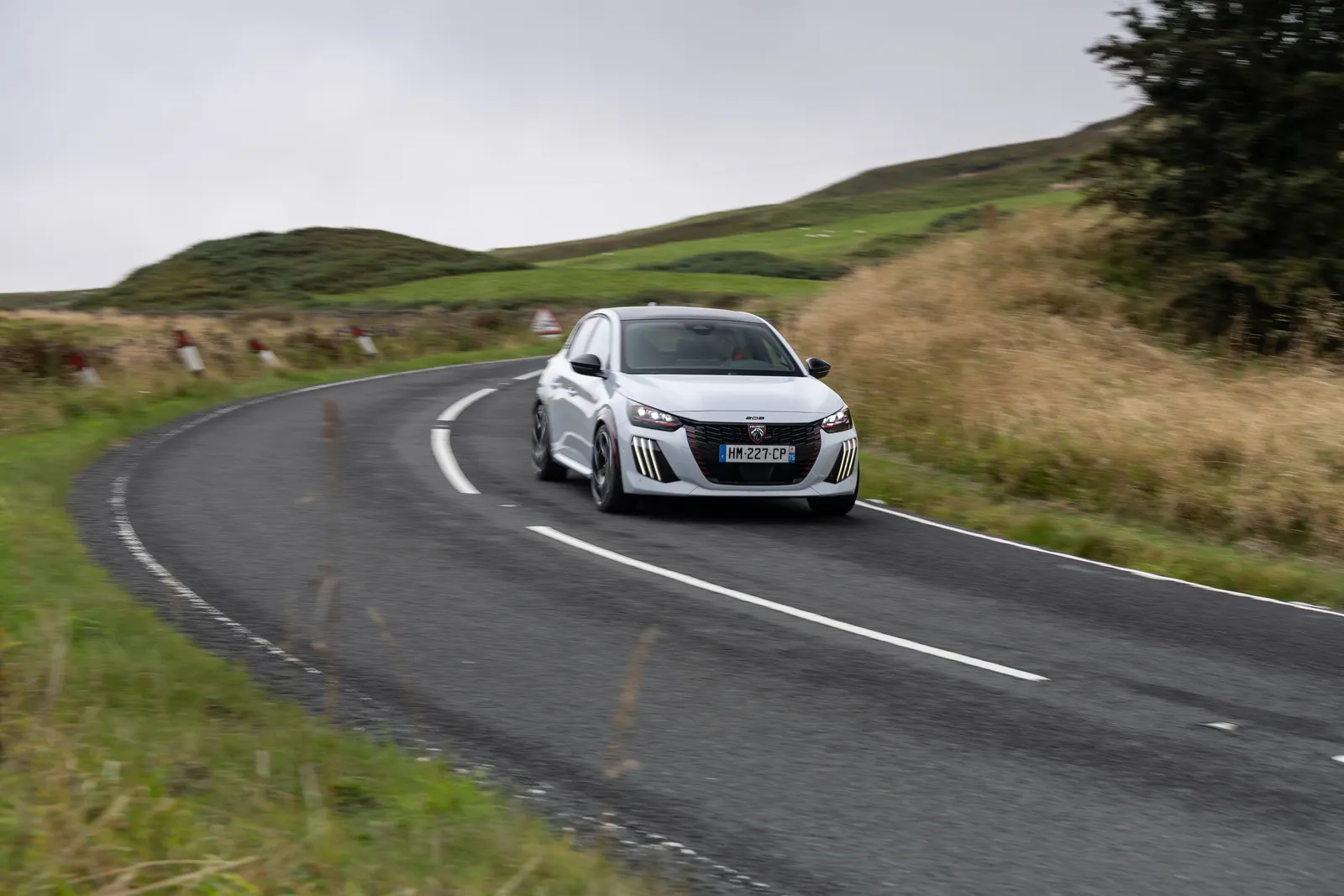
The result is a proper hot hatch experience. In sport mode – which is the one you’ll want – the throttle and steering have an immediacy and directness which marries with the chassis tweaks to create a properly playful, agile and stable little car. The Pug will dart up a road, dip its nose into a corner then drag itself out again with the spirit of its predecessors, instantly looking for the next corner. You’re aware that it’s a lot bigger than previous GTi models but there’s still a liveliness and keenness to how it eats up twisting country roads that’ll put a smile on your face.
The E-208 GTi’s biggest weakness is its ride. Although these were French-registered cars, we were driving them around the Trossachs in central Scotland, home to some of the very worst road surfaces in Europe. Over the horrifically chewed up rural Tarmac, the Pug jostles and crashes and feels very much like a small, stiffly sprung car from 10 years ago. Rivals offer more composure and there’s no adaptive chassis to soften things down in “normal” driving. Over the course of a few hours it was tolerable. Long-term, the overly firm feel could become tiresome.
Price, trim and rivals
The Peugeot E-208 GTi costs £34,995, with orders open now. That’s before the Band 2 Electric Car Grant, which cuts the on-the-road price to £33,495.
There’s just one trim level and two options. You can add metallic paint for £750 or premium Elixir Red paint for £950, and you can spend £500 to get the panoramic sunroof.
Everything else is standard, from all the GTi hardware and cosmetic touches to the Drive Assist Plus package, plus adaptive LED headlights; heated seats; all-round parking sensors and camera; tinted rear glass; acoustic front glass and a six-speaker stereo.
The small electric hot hatch segment has suddenly caught fire and the E-208 GTi is immediately competing for driver’s attention with the Cupra Raval, Mini JCW Electric and Alpine A290. it’s also got to square up to the technically identical Vauxhall Corsa GSE and pretty soon there will be the Volkswagen ID. Polo GTI to worry about as well.
Verdict 4/5
The good news for Peugeot is that the E-208 GTi is well equipped to take on all comers.
Some alternatives are more rounded and practical – whether that’s in space, ride or technology. But the E-208 is sharp, quick and willing, and feels less sanitised than rivals. It has a rawness that’s more in keeping with the old-school hot hatches that have come before it and does the GTi name proud.
For
Real hot hatch pace
Loves a twisting road
Subtle but meaningful styling
Against
Jarring ride
Outdated infotainment
Divisive driving position
Fact file
Peugeot E-208 GTi
Price
£34,995 (£33,995 as tested, Including ECG)
Powertrain
Single-motor, front-wheel-drive
Battery
51kWh
Power
277bhp
Torque
254lb ft
Top speed
112mph
0-62mph
5.5 seconds
Range
239 miles
Consumption
3.9m/kWh
Real-world range
150 miles
Real-world consumption
2.9m/kWh
Charging
up to 100kW
Boot space
309 litres
Insurance group
37
The rivals
Alternatives worth a test drive