
Performance of 15 global automakers in the first half of 2026
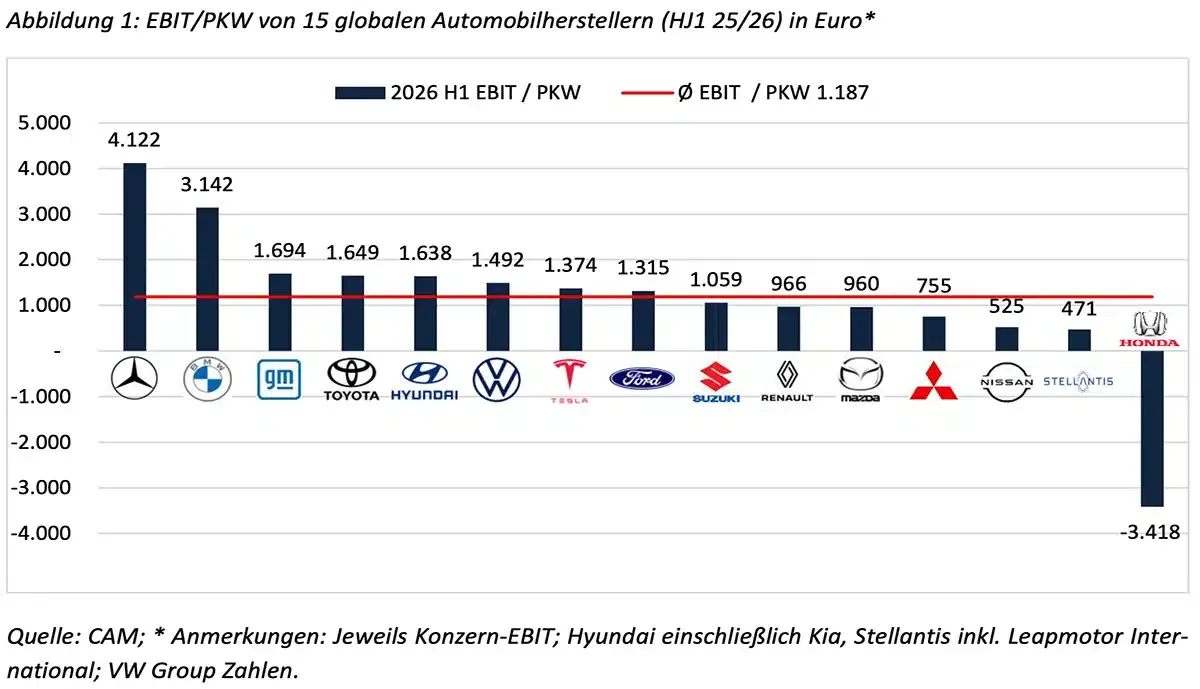
According to a study by the Center of Automotive Management (CAM), the operational profitability of the automakers analyzed deteriorated significantly in the first half of 2026. The average group EBIT (earnings before interest and taxes) per vehicle delivered dropped from 1409 to 1187 euros, a decrease of 16%. At the same time, the variance increased markedly: 8 out of the 15 analyzed manufacturers were above average, while seven were below it.
This highlights even more the differences between the top group, the broader midfield, and manufacturers with low or negative profit margins per vehicle. Several large conglomerates saw a significant drop in this metric compared to the previous year, while Stellantis, Nissan, and Mazda managed to improve their profitability after poor results in earlier years. However, the positive developments of individual manufacturers were not enough to offset the decline in the average value.
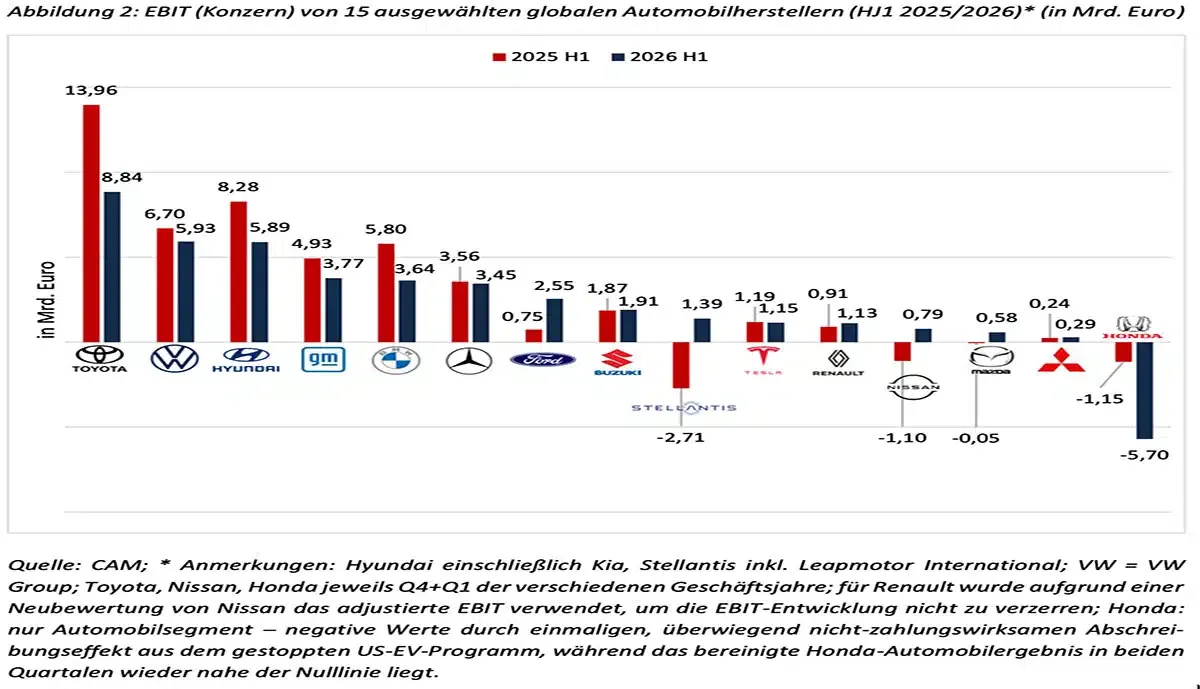
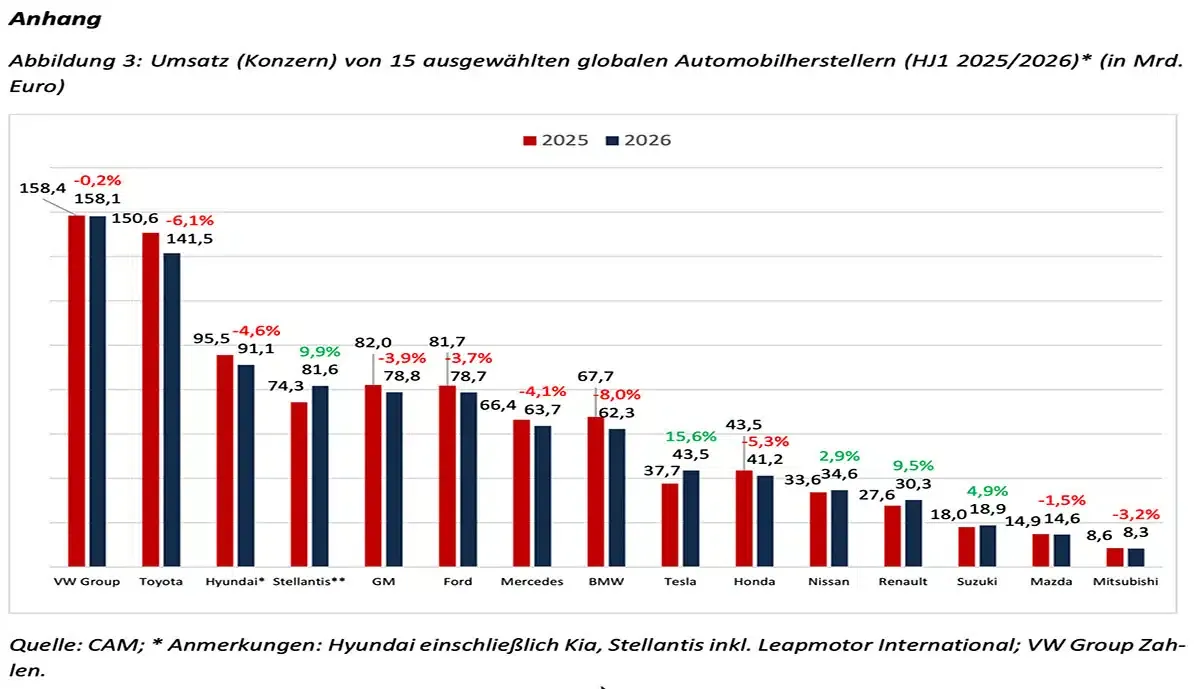
The overall results are also under pressure: The EBIT of the global manufacturers analyzed dropped by 17.5% overall to 35.6 billion euros, even though sales declined by only 1.4%. The average EBIT margin fell from 3.5% to 3.3%. As a result, many manufacturers saw both their operational profitability per vehicle and their profitability relative to sales deteriorate.
"The gap between sales growth and profit growth is the real warning sign for the first half of the year: When EBIT falls twelve times more sharply than sales, the industry loses not market share but its profitability — and that is strategically more dangerous," says study leader Stefan Bratzel.
EBIT per Car: Falling Average and Growing Disparity
The manufacturer comparison reveals a significantly varied range of results: Mercedes-Benz and BMW form a clear top group with prices of 4122 euros and 3142 euros respectively, allowing them to maintain their position as premium manufacturers. In contrast, General Motors, Toyota, Hyundai-Kia, Volkswagen, Tesla, and Ford fall within a much narrower range of 1315 to 1694 euros. The average value of 1187 euros per car thus reflects less a uniform industry standard than rather a mid-tier level that lags far behind the two leading premium manufacturers.
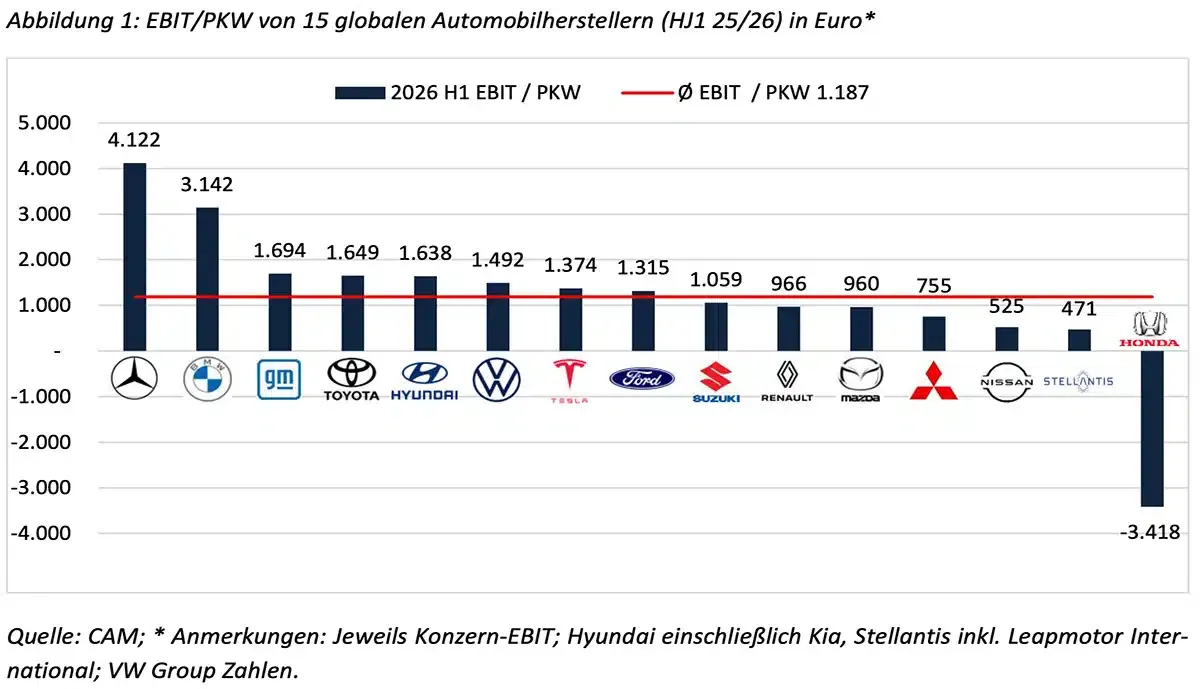
Below average are Suzuki at 1,059 euros, Renault at 966 euros, Mazda at 960 euros, Mitsubishi at 755 euros, Nissan at 525 euros, and Stellantis at 471 euros. For Mazda, Nissan, and Stellantis, the positive figures compared to the loss-making previous year are mainly due to cost cuts, restructuring, and a recovery from weak bases. Thus, Nissan’s, Mazda’s, and Stellantis’ turnarounds represent operational interim successes but not yet a structural shift in trend. A result close to zero is not a solid foundation for the investment burdens that will affect the entire industry in coming years. The gap with more profitable manufacturers remains large.
Meanwhile, BMW, Toyota, Hyundai-Kia, GM, Tesla, and Volkswagen have all reported significantly lower profits per car so far this year compared to the previous year. For BMW, Toyota, and Volkswagen, particularly weak market performance and high competitive pressure in China are exerting significant strain. For several Western and Japanese manufacturers, poor performance in the Chinese market has now become the most important single factor of pressure — “and this pressure is being transmitted to their home markets as well due to Chinese manufacturers’ export drive,” explains CAM.
Hyundai-Kia is affected by higher tariff and incentive costs, while General Motors and Tesla see their results pressured by transformation expenses and a more challenging market environment. These declines among the larger and previously more profitable manufacturers worsen the industry average more significantly than the turnarounds at the lower end of the scale improve it. Honda stands out with a decline of -3418 euros, driven mainly by high depreciation costs resulting from the realignment of its electric vehicle strategy in the last quarter.
"The decline in EBIT per car is a warning sign that many manufacturers are currently unable to fully offset their high transformation costs through pricing, product mix, and efficiency," says Bratzel. "Companies that are heavily dependent on the Chinese market while also having to make substantial investments in electric mobility, software, and new production structures are under particular pressure. In the future, it will be less about sheer sales volume and more about the ability to reduce complexity, control costs, and offer technologically advanced vehicles at competitive prices."
EBIT and margin trends: Pressure on profits despite individual turnaround efforts
At the group level, the combined EBIT of the 15 manufacturers decreased by 7.6 billion to 35.6 billion euros. The 17.5 percent drop is significantly more pronounced than the 1.4 percent decline in sales. This indicates that it is not so much the scale of sales but rather the ability to convert revenue into operating results that is under pressure. Toyota still has the highest absolute EBIT at 8.8 billion euros. However, the drop of over 5 billion euros means the group is utilizing its size advantage much less profitably than in the previous year. Hyundai-Kia, BMW, General Motors, and Volkswagen also remain profitable groups but have lost a substantial portion of their operating result base.
The gap between manufacturers in terms of EBIT margins is also widening. Suzuki achieves the highest margin at 10.1 percent, while Toyota, Hyundai-Kia, and BMW fall significantly compared to the previous year despite still having above-average figures. Mercedes-Benz maintains its margin relatively stable at 5.4 percent, showing greater resilience than BMW and Volkswagen. Ford improves its margin from 0.9 percent to 3.2 percent, while Mazda, Nissan, and Stellantis return to positive territory. These turnarounds indicate operational recovery, but with margins between 1.7 and 4.0 percent, they remain well below the level of the most profitable manufacturers. Honda stands out negatively with a margin of -13.8 percent.
The German automakers are showing varying developments. Mercedes-Benz can largely offset pressures from a weaker China business, lower net prices, and model changes through already effective cost cuts as well as higher contributions from Financial Services and Vans. BMW is primarily affected by weakness in China, price and product mix effects, currency fluctuations, and tariffs. At Volkswagen, costs associated with shutting down US production of the electric SUV ID.4 and an unfavorable product mix are particularly weighing on results.
There are also clearly identifiable main reasons for these particularly severe changes. Toyota and Hyundai-Kia are primarily burdened by Chinese and U.S. tariffs, as well as higher costs for materials, logistics, and incentives. At General Motors and Honda, value declines related to electric vehicles and adjustments to their electric strategy are weighing on results. Ford’s improvement is mainly due to a one-time tax refund of around $1.3 billion. Stellantis, Nissan, and Mazda benefit primarily from price, portfolio, and cost efficiencies. After adjusting for these one-time effects, the industry’s decline in operating results is more indicative of a structural issue than something temporary. This underscores that the pressure on profitability will not disappear once these one-time effects fade away.
"It's not just about who shows the highest profits today, but which business model remains sustainable under ongoing pressure from prices, investments, and transformation," emphasizes Bratzel. "Size does not automatically protect against declining quality of results. Manufacturers must streamline their cost structures, ensure price competitiveness, and focus investments more strategically. Those who fail to achieve this balance can still lose ground strategically despite high sales and continued positive results."
Chinese manufacturers not fully considered
Major Chinese manufacturers such as BYD, Geely, SAIC, and Chery are not included in the report because complete and comparable data on group revenue and EBIT for January to June 2026 was not available at the time of analysis. Therefore, the ranking does not constitute a complete global profitability list. According to CAM’s assessment, leading Chinese manufacturers likely further increased their sales and international market presence. However, this strong growth may not translate equally across all companies into higher margins or rising EBIT per vehicle, as the scale advantages of vertically integrated manufacturers are offset by intense price competition and high costs associated with models, software, factories, and expansion efforts.
On this, Bratzel said, “The absence of China’s major manufacturers from this analysis distorts the picture in favor of established corporations. If BYD and other large-scale manufacturers are included, the benchmark for competitive cost structures shifts significantly downward. The true benchmark for profitability per vehicle will henceforth be set in Shenzhen, not in Toyota City or Wolfsburg.”
Outlook: Pressure for results and widening gaps are likely to continue
According to CAM, no significant easing is expected in the second half of the year. U.S. tariffs, intense price competition in China, volatile currencies, and further adjustments to electric vehicle portfolios are likely to continue putting pressure on EBIT and margins. If these pressures persist, the calculated profitability per vehicle is likely to remain under strain for many manufacturers. Cost reductions, lower complexity, and a more profitable product mix could stabilize the situation, but they may not fully offset these pressures for all manufacturers.
For the full year 2026, projections suggest less of a cyclical downturn and more of a structural realignment in the order of profitability. The key question is therefore not whether results will decline, but which manufacturers can adjust their cost base fast enough to a permanently lower margin level. Manufacturers with strong cost discipline, robust price and product mix quality, and limited restructuring burdens can better defend their margins and profitability per vehicle. Companies facing high pressure due to China-related factors, tariffs, or the shift toward electric vehicles risk further declines in performance. At the same time, the international expansion of Chinese suppliers increases competitive and adaptation pressures on established manufacturers.