
Pere Navarro announces another change to the V-16 toll booth: DGT is already preparing its activation

10/09/2026 16:50
Updated to
10/09/2026 16:50
The V-16 beacon can still bring important advancements in how drivers facing breakdowns or emergencies on the road are assisted. The DGT is working on a new protocol that will directly involve the Guardia Civil whenever one of these devices sends an alert indicating a stopped vehicle.
Pere Navarro has confirmed that Tráfico aims to turn into an official directive a practice that officers already employ in some cases. The document is awaiting signature, with approval expected “soon”: when a V-16 is activated, a patrol nearby must go to the location to assess the situation and assist the driver.
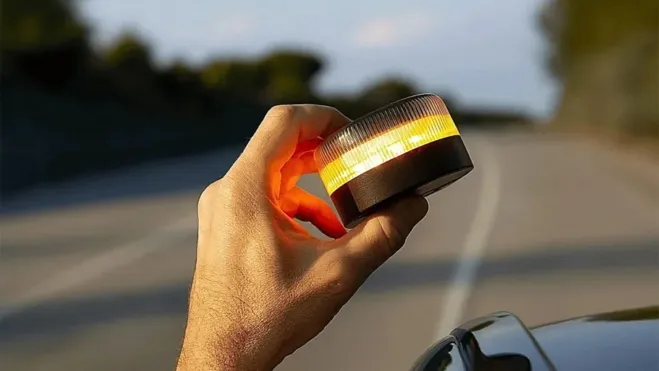
The V-16 signal will also be used to activate assistance
This functionality is made possible by one of the key differences between the new beacons and the old triangles. When a certified V-16 is turned on, its location is automatically transmitted to DGT 3.0, without the driver needing to use an app or provide personal data in advance.
With the new instruction, that information can also be used to mobilize officers. Navarro explained that when a patrol detects an activated beacon and is in the vicinity, it must approach to assist the occupants of the vehicle. The DGT aims to formalize a procedure that has been applied so far without specific instructions.
The announcement does not mean that each activation will automatically trigger the immediate arrival of a patrol from any location. The measure is intended for officers working near the incident, using the geolocation sent by the device itself to more accurately locate the stopped vehicle.
The DGT now receives over 69,000 incidents per month
The connectivity of V-16 is also changing the amount of information that Tráfico receives about road conditions. In 2025, DGT recorded an average of 8,600 incidents per month on interurban roads, while currently the figure exceeds 69,000 per month.
This sharp increase does not necessarily mean that road defects have multiplied. DGT itself attributes the rise to the automatic real-time transmission of information, which allows for the detection of events that might have previously gone unrecorded and provides a more complete picture of what is happening on roads.

Starting from January 1, 2026, the V-16 connected device will also be the only legal means of signaling an immobilized vehicle in the cases specified by regulations, completely replacing triangles. Tráfico maintains a public list of certified devices and reminds that the beacon only communicates the location when activated, without being linked to the vehicle’s license plate or transmitting the identities of its occupants.
Tráfico continues to support V-16
Navarro has once again advocated for the implementation of this system, emphasizing that using a certified beacon is no longer optional for vehicles required by regulations. The DGT also continues to run information campaigns to promote its use and remind drivers that driving without the required device can result in penalties.
The next step will be to finalize the new directive intended for the Guardia Civil. Once signed, Tráfico will have a written procedure that links the alert generated by the V-16 with the possibility of a nearby patrol arriving directly at the location to assist the driver.