
Why do you need 1,500 km if you can recover 500 km in 5 minutes?
There is a debate that becomes increasingly interesting as battery technology and charging infrastructure advance: which would be better, an electric car capable of traveling long distances but requiring a considerable amount of time to recharge, or one with a range of about 500 km that can restore almost all of its battery in just five minutes?
At first glance, the answer seems simple. The greater the range, the better. A car that can travel 1,500 km would allow one to completely forget about chargers during long trips. But when ultra-fast charging in five minutes is taken into account, the situation changes quite a bit.
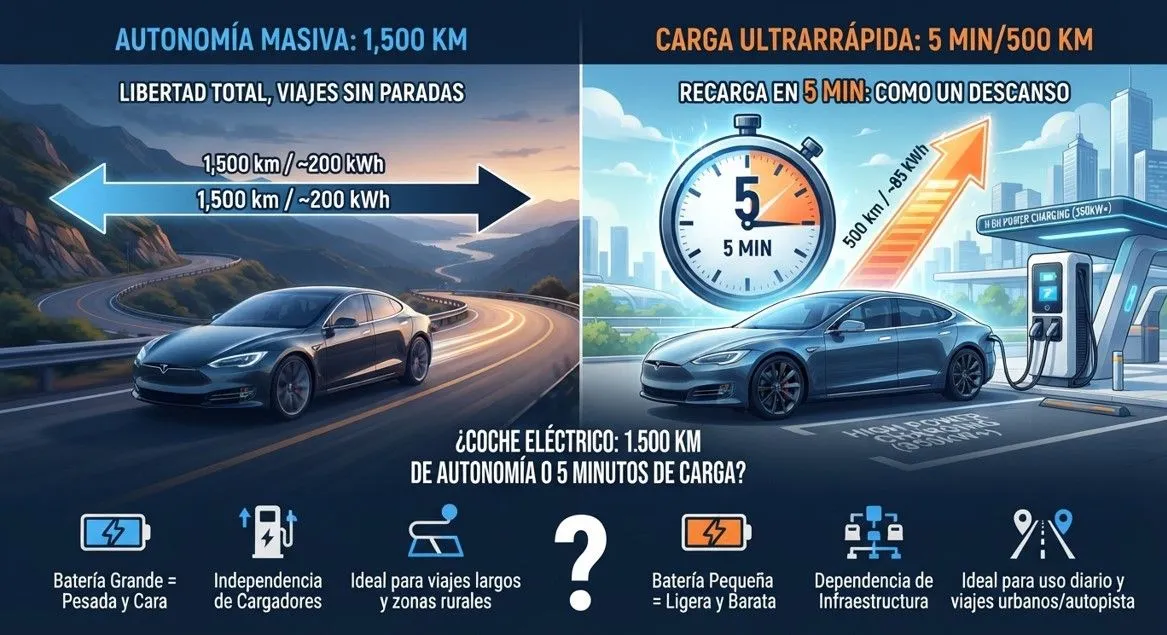
Let’s imagine two electric cars that are identical in every way except for their batteries. The first has a massive capacity that allows it to achieve 1,500 kilometers of range. The second has a much smaller battery, providing around 500 kilometers of range, but it can regain all that range in approximately five minutes.
In the first case, the main advantage is clear: the freedom to decide when to stop. There would be no need to search for a charger during most of a long journey, and in many trips, there would even be no need to think about charging until reaching the destination.
This can be particularly important in rural areas or countries where charging infrastructure is not yet dense enough. It also eliminates one of the main current concerns with electric vehicle travel: having to adjust routes based on the location of chargers.
But a battery capable of providing 1,500 km of range would have to be enormous using current technology. Until solid-state electrolytes are available, achieving a real 1,500 km range will require at least 225 kWh. That means more weight and a much more expensive vehicle. There’s another issue as well: transporting hundreds of extra kilograms of battery also requires energy.
The 500 km car adopts the exact opposite strategy. Rather than carrying a huge battery for the entire journey, it uses a more reasonable battery of around 85 kWh, which can already be supplemented by ultra-fast charging available on the market—no promises of future solutions needed.
Thanks to 800V or even 1,000V architectures that are already starting to be produced, we could regain about 500 km of range in just five minutes. This completely changes the driving experience. A charging stop would be comparable to the breaks we already take during a trip to use the restroom, get a coffee, or rest for a moment.
In that scenario, the question shifts from how long it takes to charge the car to how much time we need for our own break.
The 500 km Problem
The problem is that those 500 km aren’t always exactly 500 km. Under ideal conditions and with efficient driving, this figure may be sufficient for many users, but on the highway, in cold weather, rain, wind, with passengers and luggage, fuel consumption can increase.
A car that claims 500 km of range, even if realistic, might have a lower actual range under certain circumstances. For example, when temperatures drop in winter.
This is where the 1,500 km range truly makes sense. Not because someone would drive 1,500 km without stopping—something that’s not advisable either—but because a battery with such capacity allows one to choose where and when to stop.
With a 500 km range and very fast charging infrastructure, we still rely on the availability of compatible chargers when needed. With 1,500 km range, that dependence virtually disappears.
But it’s also important to consider that the situation could change drastically if battery energy density continues to increase. If in the future we can store much more energy without increasing the weight and size of the battery pack, a battery capable of providing 1,500 km range might stop being such an extreme solution as it appears today.
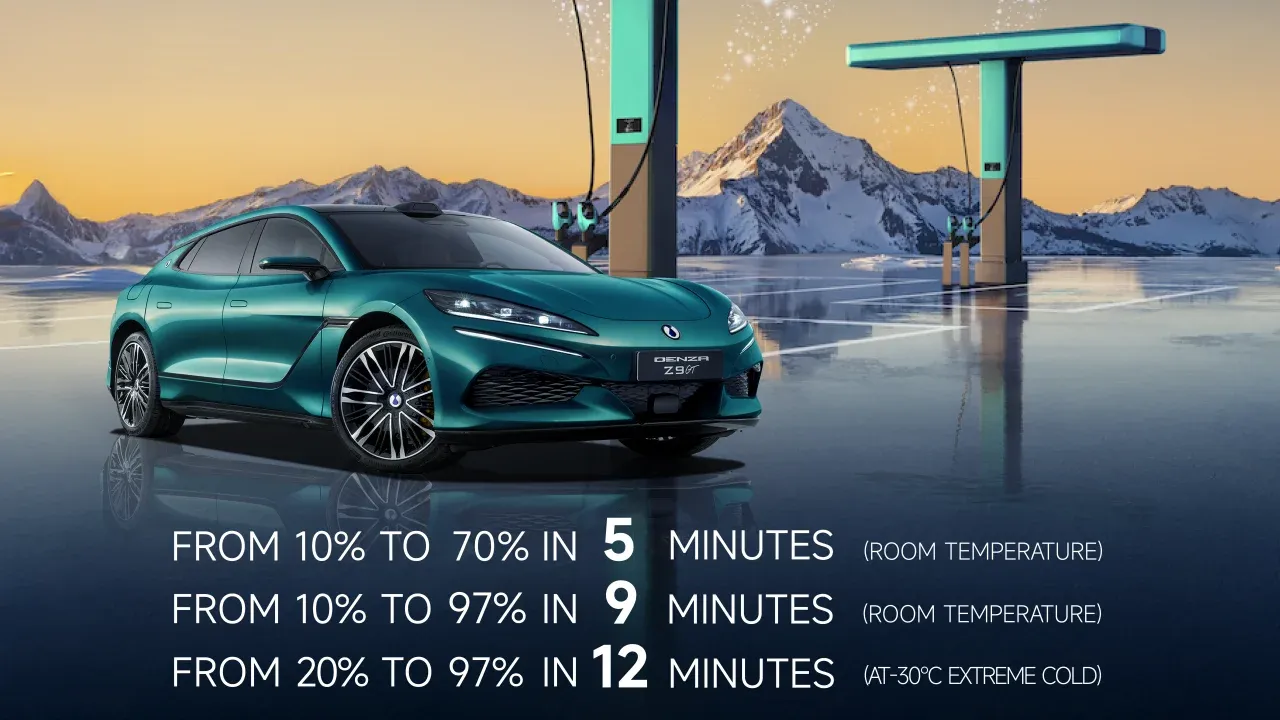
In fact, the real technological breakthrough might not lie in choosing between these two extremes. It could be achieving batteries that offer 400 or 500 km of range while being able to recover 300 or 400 km in just ten minutes.
That scenario would likely provide a much more interesting balance. The battery would still be of reasonable size, the vehicle wouldn’t weigh too much when charged, and charging stops would be short enough to make long trips not significantly different from current ones.
That’s why I think the debate shouldn’t be framed simply as 1,500 km versus 500 km. The truly interesting question is what combination of range, weight, price, and charging speed offers the best experience. And not everyone has the same needs.
A huge battery has the advantage of reducing reliance on chargers, but it increases weight and raises the vehicle’s cost. A smaller battery can make the car lighter, more efficient, and cheaper, as long as we have a charging network capable of compensating for its shorter range.
And there’s one final factor that can definitively tip the scales: the development of infrastructure.
It’s clear that the charging network will continue to expand, not shrink. If the current network already allows us to travel with some ease and a degree of redundancy, in 5 or 10 years the situation will be drastically different. There will not only be more charging points in better locations, but the power output will also increase significantly.
And for you, what appeals more— a cheaper car with 500 km of range and ultra-fast charging, or an expensive one with 1,500 km of range?