
Obstacles to electricity? The challenges of digitalization plus prices
"Those who are digital use shared and sustainable mobility far more than those who claim to be sustainable." This is the most interesting finding from the report by the Foundation for Digital Sustainability. A study that analyzed the relationship between Italian citizens, micro-enterprises, and sustainable mobility, highlighting how digital transformation in the transportation sector still faces significant cultural and structural barriers. The respondents also expressed skepticism about electric vehicles due to cost. Ignorance about their environmental impact was not overlooked either.
Digital literacy opens the door to sustainable mobility services.
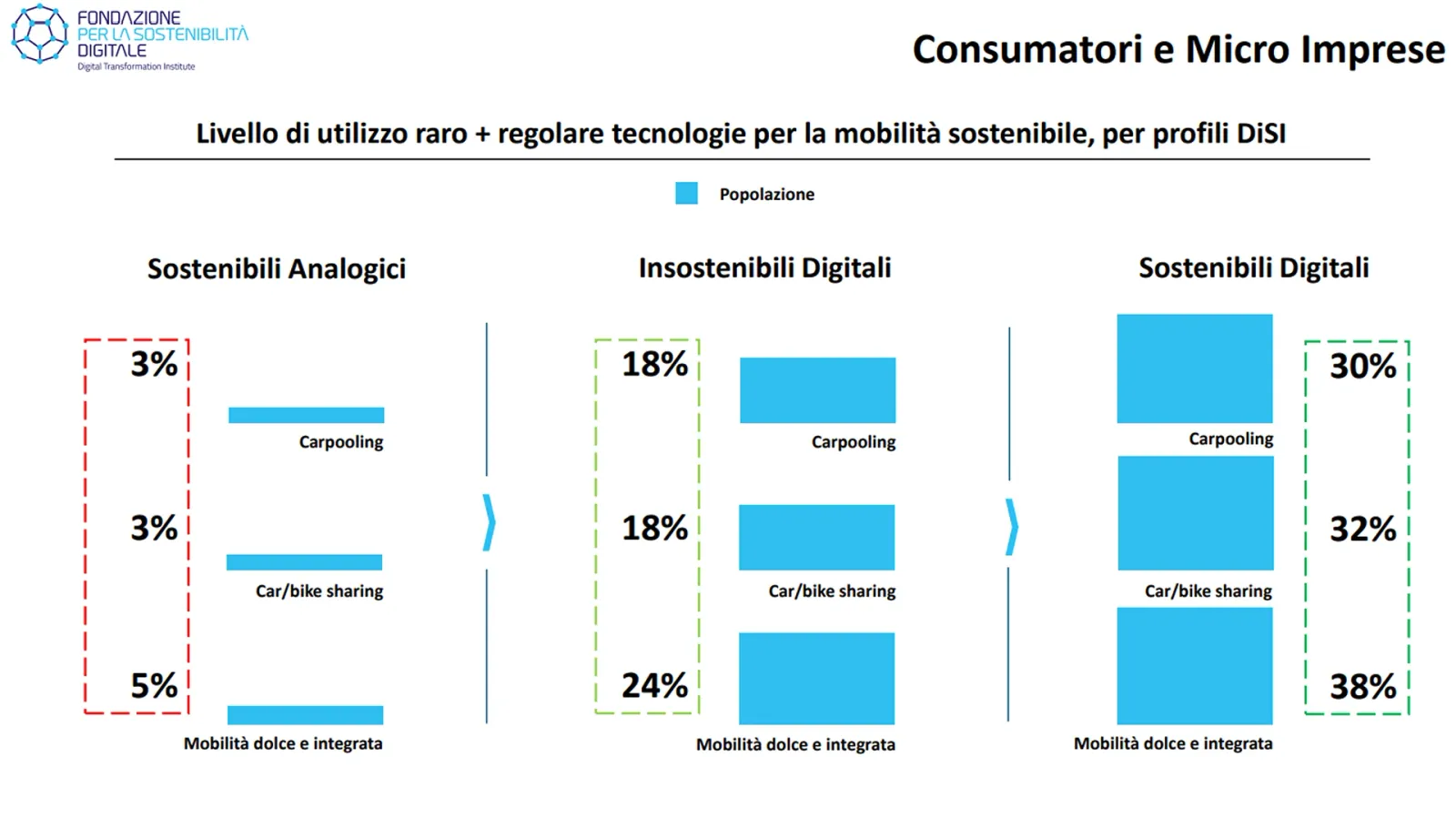
The level of digital literacy is both a catalyst and a brake for low- and zero-emission mobility. To the paradox, those who are less sustainable but more digital use green mobility services more often than those who claim to care about the environment but have limited digital knowledge. The numbers—summarized in the table below—show that only 3% of analogically sustainable people use car/bike sharing and carpooling services. This rises to 5% for public transportation, where the service can also be accessed in traditional ways compared to the first two. The paradox lies here: digitally savvy but unsustainability-conscious citizens use sharing services 6 times more often than those who are not (18% versus 3%).
The surge comes from sustainable and digital citizens: here, 30% of the sample uses car pooling and 32% uses car/bike sharing. This gap becomes enormous among sustainable analog users. The message? To increase the use of green services like car sharing—which are increasingly electric—investments in digital education and simplified access are needed. Allowing credit cards or ATMs, for example, for vehicle charging helps those who are not familiar with apps.
41% of citizens are unaware of charging, car sharing, and pooling apps.
Low digital literacy is one of the barriers to shared and electric mobility. While charging an electric car at home is simple, accessing charging stations can become a hassle, especially when trying to find the most cost-effective rate. But the problem isn’t limited to digital charging services—unknown to 41% of citizens and used by only 5%—it also applies to car and bike sharing. 36% of the respondents are unaware of these digital services that enable the sharing of cars and motorcycles. The situation is worse with car pooling, which is unknown to 39% of the respondents and used regularly by only 4% of them. Car sharing among multiple people traveling the same route, such as home to work or home to school, has not gained widespread adoption to reduce the number of vehicles on the road.
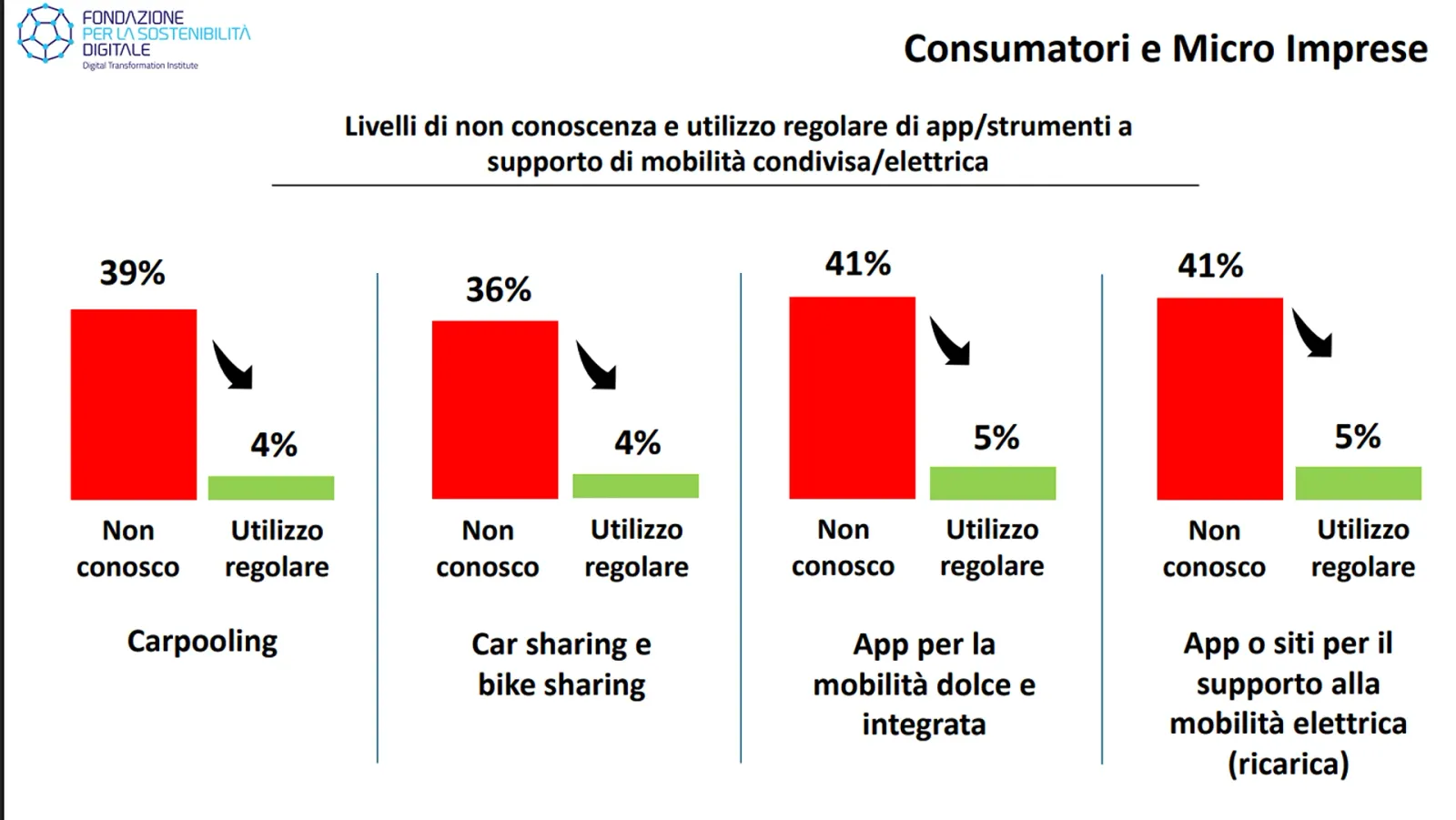
The ignorance rate rises to 41% when it comes to apps dedicated to sustainable and integrated mobility, including simply purchasing a bus ticket from a phone. Here are the figures: 40% of the population claims to be unaware of apps or websites used to buy public transportation tickets. The researchers’ conclusion is clear: “Those with fewer alternatives to public transportation are the ones who struggle the most to use it digitally.”
The price factor — few are willing to spend more than on traditional options
The authors of the Mobility Report argue that “Price, not the environment, remains the real concern for Italians in the transition to electric cars.” This is their conclusion, but the analysis is more complex. One thing is certain: there is confusion. Let’s look at the respondents’ behavior. “58% of Italians (almost 6 out of 10) say they agree to choose a hybrid/electric car even if it costs more, but when asked the same question in reverse, 66% say they disagree to spend more: two opposing positions separated by 8 percentage points. Italians’ stance on the higher price of electric cars is not yet settled or stable.”
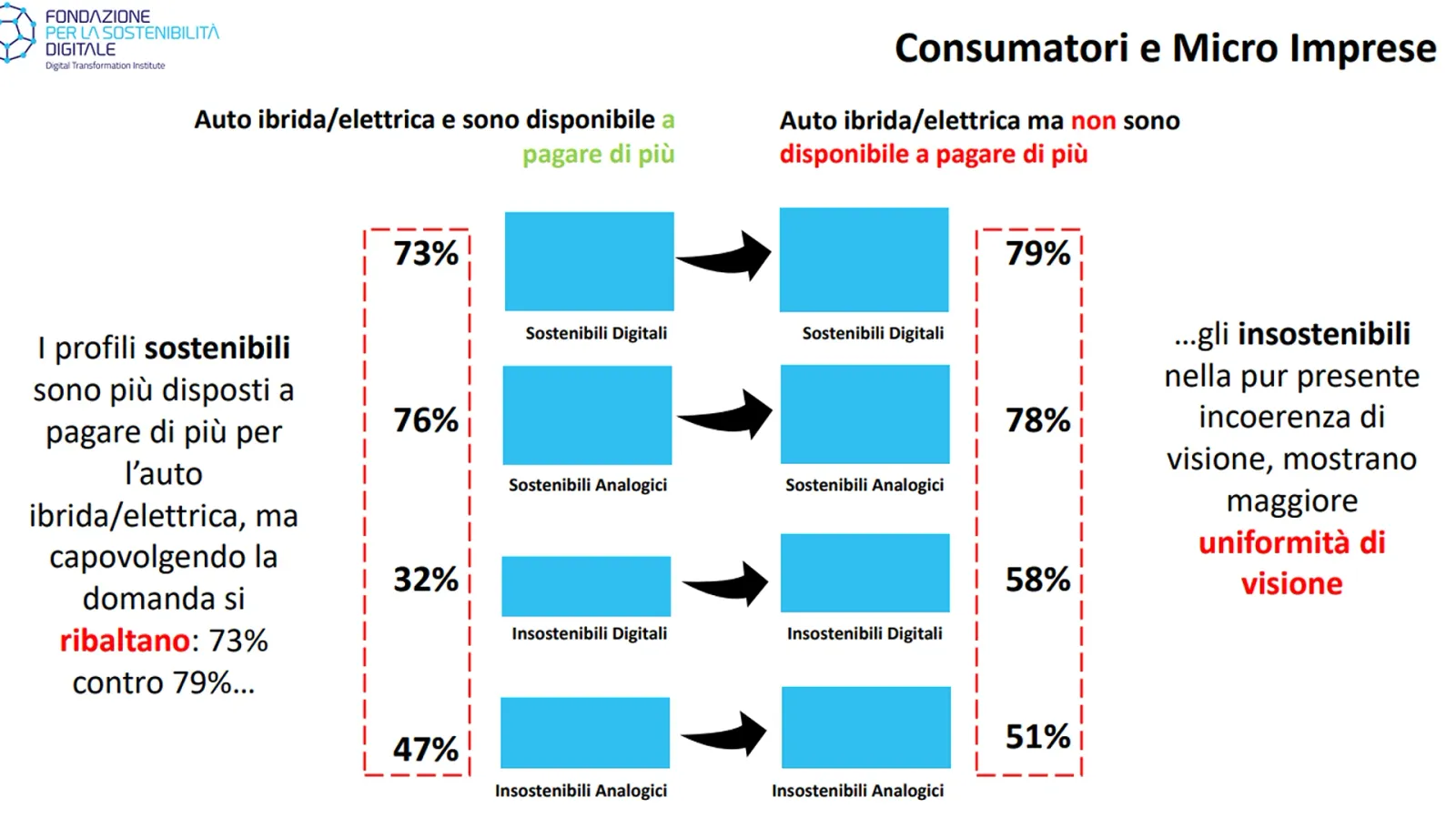
The importance of economic factors is evident in the responses of those who consider themselves unsustainable digital users; this group is more consistent in expressing their desire not to spend more. In contrast, those who claim to be more sustainable are not convinced of the need for higher spending.
Graduates are the least informed about electric vehicles
The report states that 64% of Italians believe hybrid/electric cars reduce costs and environmental impact, but 54% are equally convinced they cause the same level of pollution as gasoline/diesel cars: two opposing views separated by 10 percentage points. “Italians’ stance on the environmental impact of electric cars is still undeveloped and unstable.” There is also a lot of confusion here, which explains why we rank among the lowest in electrification in Europe.
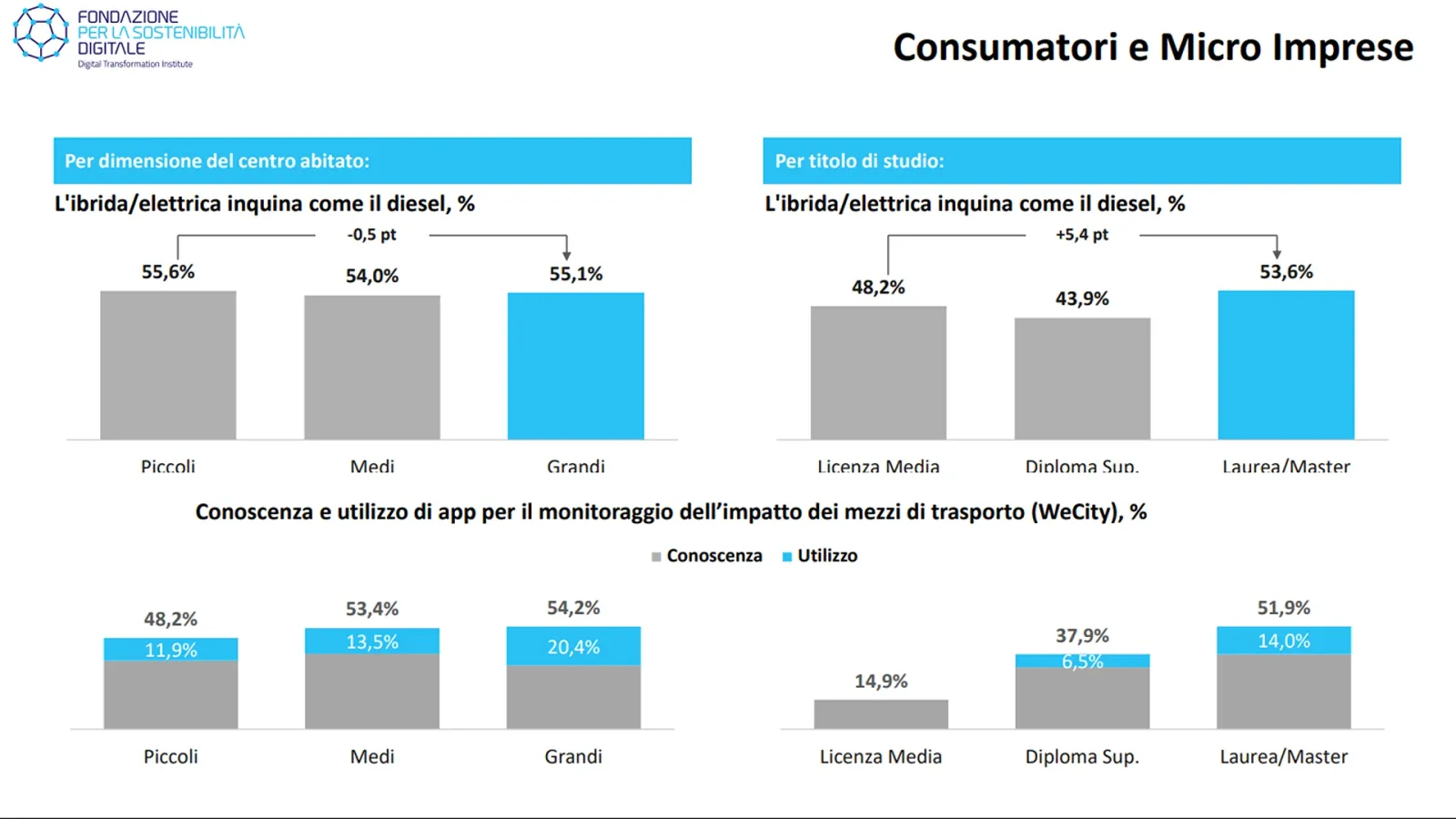
The question “Are hybrid/electric cars as polluting as diesel?” – see the table above – reveals Italians’ ignorance on this topic, as most believe zero-emission vehicles are just as polluting as those with exhaust emissions. Surprisingly, this belief is stronger in larger cities where air quality is worse. Another striking fact relates to education levels: graduates and those with master’s degrees are particularly surprised, with 53.6% thinking hybrid or electric cars are as polluting as diesel ones. This view is shared by 48% of those with a secondary school diploma and 43% of high school graduates, but they are in the minority compared to the overall sample.
The solution: lower prices, more information, and a functional digital system
To overcome these obstacles, more competitive prices compared to conventional cars and accurate information—something that is currently lacking and filled with fake news—are needed. However, the focus of research is on digital solutions, and it is useful to read the researchers’ conclusions here. “Even those who already have digital literacy and familiarity with advanced technological tools actually face natural difficulties in using digital services within their mobility contexts, precisely because travel habits are deeply ingrained and established, and do not allow for ‘leaping into the dark.’”
A step toward greater ease of use is needed. “Many mobility service systems are individually highly innovative from a technological standpoint, but often poorly functional from a systemic perspective.” The most obvious example is the numerous apps for charging at public stations. Complexity must be reduced. Starting January 1, 2027, credit card payments will be allowed, a necessary change. The full research, presented at the Journalists’ Association, can be downloaded from the link.
READ ALSO: Italian cars can win the electric vehicle race if they act ahead — watch the VIDEO
Previous Article
Electra’s General Manager: “Hourly rates help limit the impacts of rising energy costs”
Next Article
Hydrogen production: also here, failures and abandonments