
Orlen will significantly expand its charging network. Several hundred new charging stations will be added by the end of 2027.

In short:
Orlen wants to accelerate the development of its infrastructure for electric vehicles
By the end of 2027, Orlen Charge’s network is set to expand by at least several hundred charging stations
A large portion of these devices will be located in multi-station hubs, where each charging point can deliver up to 400 kW – an Orlen representative announced at KNM 2026
The company also doesn’t rule out acquiring existing infrastructure
Orlen with high power capacity
Just a few years ago, expanding the charging network usually meant installing one or two chargers at gas stations. Now, the trend is clearly changing. Orlen aims to create locations where multiple vehicles can charge simultaneously at high power levels.
“Currently, the Orlen Charge network has nearly 1,400 charging points, of which around 100 are multi-station charging hubs, each with an average of eight stations,” said Grzegorz Woliński, director of Orlen’s electric mobility infrastructure planning office.
By the end of 2027, the company plans to launch over 100 additional charging points at individual stations and several dozen new hubs. With an average of eight stations in each hub, this means expanding the network by hundreds more charging points.
The size of some locations could be even larger. Orlen is evaluating hubs with more than eight charging points, though such investments are currently in the planning stage.
400 kW is set to become the standard
In new hubs, a capacity of 400 kW per charging point is intended to be the standard. For individual stations, Orlen currently installs devices with a capacity of 200 kW most often.
This is not solely due to the choice of cheaper equipment. The biggest limitation remains the conditions for connecting to the power grid. Where available capacity permits, the company also aims to achieve 400 kW at individual stations.
“In our opinion, this should provide drivers with comfortable access to the infrastructure in the coming years,” said Woliński.
The first modern, eight-slot Orlen Charge hub was launched at the end of 2025 at the MOP Olsztynek Południe on route S7. With light demand, a single vehicle can receive up to 400 kW there, while when all slots are in use, the system dynamically distributes the available power. Since then, similar facilities have appeared in places such as Szczecin, Gorzów Wielkopolski, and Nowy Dwór Gdański.
Not only at gas stations
Multi-slot chargers are currently associated mainly with Orlen stations along highways and express roads. This is also set to change.
The company is preparing the first hubs located outside its own gas stations. They are expected to appear primarily in areas with high traffic—near transit routes and in large cities.
Gas stations will remain an important part of the strategy, as drivers can use the on-site food services, shops, or restrooms while charging for several minutes to dozens of minutes. However, a full-service gas station isn’t necessary in every location that is suitable.
This is a model increasingly adopted by other operators as well: instead of a single charging post in an arbitrary parking lot, larger charging stations are created that can serve several or even dozens of cars at once.
Orlen Doesn’t Rule Out Acquisitions
The second approach to expanding the network is even more interesting. Orlen doesn’t rule out acquiring existing infrastructure and participating in the consolidation of the Polish charging operator market.
“There are such assets in Poland in the field of electromobility that could be considered from an M&A perspective,” said Grzegorz Woliński.
The names of specific companies or networks were not disclosed. Orlen notes that any potential acquisitions would need to have economic justification in the long term.
It is still an important statement. Poland’s charging market remains highly fragmented, and building new stations from scratch requires not only purchasing equipment but also securing locations and appropriate power connections. Acquiring existing infrastructure could be one way to scale up more quickly.
Hubs are starting to fill up
Building large stations would be little sense if they ended up empty later. According to Orlen, the utilization of existing hubs is increasing as the number of electric vehicle drivers on roads grows.
Woliński admits that drivers need time to get used to the new locations. However, some facilities already experience full occupancy during the summer months.
It is situations like these that explain the shift away from a single fast charger model. Even a high-power device offers little help if there is a queue of three cars in front of it. Eight charging stations in one location significantly reduces such risks.
Orlen is also considering eHDV
The development of Orlen Charge doesn’t stop at passenger cars. At the end of August, the company launched Poland’s first public truck charging infrastructure in MCS standard near the A1 highway at MOP Stobiecko Szlacheckie Wschód and Zachód. The maximum power there reaches 1.5 MW.
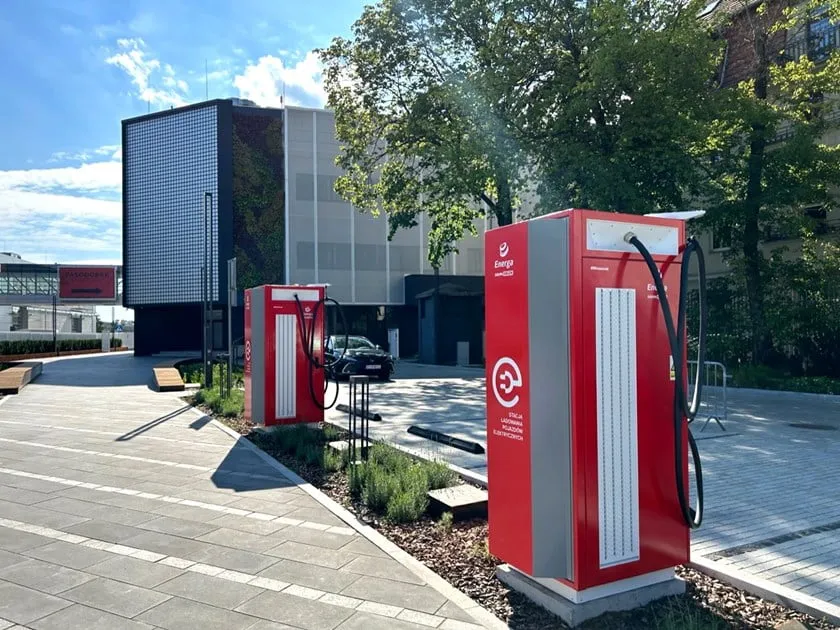
CCS stations for trucks operate simultaneously on both sides of the highway, along with four stations each for passenger cars with a power output of up to 400 kW. Orlen is preparing in this way for the requirements of the EU’s AFIR regulation and the expected increase in the number of electric trucks on major transit routes.
Orlen’s plans announced at KNM in Katowice
Grzegorz Woliński spoke about the plans to develop the network during the just-concluded Congress on New Mobility 2026, which took place from September 23-25 at the International Congress Center in Katowice.
This year’s KNM is the seventh edition of the event organized by the Polish Association for New Mobility.
The expansion of charging infrastructure is one of the key topics in this transformation. The number of electricians is growing rapidly, but for drivers, what is just as important as the sheer number of charging stations today is how many vehicles can be served simultaneously and what power can actually be delivered.
This is why the next stage in Orlen Charge’s development should involve entire hubs rather than individual chargers. If the plans for the end of 2027 are realized, there will be dozens such locations in Poland, with the network expanding by at least several hundred more charging points.
Piotr Sobczyk
Source: ISBnews, PSNM