
The ORA 5 Sport and GT start at 71,800 yuan. The EV brand GWM has just added gasoline and hybrid models.
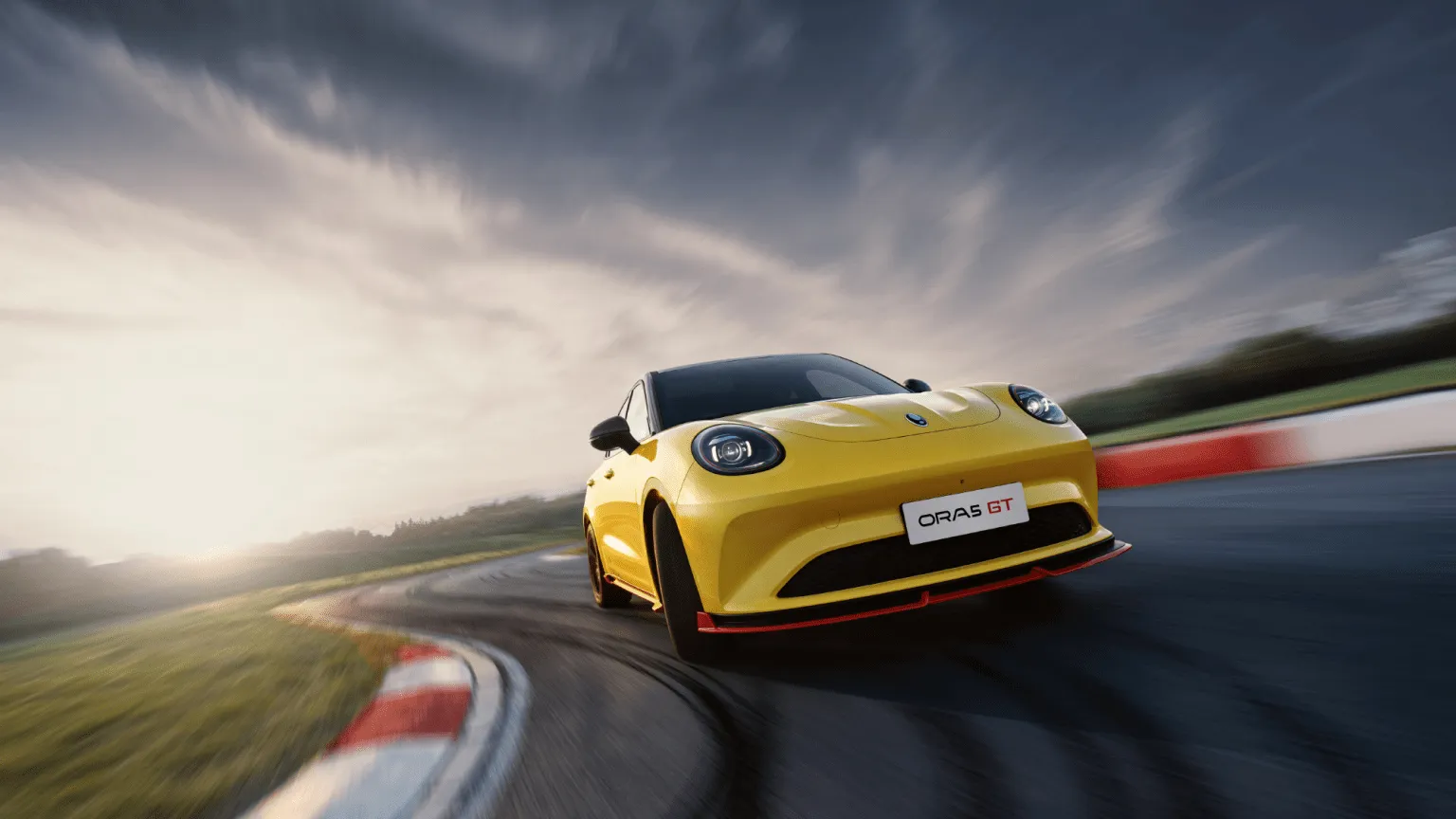
GWM unveiled the ORA 5 Sport and ORA 5 GT on August 28, 2026. Both models are available in three powertrain options: gasoline, hybrid, and electric, with promotional prices starting at 71,800 yuan, or about $10,600.
Table of Contents
Show
Hide
However, what’s most interesting here isn’t just the cars themselves but the brand’s direction. ORA was created as an electric vehicle brand, yet it is now clearly moving toward multi-powertrain options. This says a lot about China’s price war and the difficulty of sustaining a niche brand based solely on BEVs.
ORA Stops Being an All-Electric Brand
This is the most significant change. Launched by GWM in 2018 as an exclusively electric brand, ORA built its reputation on small cars in a retro style. There were the Black Cat, White Cat, Good Cat, and later the more striking Lightning Cat.
The problem is that after the launch of the Lightning Cata at the end of 2022, the brand relied for a long time mainly on facelifts and new versions of its equipment. Some models disappeared from the lineup, the range shrank, and sales did not reflect a story of success.
From January to July 2026, ORA sold 37,209 vehicles according to GWM’s data, accounting for 5.38% of the group’s total sales during that period. In China alone, the scale was even smaller. According to market data cited by Chinese media, the brand had around 19,800 domestic registrations from January to July, with 4,585 vehicles sold in July alone, the majority of which were the new Ora 5 with a gasoline engine.
In short: pure electric power is no longer enough as a differentiator. GWM did the math and adopted what more and more Chinese manufacturers are doing today—one platform, three types of powertrains, a broader customer base.
Two new variants, three powertrains, wide price range
ORA 5 Sport and ORA 5 GT are based on the Ora 5 model, which debuted at the end of last year as the brand’s first truly new model in over two years. The car was designed to compete with models such as the BYD Atto 3, also known as Yuan Plus, and the Leapmotor B10.
The Sport version is positioned as more urban and lifestyle-oriented. The GT is meant to have a sportier look and performance. It features a lower profile, an aerodynamic package, 19-inch wheels, and a large rear spoiler. In its electric version, the manufacturer claims up to 37 kg of downforce at 180 km/h. That sounds impressive, though for most users it will remain just a feature listed in the brochure.
The price range is wide:
ORA 5 Sport: officially from 81,800 to 135,800 yuan, on promotion from 71,800 to 125,800 yuan
ORA 5 GT: officially from 99,800 to 143,800 yuan, on promotion from 89,800 to 133,800 yuan
Here’s a more detailed breakdown:
Sport ICE: 71,800–95,800 yuan
Sport hybrid: 91,800–105,800 yuan
Sport EV: 111,800–125,800 yuan
GT ICE: 89,800–103,800 yuan
GT hybrid: 99,800–113,800 yuan
GT EV: 119,800–133,800 yuan
This means customers can enter the ORA world at a much lower cost than before. Though it doesn’t necessarily mean entering the EV world.
What’s under the hood
GWM uses a platform here that allows three types of powertrains in one model. One description mentions the name Guiyuan, while the company’s communications also refer to it as Global One. The purpose is the same: a shared architecture aims to reduce costs and speed up time-to-market.
The electric versions use a powertrain from Svolt. It’s a 14-in-1 system featuring an engine with 150 kW of power and 260 Nm of torque, along with a second-generation 58.3 kWh short-blade battery.
The manufacturer states:
580 km CLTC for ORA 5 Sport EV
550 km CLTC for ORA 5 GT EV
energy consumption of 11.6 kWh/100 km
charges from 30% to 80% in 20 minutes
acceleration from 0-100 km/h in 7.4 s
This needs some adjustment. CLTC isn’t a realistic range, especially for a compact car with sports aspirations. Similarly, the claimed 11.6 kWh/100 km sounds very good on paper, but without tests it’s hard to consider this as an actual road result.
The hybrids are equipped with GWM’s fifth-generation Hi2 system. The total system power is 166 kW, with a torque of 476 Nm, and fuel consumption according to WLTC is 4.5 l/100 km.
The gasoline versions use a 1.5 turbo engine paired with a third-generation 7-speed wet DCT transmission. The maximum power is 135 kW, and fuel consumption according to WLTC is 6.4 l/100 km.
If you look at it objectively, the hybrid might just be the most important selling point here. It’s clearly cheaper than EVs and easier to accept for customers who don’t want to deal with charging.
The specs are impressive, but with a caveat
Inside, both models come equipped with a 15.6-inch 2.5K display, Coffee OS 3, a 4 nm automotive chip, and 20 TOPS of computing power. The manufacturer also includes Coffee GPT, its own AI language model for voice control.
The higher-end versions may feature LiDAR and the Coffee Pilot 3 driving assistance platform. This system supports highway and urban NOA, which is driver automation navigation without relying on HD maps. It also includes memory parking over distances of up to 3 km, even between different parking levels.
On paper, this looks like high-end equipment. The problem is that with Chinese ADAS launches, one almost always has to exercise caution. “Urban NOA without HD maps” sounds great in marketing, but that doesn’t mean the system will be as mature as Huawei’s, Xpeng’s, or NIO’s top-tier solutions.
The GT also comes with several stylish extras. There’s a red button to activate Super Sport Mode, a V8 sound simulation, and launch control in all versions. It’s the classic Chinese blend of seriousness and showmanship. Some will be attracted to this, while others will find it annoying.
Design updated, not retro
ORA has long been associated with rounded, retro designs. The Good Cat and Ballet Cat were easy to recognize from a distance. The Ora 5 took a different direction, and the new variants only confirm this.
The Sport model features a two-tone body, 18-inch wheels, contrasting brakes, and lighting details. The GT has a more aggressive appearance with sporty seats. Inside, new trim themes are available, including Starry Night and Dawn Break.
This is a sensible move. Retro styling offers recognizability but can also trap a brand in a narrow niche. ORA clearly wants to reach beyond its former customer base today, including moving away from the image of a brand primarily targeted at women.
What does this mean for the market and Europe?
In short: Chinese brands are paying less attention to the purity of their brand narrative. If an electric brand needs to offer gasoline and hybrid versions, it means volume has overtaken ideology.
For Europe, this trend is interesting because it shows a possible direction for exports. GWM is already present outside China and is growing rapidly overseas. In July 2026, the group sold 108,067 vehicles, of which 62,015 went to foreign markets. This represents a 50.93% year-on-year increase in exports, while domestic sales declined by 27.23%.
There is no firm announcement yet about the introduction of the ORA 5 Sport and GT to Poland. However, if GWM wants to compete more broadly in Europe beyond just BEVs, such models would make sense. Especially hybrids. In that case, ORA would have to explain why a brand built around electric vehicles also sells traditional ICE cars. And that wouldn’t be such an elegant marketing story as before.
In the end, the most interesting aspect of this debut isn’t the wheels, spoiler, or 2.5K display—it’s the fact that this EV brand has stopped pretending that it’s possible to live solely on EVs. What do you think: is this pragmatism or the beginning of the end for ORA’s identity?