
The Onvo L60 has hit 110,000 deliveries. Sales have picked up after the price cut and 2026 model update.

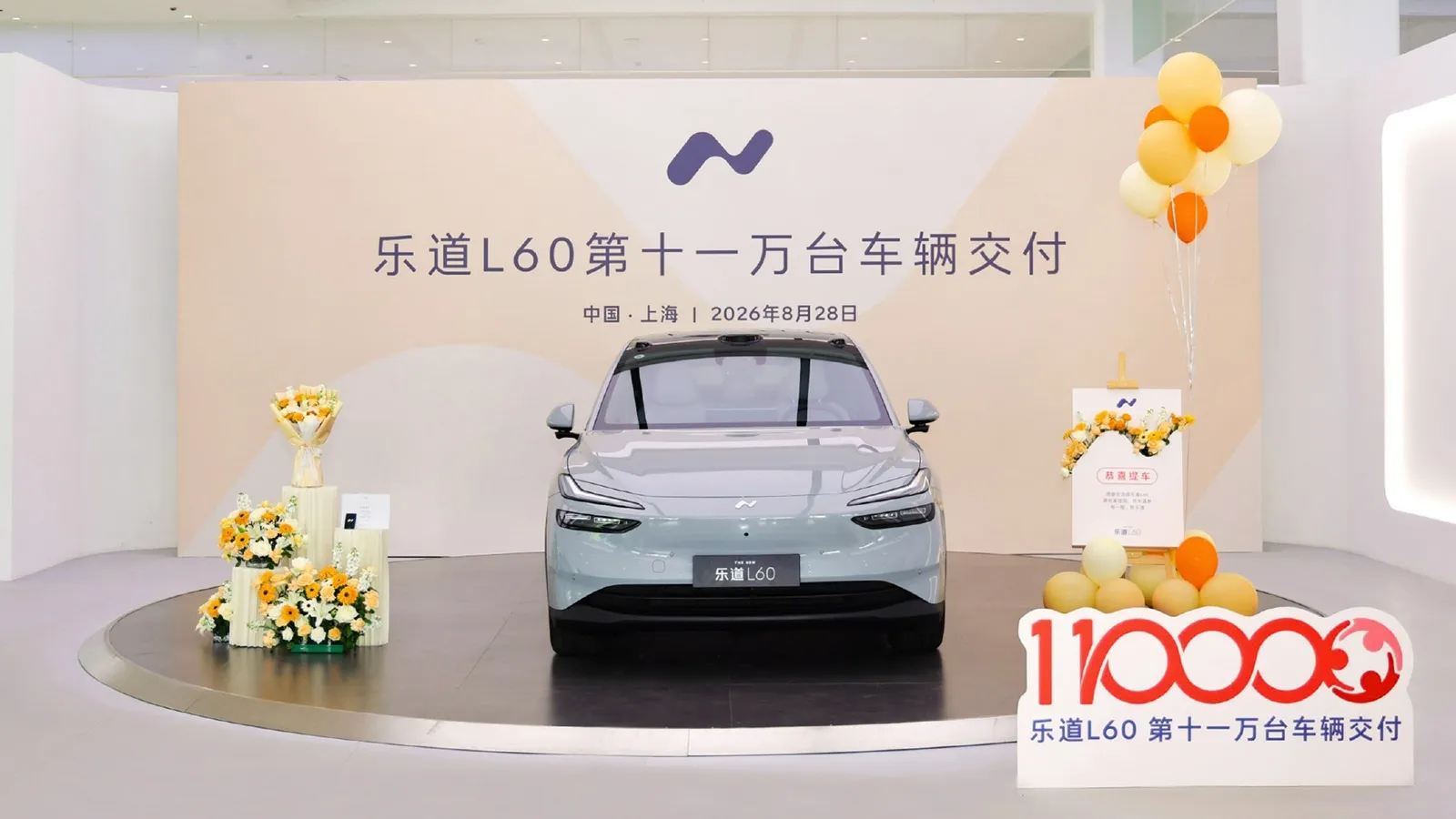
Onvo announced in Shanghai on August 28 that the L60 has reached 110,000 deliveries. The previous milestone of 100,000 units was reached on June 26, so another 10,000 cars were delivered in about two months.
Table of Contents
Show
Hide
This tells us two things at once. First, the L60 is still selling well, even though 2026 hasn’t been as strong for this model as 2025. Second, the price cut in June clearly helped, but it doesn’t change the fact that this car competes in China mainly on price, features, and Nio’s ecosystem.
110,000 deliveries, but the pace isn’t consistent throughout the year
The L60 is Nio’s Onvo brand’s first model. It entered the market in September 2024, with deliveries starting on September 28, 2024. Thus, it took about 23 months since its launch to reach 110,000 units sold.
The overall figure looks solid. What’s even more interesting, however, is how it was achieved. By the end of July, cumulative L60 deliveries totaled 106,799 units, meaning the model added at least 3,201 cars during the first 28 days of August. This already appears better than previous months in 2026, though it’s still a bit short of the best months in 2025.
In July 2026, the L60 found 4,949 buyers. For comparison, in August 2025 the figure was 5,859 units, and at the end of 2024 Onvo even had stronger months, with December reaching 10,528 units. In other words, the model isn’t currently experiencing record demand—it’s showing stability.
This is probably the most honest description of this situation. Onvo claims it ranks among the top 3 electric mid-size SUVs in the segment around 200,000 yuan, but annual data shows that from January to July 2026, the L60 received 21,615 deliveries, representing a year-on-year decline of 42.87%. In July alone, the year-on-year drop was 17.19%.
The June 2026 refresh cut prices and added better electronics
The refreshed Onvo L60 went on sale on June 11, 2026, with deliveries starting a day later. The most significant change was simple and straightforward: the price.
The base model starts at 192,800 yuan when purchased cash, which is about 6.8% lower than before. According to some data, this represents a reduction of 14,000 yuan. The top price points for the Max+ and Ultra+ versions reach 222,800 yuan.
This becomes even more apparent in the BaaS model, which involves renting batteries from Nio. In that case, the starting price drops to 135,800 yuan. On paper, it seems impressive. In practice, it’s important to remember that a lower entry price means an additional subscription fee for the battery later on. It’s not a miracle, just a different cost structure.
Onvo has also added updates in six areas, including driver assistance systems, the cockpit, and comfort features. The most technically interesting aspect is the version breakdown:
Pro remains with a vision-only setup using Nvidia Orin-X chip with 254 TOPS of performance.
Max+ and Ultra+ come equipped with Nio’s own Shenji NX9031 chip manufactured using 5 nm lithography.
The higher versions also utilize Nio World Model architecture.
It sounds ambitious, but it’s still not as simple as: new chip = immediately better autonomous driving. Chinese announcements often blur the line between real ADAS and software marketing. However, the fact that Nio is moving to its own chip is significant because it shows the company wants to become less dependent on NVIDIA, at least in its higher-end models.
900 V, battery swap in 3 minutes, and a range of up to 740 km CLTC
Technically, the L60 targets a very typical Chinese set of selling points. It features a 900 V architecture, battery swap capability, and two battery pack options.
The choices are:
60 kWh with a maximum range of 560 km CLTC
85 kWh with a maximum range of 740 km CLTC
In addition, there is the option to swap batteries in about 3 minutes at Nio’s charging network. This remains one of the group’s key advantages, at least in the Chinese market where battery swap infrastructure is real and operates on a large scale. In Europe, this argument holds much less weight, as without a dense network of stations it becomes merely a novelty.
We should also give standard stars to the range. CLTC is not a realistic road test result. Chinese standards are usually more optimistic than WLTP, let alone when driving on the highway at 140 km/h.
A competitor to Tesla’s Model Y, but no longer the brand’s sole focus
The L60 was positioned from the start as a competitor to the Tesla Model Y. This makes sense in terms of size and price. The problem is that the mid-range electric SUV segment in China is currently extremely crowded. Being “cheaper than Tesla” alone is no longer sufficient; it’s also necessary to excel in software, equipment, and promotions.
Nevertheless, the L60 remains a very important vehicle for Onvo. In July 2026, the brand delivered a total of 10,155 cars, representing a year-on-year increase of 69.93 percent. Of these, 4,949 were L60 models.
There is a slight discrepancy in the available data. Some calculations show that the L60 accounted for 48.7 percent of the brand’s July sales volume, while others suggest around 19.4 percent. The latter figure seems to be either a calculation error or a mistake resulting from confusion with the figures for the L90. If 4,949 is divided by 10,155, it indeed comes out to around 48.7 percent.
In other words: the L60’s share in the brand’s overall sales declines as newer models are introduced, but it still accounts for nearly half of Onvo’s monthly sales. Without it, the brand wouldn’t be at this scale today.
A high residual value is a good sign, though one should avoid getting overly optimistic after just one year.
An interesting point is the residual value. According to data from a Chinese dealers association, the L60 achieved 74.92% of its original value after one year, which is expected to put it at the top among mid-size electric SUVs in China by the first half of 2026.
This is worth noting because China’s EV market is unforgiving toward vehicles that quickly experience price declines. If a model maintains its used value better than competitors, it usually means demand isn’t driven solely by promotions.