
The silicon cell went through 1000 cycles and kept 83% of its capacity. But only under a pressure of 10 bars.
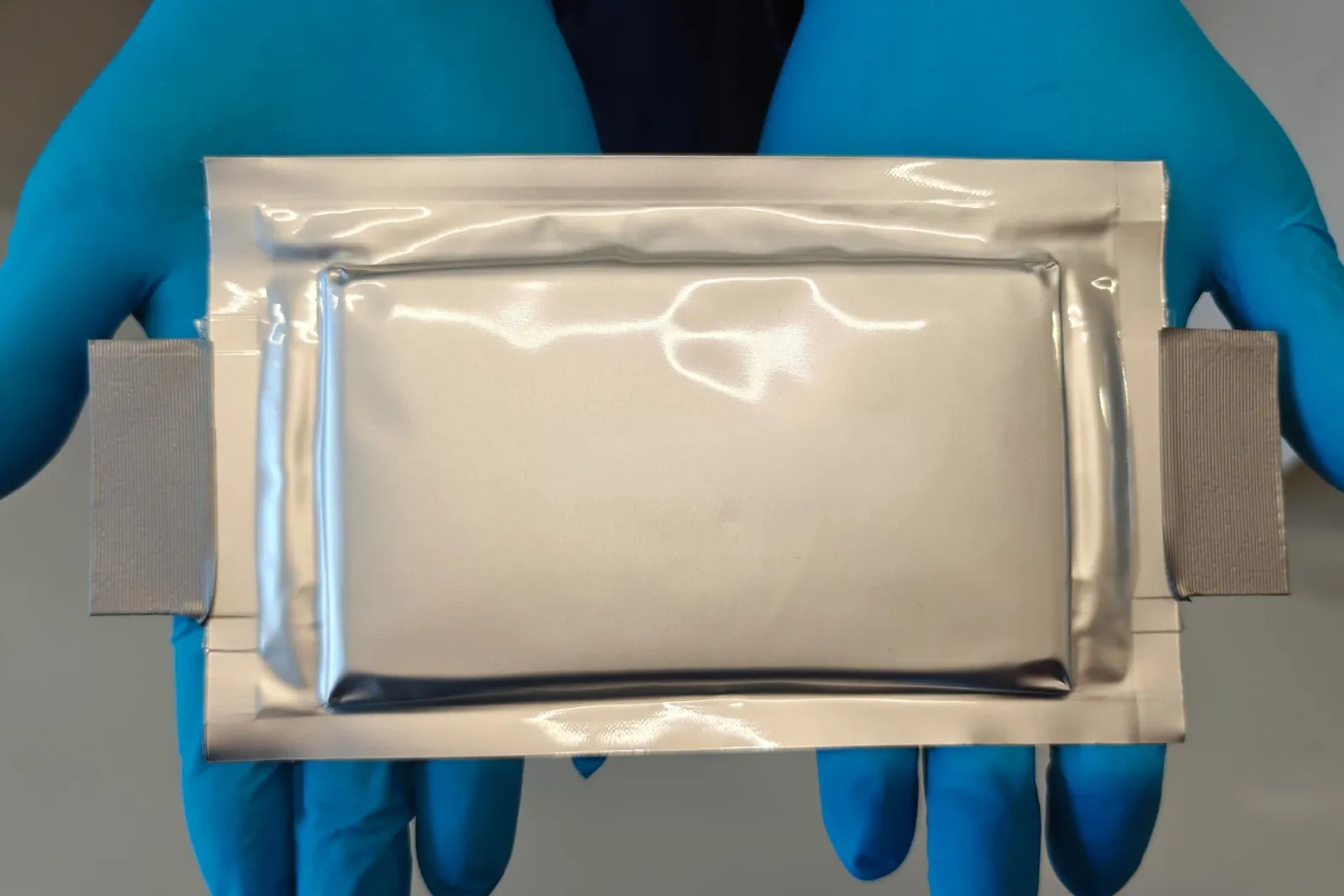
Fraunhofer ISE tested a homemade 25 Ah pouch cell with a silicon-rich anode in the StrOboBatt project. After over 1000 full charge-discharge cycles, it retained more than 83% of its capacity, exceeding the 80% threshold considered minimum for commercial use. If this result can be applied to mass-produced batteries, vehicles with the same number of cells will have greater range.
Silicon offers much, but swells significantly
Silicon in the anode allows for higher energy density than graphite. The problem is that during charging, it absorbs lithium ions and expands by up to 300%, then shrinks again during discharging. Graphite operates within a 10-12% range. Such expansion and contraction break electrical contact in the electrode and accelerate electrolyte degradation, causing silicon-based cells to age too quickly.
Germany used a silicon-carbon composite that makes up 51% of the active material in the anode. They combined it with a nickel-rich cathode, and the entire assembly was produced on an industrial pilot line.
Pressure and charging power affect performance
Mechanical pressure proved to be decisive. At an axial pressure of 1000 kPa (about 10 bar) during charging and discharging, the contact in the electrode remained stable. At 300 kPa (about 3 bar), the useful capacity declined much more rapidly. The available materials do not indicate how such pressure can be achieved in a vehicle package or what the cost implications are in terms of weight and design.
The second conclusion from tests under dynamic, driving-like conditions is that at high power levels, capacity drops faster than in gentle laboratory cycles. Battery management systems in future vehicles will need to take this into account.
280 Wh/kg measured, 330 Wh/kg planned
The tested cells achieved 280 Wh/kg. The value of 330 Wh/kg is an estimate by Fraunhofer ISE for optimized mass production, not a measured result. According to the institute, this would be 20-35% higher than current NMC and NCA cells and almost twice as high as LFP cells.
The institute converts this to a car. With the same battery weight, a vehicle could have nearly 100 kWh instead of the current around 75 kWh, and the actual range of a mid-size model would increase from about 450 km to over 600 km. This is a calculation based on energy density, not a test in a real car.
There is also the issue of raw materials. Graphite currently enters Europe mainly from abroad, while silicon can be sourced and produced synthetically within the region. According to the institute, this would allow some of the added value to remain in Europe.
For now, it’s a single 25 Ah cell, not a kit for use in cars. The materials don’t mention an release date, the cost of the cell, or any information about an industrial partner. Whether a 10 bar pressure can be accommodated within the battery design in vehicles remains to be seen.
LovEV Newsletter
Want more content like this?
Sign up — we’ll send you a weekly summary once the newsletter starts.