
New Hyundai Tucson PHEV with a battery capacity of 17.1 (~15.5) kWh. Up to 81 WLTP miles of range, single-phase charger only
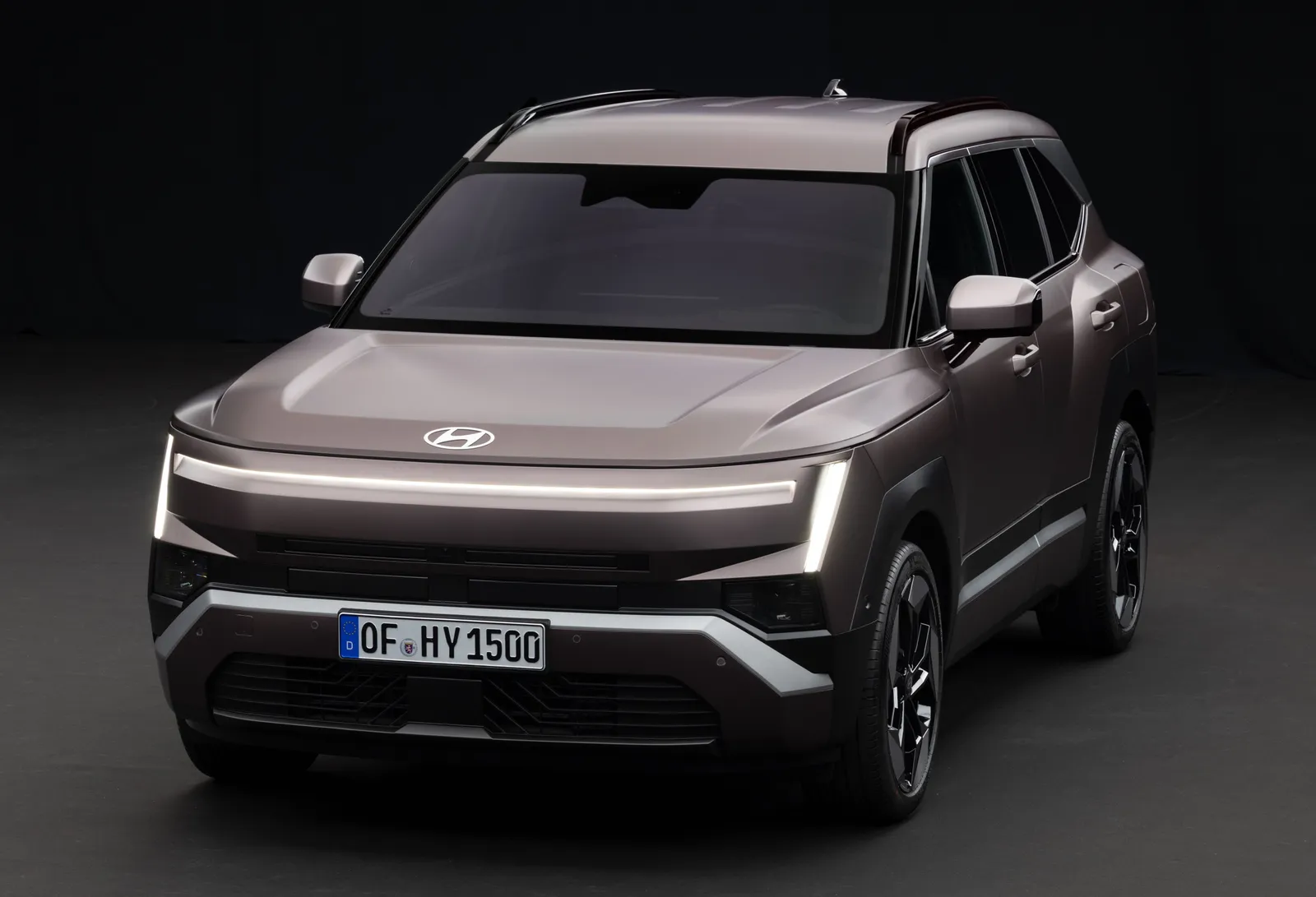
Hyundai has unveiled a new version of the Hyundai Tucson. The European bestseller – which has sold over 2 million units since its launch in 2004 – now appears completely different. From our perspective, the most important version is the Hyundai Tucson PHEV, a plug-in hybrid edition equipped with a battery having a total capacity of 17.1 kWh, enabling up to 81 WLTP miles per charge. This figure still needs to be confirmed by official homologation.
The new Hyundai Tucson without an electric version or electric counterpart
Hyundai cites Dataforce research indicating that in 2025, the outgoing generation of the Tucson was the most popular C-SUV model among individual consumers. Despite this — or perhaps because of it? — the vehicle had no direct equivalent among the manufacturer’s electric models. The Hyundai Kona Electric was significantly smaller (4.36–4.39 meters compared to 4.5–4.51 meters for the Tucson), while the Ioniq 6 was slightly larger but much more spacious and expensive due to its 3-meter wheelbase (2.68 meters in the Tucson compared to 2.66 meters in the Kona Electric).

The new Hyundai Tucson MY27. Illustrations show the gasoline (hybrid) version (c) Hyundai


The electric Tucson might be called the Hyundai Ioniq 4, as the company clearly doesn’t want to mix powertrains and “ruin the model.” Additionally, the new Hyundai Tucson has grown larger: it measures 4.56 meters in length with a wheelbase of 2.72 meters (along with 1.9 meters in width and 1.67 meters in height; source). Only gasoline variants will be available: conventional, hybrid (HEV), and plug-in hybrid (PHEV). The latter has a battery with a capacity of 1.49 kWh, while the third can store 17.1 (~15.5) kWh of energy. So the upgrade isn’t significant, as the previous generation had a battery holding 13.8 (~12) kWh.
The plug-in hybrid is the most powerful model in the lineup, delivering a total of 215 kW/292 hp of power, 380 Nm of torque, and accelerating from 0 to 100 km/h in 7.9 seconds in the all-wheel-drive version. A front-wheel-drive variant is also set to be available. Both hybrids come standard with a 6-speed automatic transmission, while the gasoline-only version offers either a 6-speed manual transmission (non-electrified variant) or a 7-speed dual-clutch transmission (pseudohybrid, mHEV).


The aforementioned 81 WLTP range figures for the PHEV with 17-inch wheels correspond to 69 kilometers in urban or urban-suburban driving conditions and 49 kilometers at 120 km/h. It should be noted, however, that the car’s electronics rarely allow the battery pack to be deeply discharged; typically, the internal combustion engine kicks in once the charge level drops to a certain point. Compared to Chinese or some German plug-in hybrids, it’s also disappointing in terms of the onboard charger, as it appears to be single-phase (7.2 kW) — though perhaps Hyundai knows better that with such a small battery pack, buyers can get a full charge overnight using just a regular outlet?
Among the interesting new features, Hyundai mentions the Pleos operating system as well as a glass layer with metallic properties that, when powered at 13.5 V, can be completely defogged within 15 minutes.

Article Rating
Readers' Ratings
[Total: 6 votes Average: 3.8]
Don’t miss new content — CLICK and FOLLOW Elektrowoz.pl on Google News. You might also be interested in the following ads:
