
We witnessed a spectacular crash test between two Mercedes CLA: Did the battery hold up?
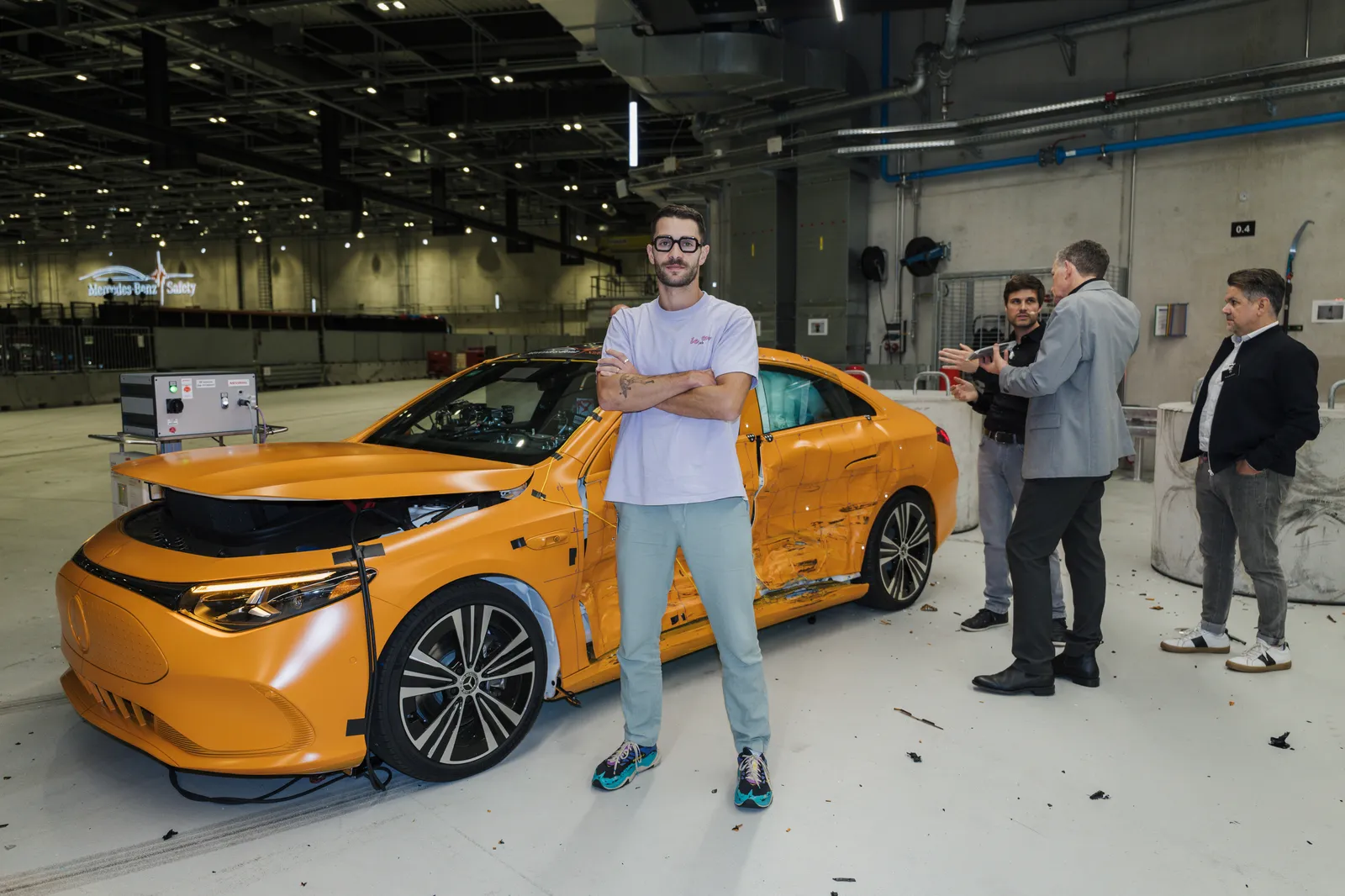
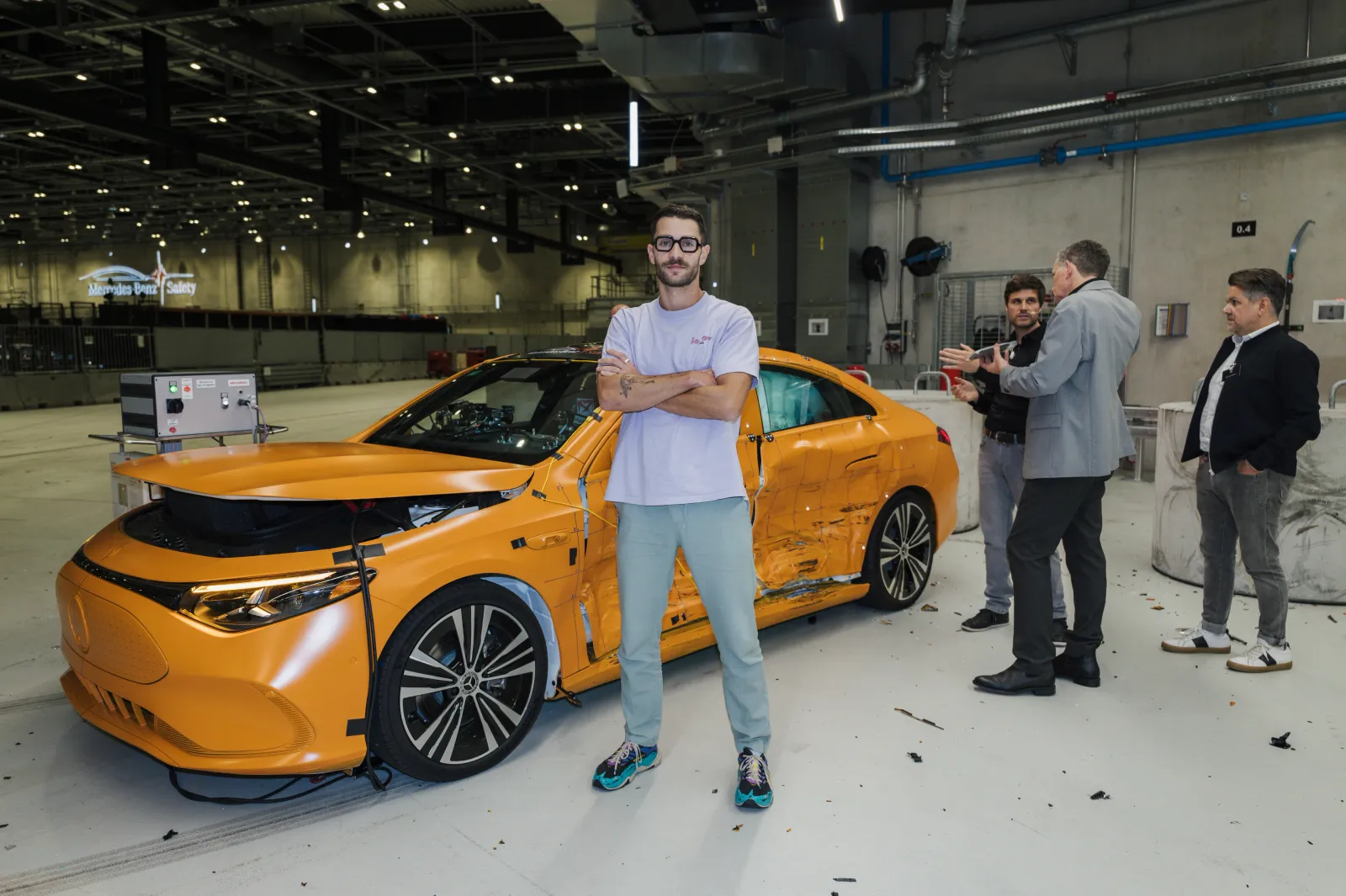
Two Mercedes CLA vehicles collided at 56 km/h, each carrying eight crash dummies, with an electric battery also subjected to extreme force. As part of the Tech Experiences held in Stuttgart, Mercedes presented an unprecedented crash test to demonstrate the safety level of its new CLA. The results are quite interesting. Here’s what you need to know!
What happens when an electric car is struck violently on the side by another vehicle? It was this question that Mercedes aimed to answer during the Tech Experiences held on October 15 and 16, 2026, in Stuttgart, Germany. After learning about the automaker’s ambitions in the field of artificial intelligence, we turned our attention to another crucial topic: safety.
To demonstrate its expertise, the German company didn’t skimp on efforts. It chose to stage a collision between two units of its new CLA. This was a particularly demanding test, especially for the fully electric version.
Two Mercedes CLAs collided at 56 km/h
On one side, a hybrid CLA Shooting Brake. On the other, an electric CLA. Both vehicles (each over two tons) were set in motion at 56 km/h. The first vehicle collided with the driver’s side of the second to simulate a severe accident at an intersection. The vehicles did not brake before the collision. This was done to mimic a challenging scenario, although modern driver assistance systems can help prevent such accidents or reduce their severity.
Also read
Tesla finally reveals its new Roadster: a crazy electric car that defies the laws of physics
According to Mercedes, this is the world’s first public crash test conducted in this configuration with two production cars in motion. It exceeds normal regulatory requirements, as approvals do not require a side collision between two actual vehicles. The manufacturer states that it used a speed corresponding to the upper range of severe accidents observed at intersections. This is a particularly interesting scenario, as side collisions account for about one quarter of all traffic accidents, according to Mercedes-Benz.
Why is this collision especially dangerous?
Unlike a frontal collision, a side impact leaves less room to absorb the energy of the crash. The space between the door and the occupants is limited. Therefore, the vehicle’s structures and various airbags must act very quickly to minimize the consequences of the accident. In the case of an electric vehicle, the presence of a large high-voltage battery under the floor complicates matters further.
This component must be adequately protected to prevent structural deformation from damaging the battery cells or electrical system components. In the event of a severe impact, a damaged battery can pose a risk of thermal runaway. This is why Mercedes set out to address a dual challenge with its electric CLA: protecting the cabin and its occupants while also ensuring the battery is safeguarded.
An Intact Battery and Well-Protected Occupants
So, what were the results? According to the manufacturer’s information and our observations in Sindelfingen, both cabin compartments retained their structural integrity after the collision. The eight dummies installed aboard, representing four adults and four children, also showed readings below the reference biomechanical thresholds. Each dummy was equipped with numerous sensors, enabling up to 150 measurement points to be collected. The results indicate a low risk of serious injuries or death for the occupants under the conditions of this test.
Also Read
Euro NCAP Crash Test: Kia EV2 Earns 5 Stars with a Stricter Protocol
Another reassuring factor is that the high-voltage battery in the electric CLA remained intact despite the severity of the side impact. Care should be taken to avoid drawing overly general conclusions. A crash test, no matter how dramatic, represents a very specific scenario. Its results cannot guarantee that a vehicle will protect its occupants in the same way under all possible situations.
Nevertheless, this demonstration provides interesting insights into the structural resilience of the new CLA and the protection of its battery.
150 crash tests for each model
To achieve this level of protection, Mercedes relies on decades of research. Since 1969, the manufacturer has analyzed and recreated real accidents to better understand the circumstances in which occupants are injured.
Approximately 6,000 accidents have been studied by its teams in Germany, China, and India. The insights gained from these studies are then incorporated into the development of new models. Even before manufacturing the first vehicles for crash tests, Mercedes conducts around 15,000 digital simulations for each new model. Artificial intelligence is also utilized to improve the accuracy of these predictions.
However, virtual tests still do not replace physical testing. The manufacturer states that it conducts about 150 crash tests for each new model. This is a large number and, according to the Stuttgart-based company, is “well beyond mere legal requirements.” This approach allows for comparing simulation results with the actual behavior of vehicles during collisions.
Will firefighters be part of the loop soon?
Mercedes also took this opportunity to unveil a new technology called Rescue Intelligence. Its purpose is to simplify the work of emergency services after an accident. The idea is to transmit important information to firefighters while they are still on their way to the scene. According to available data, responders could, for example, know the number of occupants in the vehicle, the status of airbags and seat belts, or whether the doors are open.
For electric vehicles, additional information could be transmitted, such as battery temperature and high-voltage system status. This would help teams anticipate potential risks better and prepare the appropriate equipment before their arrival. Mercedes plans to roll out this technology gradually starting in 2027. The specific details of how it will function and the conditions required for emergency services to benefit from it are still to be determined.
Also read
EuroNCAP crash test: BMW iX3 successfully introduces the new rating protocol
One thing is certain: automotive safety no longer relies solely on a vehicle’s ability to withstand a collision. It also involves accident prevention and rapid response when a crash cannot be avoided. With this crash test and its new Rescue Intelligence technology, the German manufacturer demonstrates its continued heavy investment in safety in the era of electric vehicles.