
Norway will drill through a mountain so that ships can pass through it internally: this will make it the world’s first underwater tunnel.
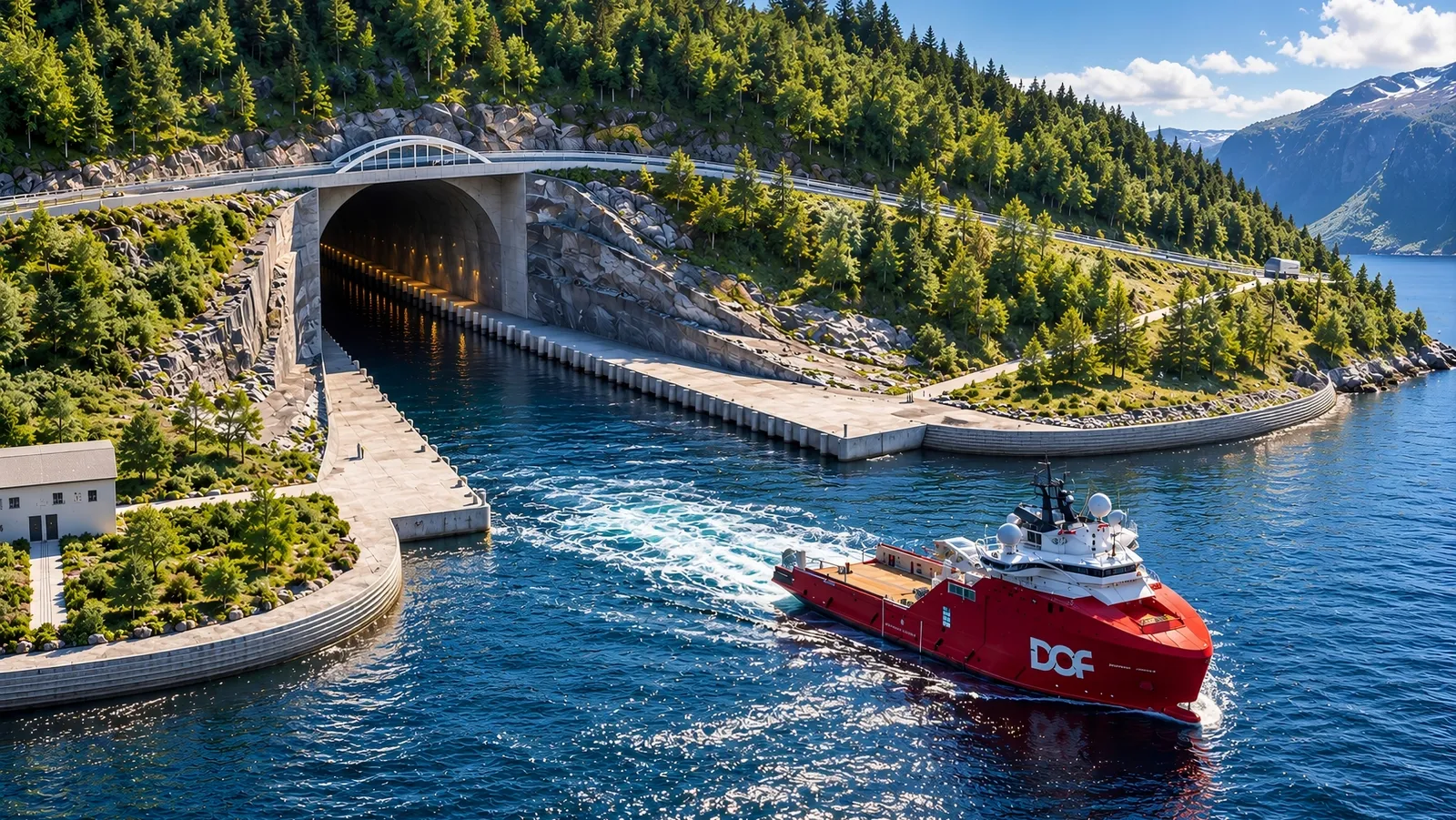
Norway is preparing one of Europe’s most unique engineering projects. It will not be a tunnel for cars, trains, or pedestrians, but rather an infrastructure designed specifically to allow ships to pass through a mountain instead of going around it by sea—a novel solution on this scale aimed at improving the safety and reliability of maritime traffic.
The project is called the Stad Ship Tunnel and will be located on the Stad Peninsula, one of the most exposed coastal areas in Norway’s western coast. There, wind, waves, and currents can significantly complicate navigation and cause delays, so authorities have been studying an alternative to avoid passing around it for years.
The chosen solution involves digging directly into the mountain to create an internal waterway. Norway’s Coastal Administration presents the Stad Ship Tunnel as the world’s first large-scale marine tunnel, with a dug gallery of about 1,700 meters and total infrastructure reaching approximately 2.2 kilometers when including access routes at both ends.
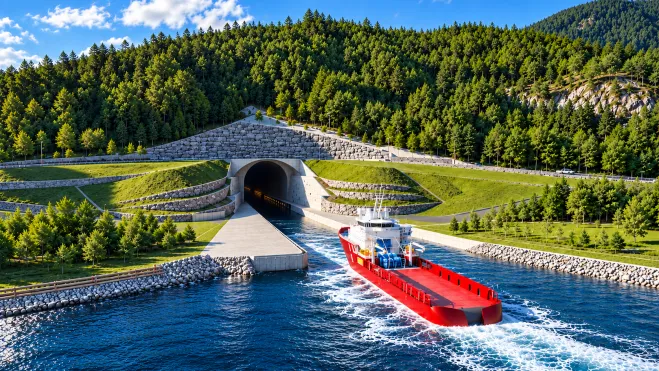
A 50-meter-high hole inside a mountain
The dimensions help to understand the scale of the project. The tunnel will have a total height of about 50 meters, a width of 36 meters, and a freeboard above the water surface of around 33 meters, sufficient to allow large coastal vessels used on Norway’s maritime routes to pass through.
Its cross-sectional area will be approximately 1,661 square meters, meaning the excavation will resemble opening a huge cavity inside a mountain rather than building a conventional tunnel. The goal is to enable ships to navigate through it with sufficient safety margins and without relying on favorable weather conditions outside.
To create this gallery, it will be necessary to remove around 3 million cubic meters of solid rock. Once that material is excavated and fragmented, the resulting volume will be considerably larger, to the point where Norwegian authorities compare it to hundreds of thousands of truckloads.
The tunnel will connect Kjødepollen in Vanylvsfjorden with Moldefjorden near Selje. In practice, ships will be able to enter from one side of the peninsula, sail 1.7 kilometers underground, and emerge directly in the other fjord without having to go around Stadlandet at sea.
The goal is to avoid bad weather
Unlike many large transportation infrastructure projects, the Stad Ship Tunnel was not created primarily to reduce distances or significantly cut travel time. Its purpose is to provide a safer and more predictable alternative to a sea route that is particularly exposed to storms.
Stadhavet is considered one of the most challenging areas along Norway’s coast due to the combination of open water, waves, wind, and rapid weather changes. These conditions can force ships to wait, adjust their schedules, or face significantly more difficult and dangerous navigation.
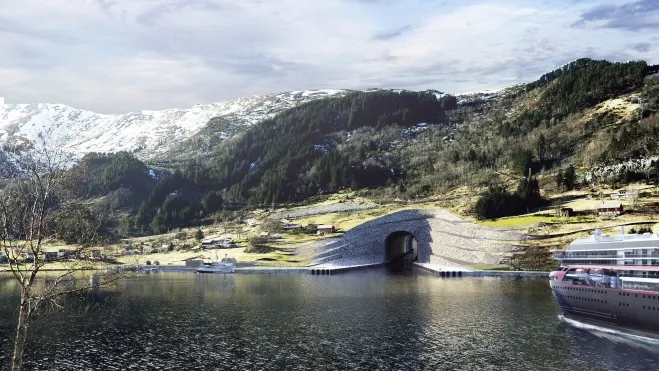
With the new tunnel, certain vessels will be able to completely avoid that area even when external conditions are harsh. The infrastructure aims to improve safety as well as the reliability of passenger, freight, and other maritime services that rely on a coastal route of particular importance to Norway.
The country also hopes this infrastructure will benefit tourism and certain economic activities linked to maritime transport. Nevertheless, the priority will remain reducing dependence on a stretch of coast where weather conditions can change rapidly and directly affect navigation.
A project costing over 8.5 billion kroner
The project has an approved budget of around 8.588 million Norwegian crowns, including taxes. The main construction has been awarded to AF Gruppen under a contract worth approximately 5.600 million crowns before taxes, following a competitive bidding process involving several companies.
AF Gruppen will be responsible for both the detailed design and the execution of the work. The official timeline calls for the start of major construction in 2027 with a building period of about five years, assuming no significant delays occur during excavation.
The preparatory work has already begun on site. Before starting to drill through the mountain, it is necessary to remove buildings, prepare access routes, prepare the construction areas, and organize the logistics needed to move millions of tons of material over the coming years.
The excavation will be one of the most complex aspects of the entire project, as work must be carried out from both ends of the mountain while carefully controlling the geometry of a tunnel that is much wider and taller than most tunnels built for roads or railways.
The first major tunnel designed to allow ships to pass through
What makes the Stad Ship Tunnel such a remarkable infrastructure is that it isn’t about expanding an existing channel or protecting a maritime route with dikes. Norway will literally dig through a mountain to create a completely enclosed new waterway.
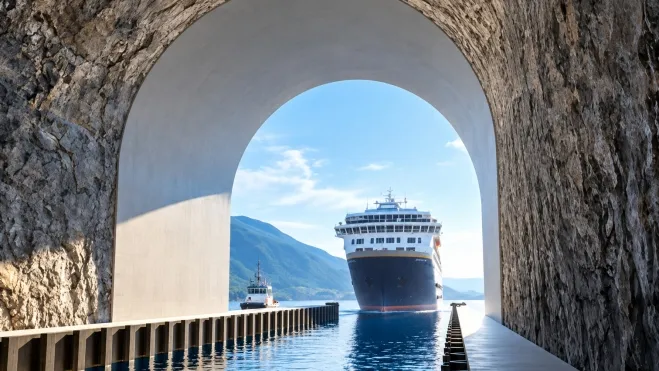
The result will be a scene unlike any other: large ships approaching an enormous opening carved into the rock, entering the mountain, and disappearing for over a kilometer before reemerging into the sea at the opposite end.
The project has been under study for years and even faced periods of budget uncertainty. However, funding was finally secured, allowing Norway’s Coastal Administration to proceed with contracting and making the necessary preparations to begin construction.
With the main contract awarded and initial work already underway, the Stad Ship Tunnel is no longer just an engineering concept. Norway is set to build a 1.7-kilometer infrastructure that will allow ships to do something that has so far been more associated with cars and trains: crossing a mountain directly.