
The Nissan Pixo EV has a WLTP range of 259 km and 60 kW of power. Its twin, the Twingo, targets a price of 20,000 euros.
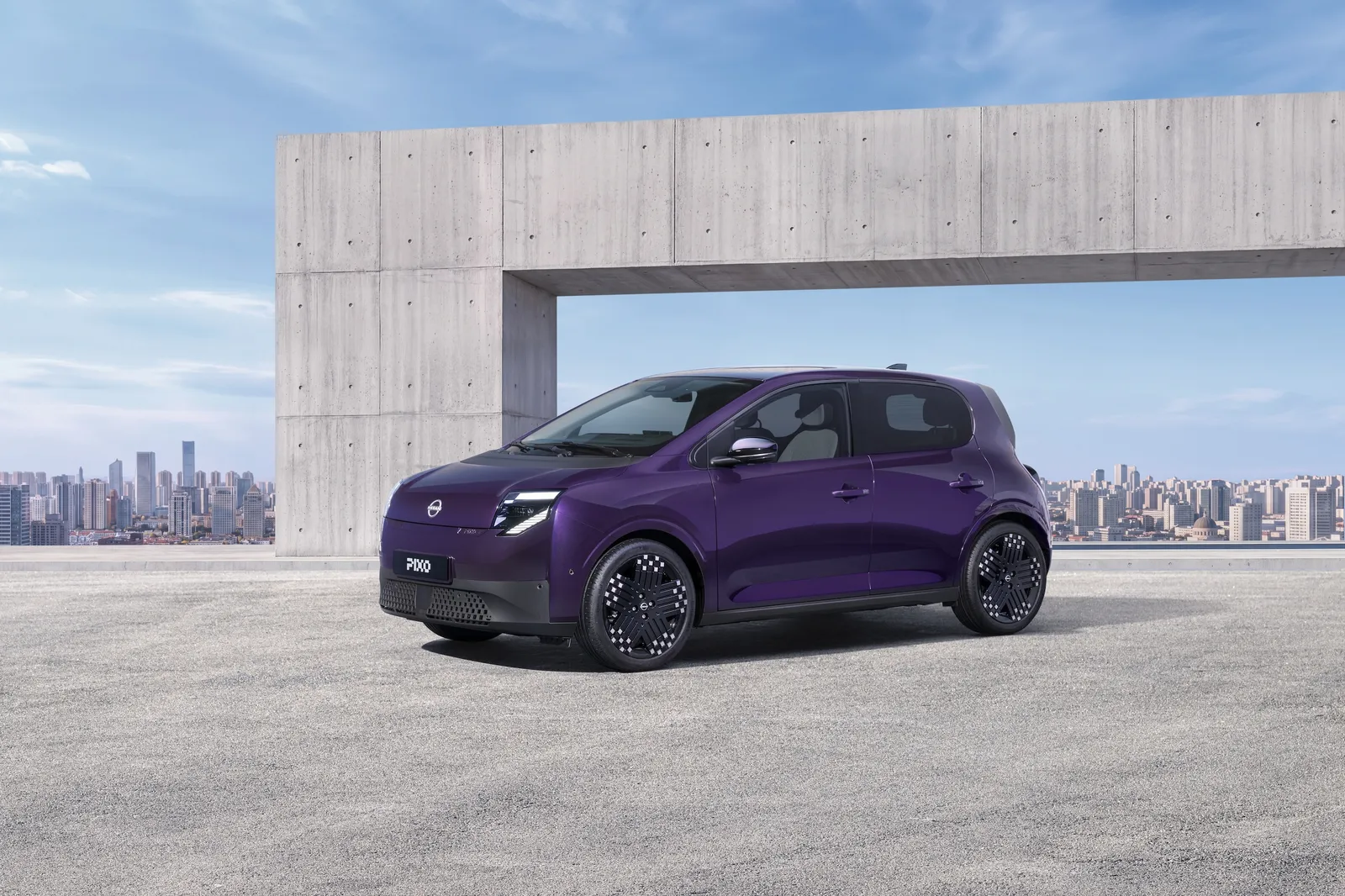
Nissan unveiled the Pixo EV, an electric city car designed for Europe and positioned below the new Micra. It features a 27.5 kWh LFP battery, a WLTP range of 259 km, and is expected to cost less than 20,000 euros before local incentives.
Table of Contents
Show
Hide
This is a return to the Pixo name, previously used for a small gasoline car sold in Europe from 2009 to 2013. This time, Nissan isn’t building the vehicle from scratch. It uses Renault’s technology, leaving styling and equipment as its own areas of focus.
Renault Twingo under Japanese skin
The Pixo EV relies on the RG-EV platform, the same one used in the Renault Twingo E-Tech Electric. The manufacturer was responsible for Nissan’s bodywork, but the proportions reveal their familial ties: a short front end, a heavily forward-mounted cabin, and an almost vertical front windshield that slopes upward.
The car is 3,796 mm long, 1,790 mm wide, and 1,512 mm high, with a wheelbase of 2,492 mm. This is almost exactly the dimensions of the Renault Twingo and Hyundai i10. The Pixo will thus be a car for city driving, parking in apartment complexes, and narrow streets, not a substitute for a compact crossover.
Nissan differentiates its model from the Renault with pixel-inspired lighting and its own front fascia. Inside, it is expected to feature Google’s built-in system with navigation, charging stop planning, and the Gemini assistant. These functions can also be controlled via the MyNissan app.
It’s good that Nissan didn’t treat the cheapest model as a household appliance on wheels. At the same time, Google and the screen won’t change the fact that technically it will still be a Twingo with a different brand name.
60 kW, LFP, and 15-80% charging in 28 minutes
The Pixo EV will be equipped with an electric motor producing 60 kW, or 82 horsepower, and 175 Nm of torque. Power is delivered to the front axle. Nissan has not yet specified the acceleration or top speed, but the identical Renault Twingo takes 12.1 seconds to reach 100 km/h and can go up to 130 km/h.
Specifications
Nissan Pixo EV
Powertrain
front
Power
60 kW
Torque
175 Nm
Battery
LFP, 27.5 kWh
WLTP range
up to 259 km
DC charging
up to 50 kW
AC charging
11 kW
DC charging 15-80%
about 28 minutes
Length
3,796 mm
Production location
Novo Mesto, Slovenia
The lithium-iron-phosphate battery is used for the first time in a European Nissan electric vehicle. LFP chemistry generally tolerates frequent full charging better and is cheaper than popular NMC packs, though it provides less energy at the same weight. In a city car, this trade-off is reasonable.
The claimed 259 km WLTP range places the Pixo between the Dacia Spring, which offers up to 250 km WLTP, and the Renault Twingo with a range of up to 263 km. However, one should not expect 259 km in winter or during constant driving on the highway. The 27.5 kWh battery is more than enough for a few days of normal city driving rather than comfortable vacation trips.
The standard will be DC charging at up to 50 kW. Nissan claims 28 minutes to charge from 15% to 80%. With the more commonly used 10% to 80% measurement, it takes around 30 minutes. This is a decent result for an urban electric car, but there’s no technological magic involved.
For AC charging, the Pixo can accept up to 11 kW and support two-way charging. The manufacturer has not yet specified which functions and adapters will be available in different markets, so it’s best to wait for the European pricing before expecting it to power a home or devices.
The price is meant to distinguish the Pixo from the Micra, not the Twingo
Nissan will announce prices for specific markets in December. The target is a price below 20,000 euros, which at the current exchange rate is around 85,000 Polish zlotys before taxes and possible differences in equipment. The Polish pricing has not been confirmed yet.
Pixo is set to enter a segment that quickly fills up with small electric cars. Dacia competes on price and the simplicity of the Spring. Renault sells the Twingo on sentiment and French style. Nissan will try to convince customers with its own design, more comprehensive equipment, and a brand that some buyers still associate with the Leaf.
Standard features will include automatic emergency braking, lane-keeping assist, and e-Pedal. This latter system allows for faster deceleration when the accelerator pedal is released, which truly simplifies driving in urban areas.
Production will take place at Renault’s factory in Novo Mesto, Slovenia. It is a European model designed for European cities, also serving as a response by the Renault-Nissan alliance to the affordable models of Chinese brands such as BYD and Leapmotor.
The Pixo may not win on specifications against larger cars, but at a price close to 20,000 euros, it could be a more sensible choice than an inexpensive electric car with DC charging available only as an option. Is Nissan’s unique style enough for you to choose the Pixo over the Renault Twingo?
LovEV Newsletter
Want more content like this?
Sign up — we’ll send you a weekly roundup once the newsletter starts.