
Nissan Pixo: The electric return to the A-segment
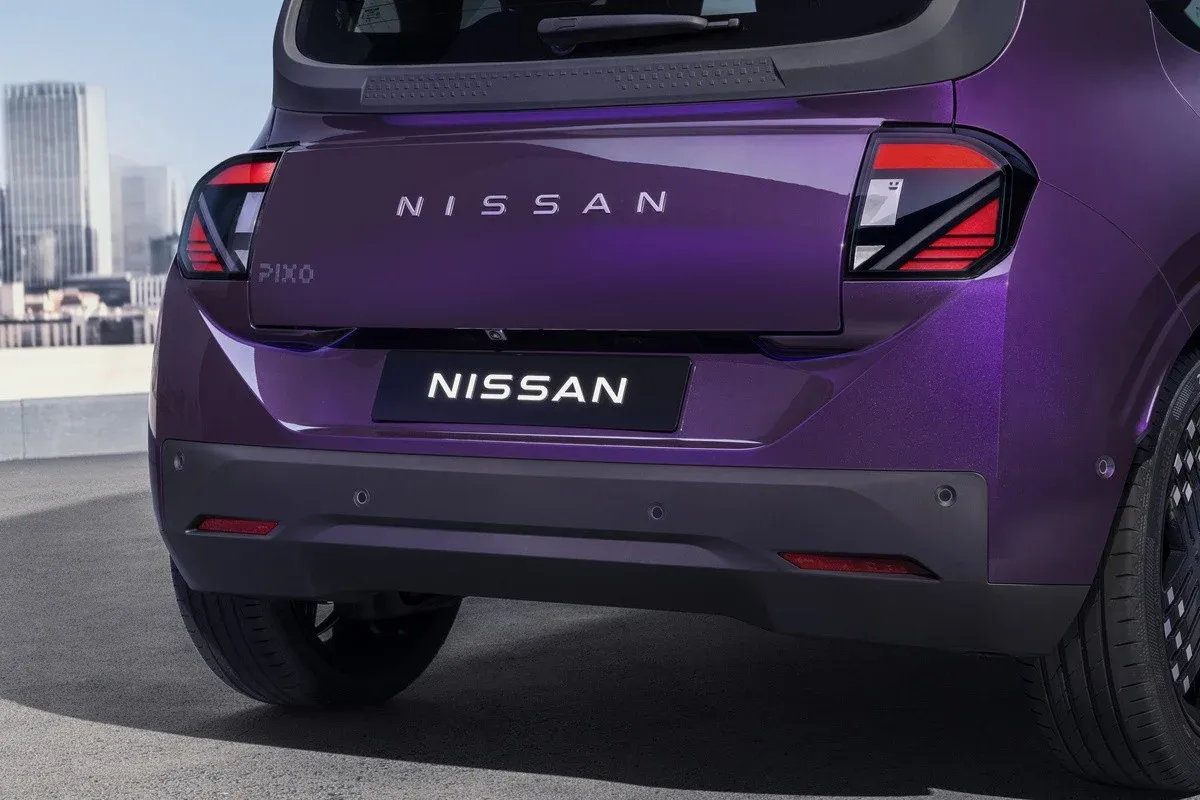
Nissan has unveiled its electric city car, the Pixo. This model marks the brand’s return to the European A-segment and shares its technical platform with other electric vehicles based on Renault’s RG-EV platform. There are no surprises in terms of performance specs: Nissan’s partner Renault has provided the Pixo with its electric small car drive system, which has already been widely discussed this year. What’s interesting, however, is that the Nissan variant matches the Renault E-Twingo in terms of equipment level, while the new Dacia Spring, with features like a DC charging option that must be added separately, is clearly positioned below its two sibling models.
The group’s strategy is clear: Dacia aims to attract price-sensitive customers with a stripped-down lineup, Renault wants to capitalize on the nostalgia trend with the Twingo E-Tech Electric, and Nissan is now tasked with bringing a budget electric vehicle to market without the dull vibe of its economy models. The Japanese team was only responsible for the design of the Nissan Pixo. Even this design, with its flatly rising windshield, bears a strong resemblance to the E-Twingo once you know they’re related. Still, Nissan tries to differentiate itself with features like pixel-inspired lighting. More on that soon.
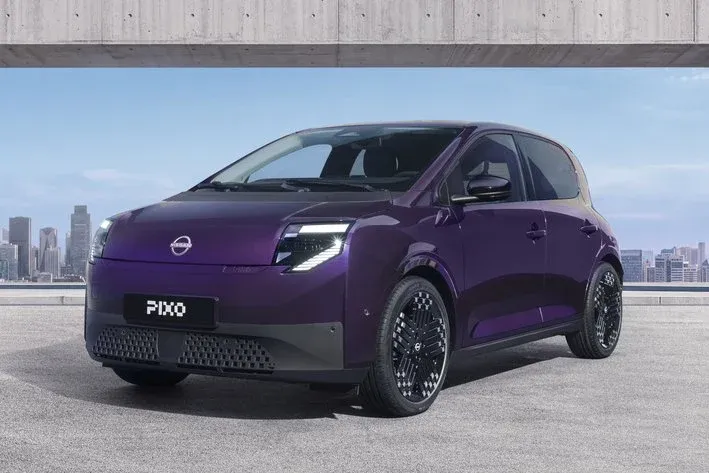
Image: Nissan
- 1/6
- 2/6
- 3/6
- 4/6
- 5/6
- 6/6
To provide context: We have known since last year that Nissan is developing a new city electric vehicle for the European market, built on the same platform as the Renault 5-related Nissan Micra. Initially, the name “Waved” was circulating, but Nissan ultimately chose Pixo. This name was already used for a gasoline-powered microcar between 2009 and 2013, based on the Suzuki Alto and manufactured in India. Notably, as the only electric vehicle in Nissan’s lineup to date, the Pixo features an LFP battery as its unique selling point.
Nissan Pixo is said to have a range of 259 kilometers
This brings us to the “internal specifications” of the electric city car: The Pixo is a front-wheel-drive vehicle equipped with the well-known combination of a 60-kW electric motor and a 27.5-kWh LFP battery. Nissan claims a range of up to 259 kilometers, placing it midway between the Dacia Spring (up to 250 km) and the E-Twingo (up to 263 km). The Pixo comes standard with DC fast charging at 50 kW and an 11-kW AC onboard charger that also supports two-way charging. Nissan states that DC charging can bring the battery from 15% to 80% in 28 minutes. However, the more common metric is the charging time from 10% to 80%, which for the Pixo should be around 30 minutes, similar to its sibling models. The table below shows the largely identical performance specifications of the Pixo and E-Twingo:
| | Nissan Pixo | Twingo E-Tech Electric |
| --- | --- | --- |
| Drive type | FWD | FWD |
| Power | 60 kW | 60 kW |
| Torque | 175 Nm | 175 Nm |
| Acceleration | n.a. | 12.1 s |
| Top speed | n.a. | 130 km/h |
| WLTP range | 259 km | 263 km |
| Battery capacity | 27.5 kWh | 27.5 kWh |
| DC charging speed | 50 kW | 50 kW |
| DC charging time 10-80% | 30 min | 30 min |
| Price | n.a. | 19,990 Euros |
In terms of dimensions, the Pixo measures 3,796 x 1,790 x 1,512 millimeters with a wheelbase of 2,492 millimeters. It differs from the E-Twingo significantly only in width: the Nissan model is seven centimeters wider than its French counterpart. Nissan emphasizes that “intelligent space utilization maximizes the interior volume and provides room for up to four adults.” Similar to the E-Twingo, individually adjustable rear seats are intended to enhance flexibility and offer additional storage space for larger items when needed (this feature is not available in the Dacia Spring). By the way, the Pixo’s trunk capacity is stated to be up to 356 liters, including a 50-liter compartment for charging cables.
Youthful colors, but not as bold as Renault’s
Nissan’s own description is “a compact all-electric city car that combines everyday usability, progressive design, and seamless connectivity.” The Pixo is intended to offer “a fresh, distinctive character and a particularly affordable option for urban drivers.” Visually, the Japanese brand achieves this through a new design language that differs significantly from the slightly larger Micra unveiled in 2025 (which is also built by Renault and shares technology with the Renault 5). Key features of the Pixo include pixel-inspired lighting, a uniquely shaped front end with a prominent bumper, a windshield that rises gently like the Twingo’s, and a steeply sloping rear. The color palette aims to appear youthful with shades such as Midnight Purple and Authentic Blue, but it is not as bold as those used by Renault.
In terms of connected technology, Nissan relies on a Google ecosystem. As a result, the Pixo gets a AI assistant via Gemini — a first for Nissan in the A-segment. At launch, Gemini will be available in 16 languages and support navigation, entertainment, and communication through natural language interaction, according to the company. Google services for navigation, real-time route planning, and seamless connectivity are also included. All services in every trim level can be controlled via a 7-inch driver display and a 10-inch touchscreen for infotainment (the latter is not part of the base setup in the Dacia Spring). Standard driver assistance features include an adaptive cruise control, lane-keeping assist, and hands-free parking. The one-pedal technology is also available.
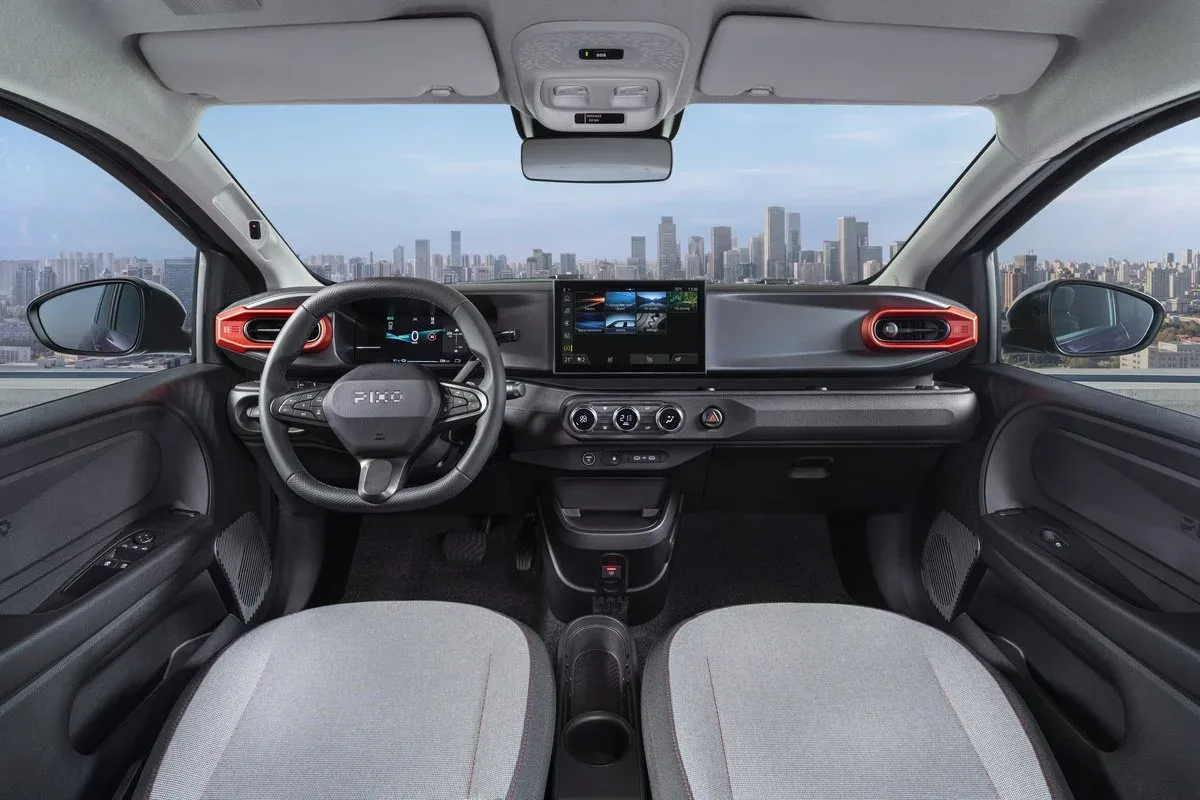
Image: Nissan
- 1/4
- 2/4
- 3/4
- 4/4
According to the Japanese brand, the development of the new Pixo demonstrates “how Nissan turns its vision into action by combining customer-focused innovation with a more efficient rollout of new electric vehicles alongside partners. This partnership is made possible by strong support from China: the Renault Group’s research and development center in Shanghai dedicated to electric vehicles, called ACDC, contributed to the entire engineering work related to the key powertrain. This is intended to bring about ‘China Speed.’ Renault itself recently emphasized that its Chinese facility advanced the projects ‘by working closely with local partners and new industry companies’—such as CATL for battery design and Shanghai e-drive for the powertrain.
Nissan Pixo deliveries begin in early 2027
Nissan emphasizes that the Pixo was “developed specifically for European customers,” despite its partly Chinese origins. It is produced at the Renault plant in Novo Mesto, Slovenia, along with the E-Twingo and Dacia Spring. First deliveries are scheduled for early 2027. Nissan plans to “announce prices, market-specific features, and pre-order information starting in December 2026.” However, the price is likely to be not too far from that of its French counterpart, which starts at 19,990 euros.
"We are convinced that the future of electric mobility does not lie in building larger vehicles with even more technology," comments Clíodhna Lyons, Vice President Product for Brands and Brand Strategy at Nissan AMIEO. What matters most are smarter vehicles that integrate seamlessly into people’s lives. "The Nissan Pixo was developed specifically for Europe and its cities. It offers everything customers expect from an electric vehicle—without unnecessary complexity," says Lyons, who also highlights Nissan’s comprehensive electrification approach: "With rising fuel costs, our focus remains clear: we provide customers with practical alternatives to reduce their transportation expenses. Whether through our rapidly growing range of electric vehicles or our highly efficient models.
“with the e‑Power hybrid technology.”It is also clear that Nissan is tied to Renault for its current and future product lines — and vice versa. The two companies have been partners for a long time. Renault once held 43.4 percent of Nissan, while Nissan owned 15 percent of Renault. However, this asymmetric relationship was restructured in 2024. Since then, each automaker holds 15 percent of the other company. In March 2025, Renault and Nissan made further adjustments to their partnership and explicitly announced that starting in 2026, Renault would also develop and produce a derivative of the new electric Twingo for Nissan. Voilà: the newly unveiled Nissan Pixo.