
Nissan and Honda will have shared controllers and software in the next generation of new vehicles. Eventually
Nissan and Honda have announced that starting from the fiscal year 2029, which ends in the first quarter of 2030, they will use common, standardized controllers along with their software, as well as shared operating systems. This change will apply to “software-defined vehicles” (SDVs), which are new generation cars where software becomes a key aspect determining the vehicle’s performance, functions, or applications.
Nissan and Honda together, yet separately
Honda did not back down when the Japanese government pressured it to merge with Nissan. But the company’s leadership is not foolish: when even engine segments for boats and lawnmowers are being challenged by electric drives, it is essential to quickly find allies to navigate the coming tougher times. The two companies will use a shared hardware-software architecture in the controller and operating system layers, which should reduce the costs of developing new vehicles (source).
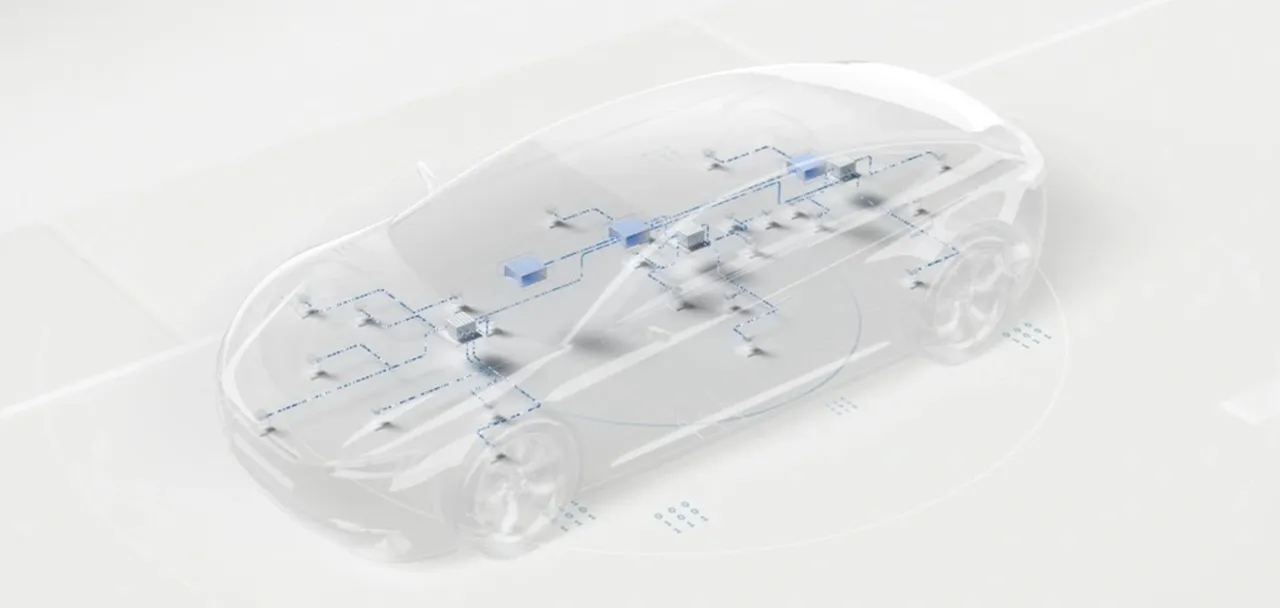
That’s not all. The companies will explore cooperation opportunities in other segments, aiming to “accelerate progress toward emission neutrality” (in other words: finally find a solution to the influx of Chinese electric vehicles) and achieve zero fatal accidents involving Honda and Nissan vehicles. Development cycles are set to be shortened, with expenses better controlled. The common electrical/electronic architecture (E/E architecture) will be adapted to current trends, using multi-core processors and several powerful computers instead of a swarm of small, specialized controllers.
Schematic of an E/E architecture based on several powerful computers rather than a network of distributed controllers (c) Bosch
It sounds good: by 2030, Nissan and Honda vehicles should start supporting over-the-air updates (OTA), their own semi-autonomous and fully autonomous driving systems, and at the same time become cheaper to produce—though initially more expensive to develop, as part of the budget will need to be reallocated to software-related areas. This should eliminate once and for all the situation where a certain flaw persists in every subsequent generation of cars. After all, an improved software base is unlikely to be deliberately damaged for future models.
Editor’s note from Elektrowozu: It’s interesting that Nissan and Honda’s entirely reasonable statements, applied to the European context—where the Union has very similar goals regarding safety and emissions—trigger discussions about “communism” and “coercion”
Article rating
Readers’ rating
[Total: 2 votes Average: 5]
Don’t miss new content — CLICK and FOLLOW Elektrowoz.pl on Google News. You might also be interested in the following ads: