
Nio is introducing the fifth generation of battery swap stations
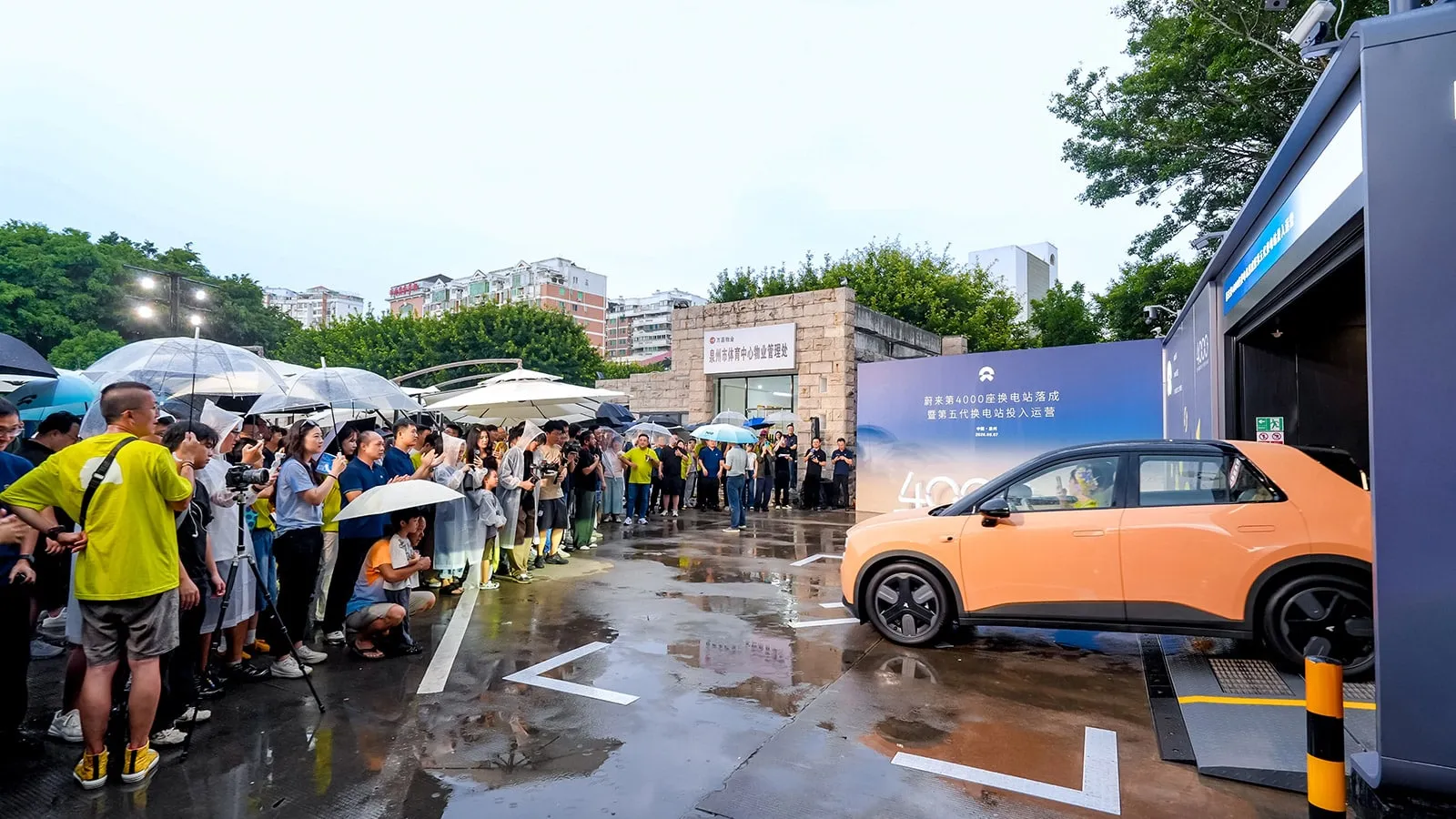
Nio has launched the first fifth-generation battery swap stations in China. This new technology also integrates Nio’s compact car brand, Firefly, into the swap network for the first time. Meanwhile, Nio has surpassed 4,000 swap stations in China.
The first stations of the new generation were put into operation in Beijing, Shanghai, Guangzhou, Suzhou, Hefei, Chengdu, and Quanzhou. The location at Qiaoxiang Gymnasium in Quanzhou is both Nio’s 4,000th battery swap station in China and the first station of the fifth generation.
The core of the new generation is said to be a swap platform developed by Nio itself. According to the company, it adjusts its configuration in real time to locate the battery mounting points for each vehicle. It supports vehicles with wheelbases up to 3.5 meters, ranging from compact cars to large SUVs. For the first time, models from all three of the company’s brands—Nio, Onvo, and Firefly—can use the same battery swap network. This is a significant step for Firefly, as its approximately four-meter-long electric compact car could not use previous swap stations due to its shorter wheelbase.
Nio Reaches 120 Million Battery Swaps
The launch of these new stations coincides with another milestone: on August 7, Nio completed its 120-millionth battery swap. The company had only surpassed the 100-million mark at the beginning of February, meaning the latest 20 million swaps were added within roughly six months.
The network itself continues to expand steadily. As of August 7, Nio operated 4,006 battery swap stations and 5,160 charging stations in China, totaling 29,801 charging points, of which 1,049 swap stations are located along highways. According to Nio, these stations connect nine north-south and eleven east-west corridors as well as 16 major urban areas, covering more than 550 cities. In these cities, 80.1 percent of users are expected to have at least one swap station within three kilometers of their home or workplace.
The current massive expansion is clearly focused on Nio’s home market in China. The company has slowed down its pace of international expansion recently. In Europe, Nio does not plan to build any additional battery swap stations or its own charging facilities for now, opting instead to rely more on partnerships and a less capital-intensive business model. New vehicles based on the NT3 platform with a 900-volt architecture are not expected here until at least late 2027 or early 2028.
The European swap network is likely to remain at its current level for the time being, while Nio continues to scale up this concept in China. The fifth generation will not only increase the number of stations but also make them available for all three of the company’s brands for the first time.