
No one with a sound mind would want to install a combustion engine in an electric vehicle. Obrist is going bankrupt, with 31.8 million euros in debt.
Austrian company Obrist Group believed that electric car buyers would eventually realize the extent of their mistake. At that point, they would want to return to conventional vehicles and opt to add a combustion engine to their cars. Therefore, one of its subsidiaries developed a kit to convert BEVs into gasoline-powered models by installing an additional two-cylinder traditional engine. Unfortunately, after a few years, reality proved these optimistic assumptions wrong—Obrist Group is now on the verge of bankruptcy with debts amounting to 31.8 million euros (equivalent to 140 million zł).
Converting Electric Cars to Gasoline Vehicles: Finding an Anti-Midas
In public discourse, there are numerous companies and individuals whose advice should be heeded to do exactly the opposite of what they recommend, which is actually something a normal person senses intuitively. For example, in the United States, people jokingly refer to the inverse Cramer rule, and there is even a satirical profile by the same name that advises taking actions precisely opposite to those recommended by CNBC journalist Jim Cramer. Indeed, investing money in the opposite direction of these recommendations usually yields better results than relying on the journalist’s advice.
In Europe as well, we have such figures, mainly in politics, but we can also find journalists. The Austrian company Obrist, although clearly rooted in engineering circles, also belonged to this group.
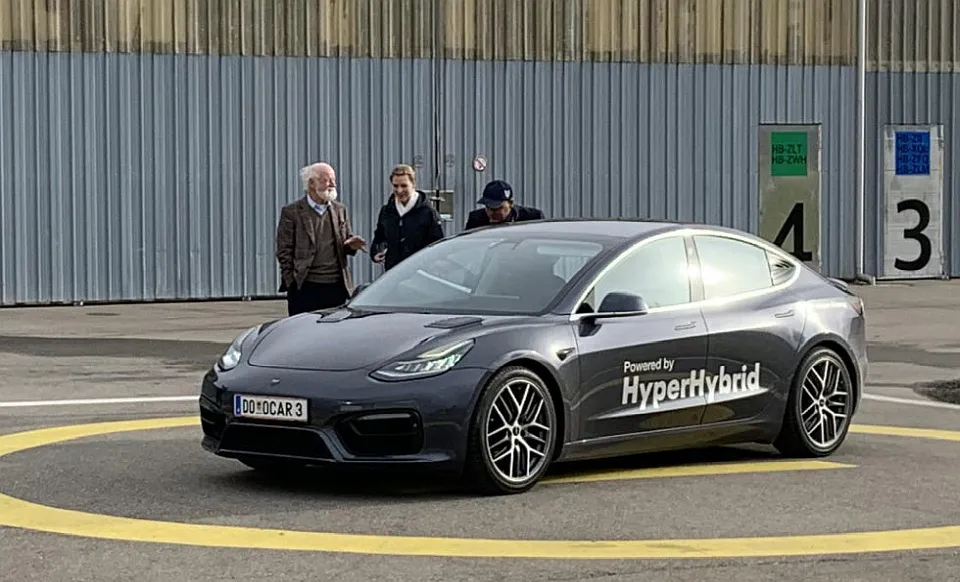
A picture promoting the Obrist HyperHybrid drive system. The bearded statistician fit the role of a mad scientist perfectly
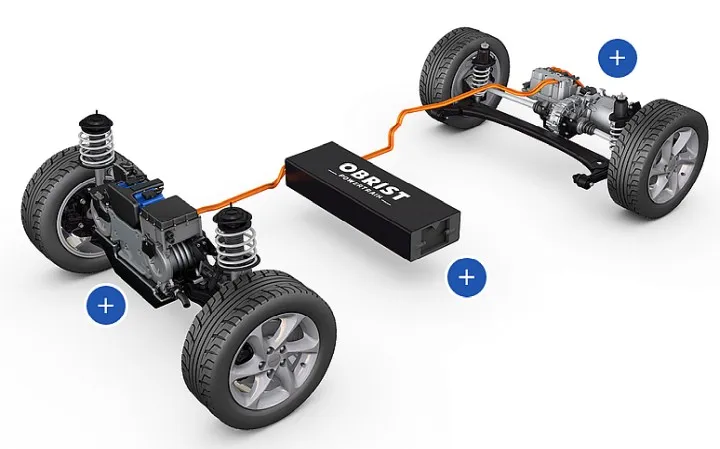
In 2018, its subsidiary company developed the HyperHybrid drive system, which consisted of a 11 kWh battery, an electric motor that powered the wheels, and an internal combustion engine that served as an energy generator. In other words, roughly five years after the BMW i3 REx was launched, Obrist created an identical plug-in series hybrid (EREV) using a two-cylinder generator. The main advantage of this Austrian solution was its ease of integration into any internal combustion engine model. Yet car manufacturers somehow failed to be convinced…
That’s why in 2020, the Austrians began aggressively convincing the public that while people do buy electric vehicles, they will eventually realize their mistake, as a range of 1,000 kilometers is the most important factor. Additionally, batteries are expensive, whereas a small internal combustion engine can easily increase range. So the company’s founder, Frank Obrist (pictured below), removed the battery from a Tesla Model 3 SR+, replaced it with a 17.3 kWh battery pack, and installed an internal combustion engine in the trunk. It’s no coincidence he chose a Tesla—all other electric vehicles at the time had complicated engine layouts under their hoods:
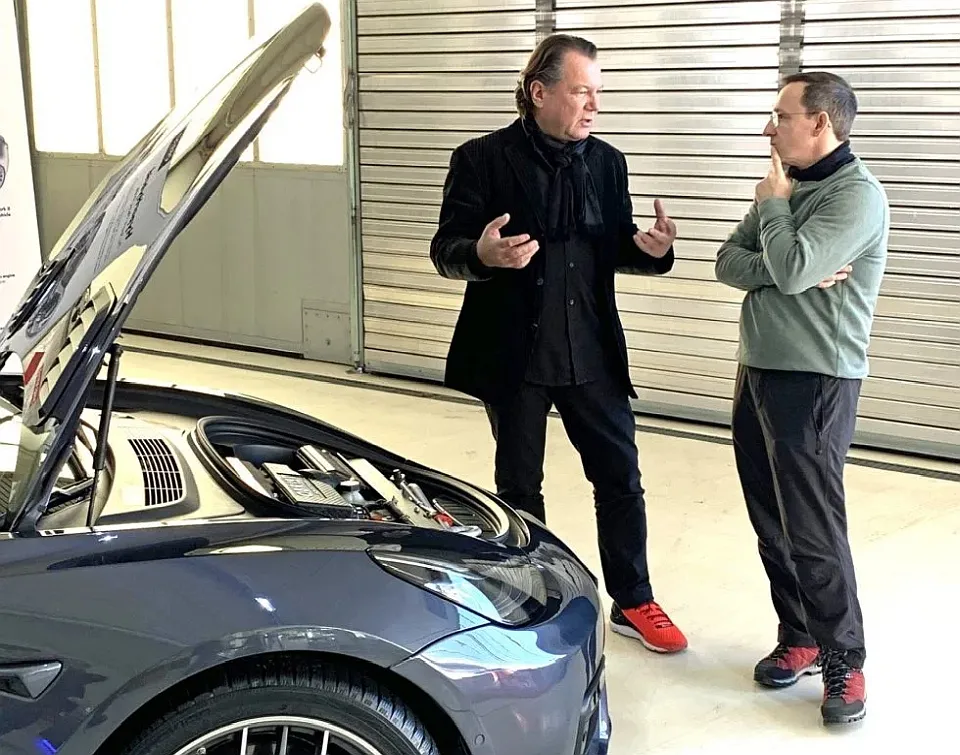
Frank Obrist, co-creator of the drive system, advocates for the advantages of his solution.
The Tesla Model 3 HyperHybrid was a real marvel. On electricity alone, it could travel several dozen kilometers (“100 NEDC units”), and additionally, the internal combustion engine would start humming at the front as soon as the driver exceeded 65 km/h. The fully assembled model with this drive system and the conversion kit were supposed to be ready by 2023 at the latest. A Chinese engine from the Geely EC7, four-cylinder, was used as the power generator, although Obrist had previously insisted on two-cylinder units. All these upgrades were intended to reduce the car’s price to 20,000 euros (!) by removing a large portion of the battery. But this did not take the costs of conversion into account.
Over time, it became apparent that internal combustion engines must be fueled by methanol or at least a mixture of methanol and gasoline. Now, Obrist is going bankrupt, with debts of 31.8 million euros, and it seems there is no hope for the company.
Article Rating
Reader Ratings
[Total: 0 votes Average: 0]
Don’t miss new content — CLICK and FOLLOW Elektrowoz.pl on Google News. You might also be interested in the following ads: