
Neither Tesla nor BYD: A study of 500,000 batteries reveals the surprising best electric car brand
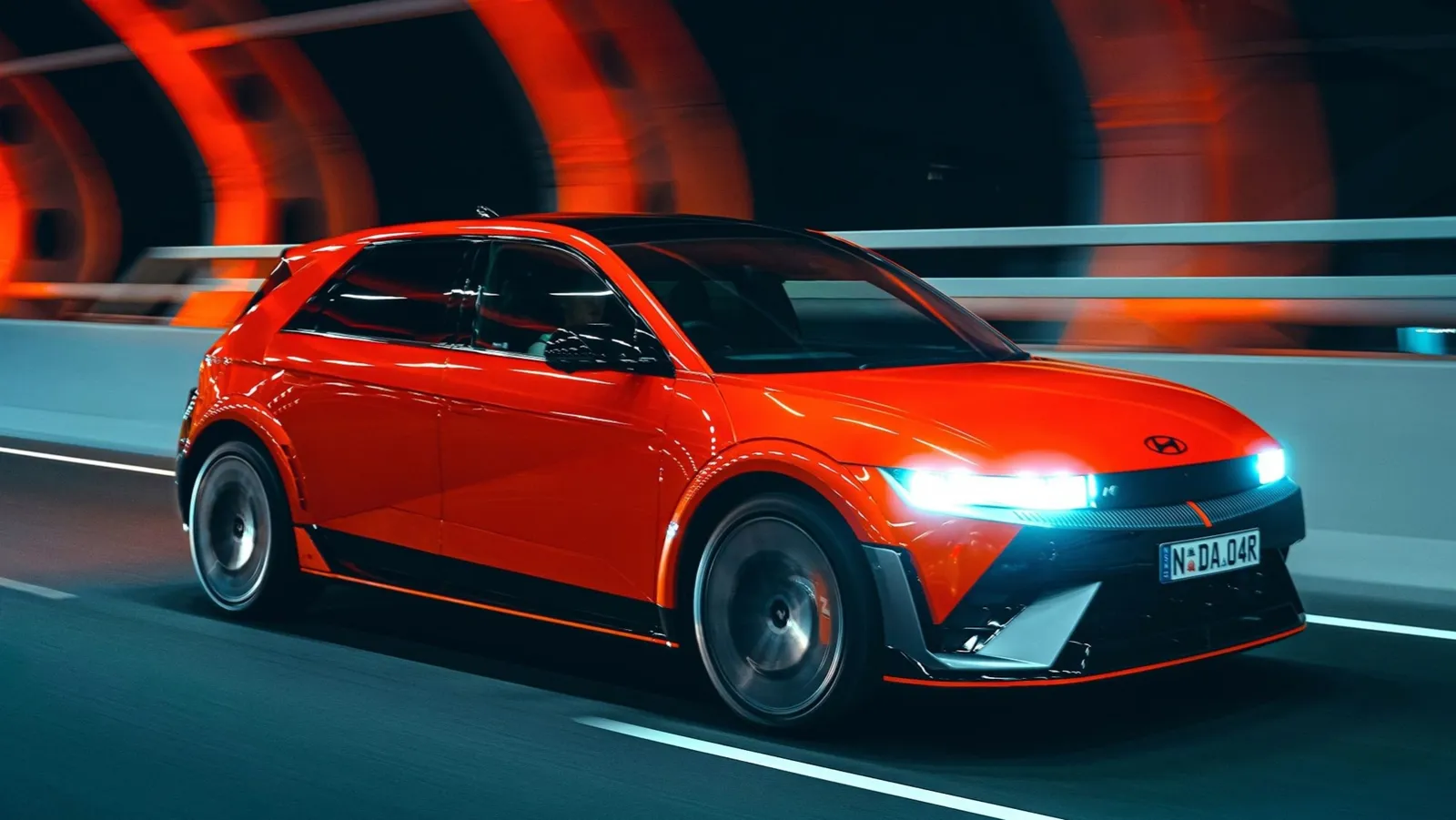
The batteries in electric cars and how they age—explained here—are one of the biggest concerns for those interested in electric vehicles. And although this has become a less significant issue over time, it remains a key factor when choosing between different brands of these cars, whether Tesla, BYD, Geely, BMW, or others.
A study of nothing less than 500,000 batteries sheds new light on this matter. It clearly identifies which electric car brand performs best in this regard. And no, it’s neither BYD—which dominates the electric car market in Spain—nor Tesla, despite having achieved a historic record.
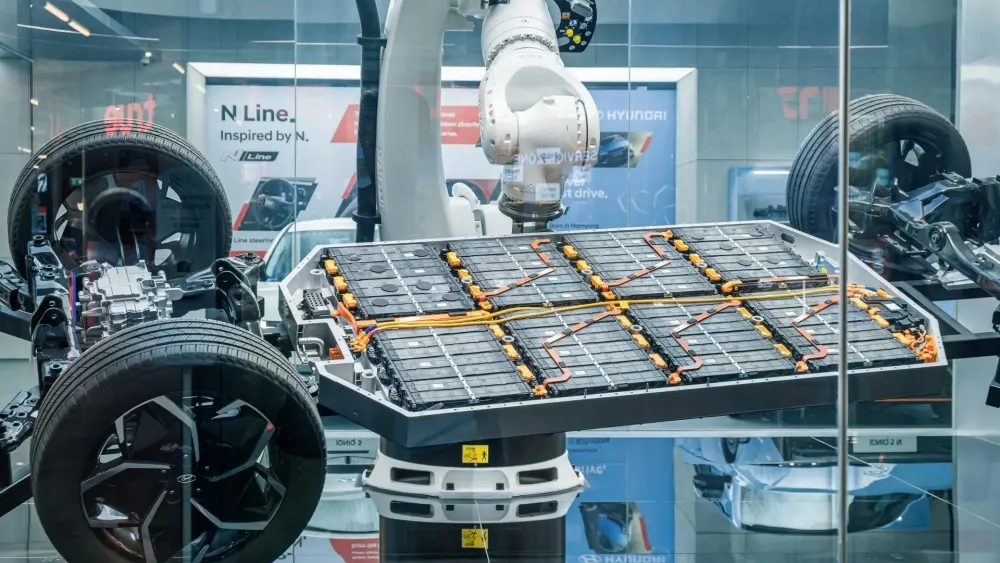
After analyzing 500,000 batteries, this is the surprising best brand of electric cars
The company in question is battery diagnostics specialist Aviloo, which examined the degradation of batteries in 20 popular electric vehicle models through 500,000 battery condition checks. And this wasn’t limited to just one country—according to Insideevs, the study covered North America, South America, Europe, Asia, and Australia, and it took place between 2022 and 2026.
But there’s more, highlighting the scale of this study and its importance in identifying the best electric vehicle brand. The 500,000 battery inspections were conducted at three intervals: 50,000 kilometers, 100,000 kilometers, and 150,000 kilometers. And one single brand stands out across all three intervals. Again, it’s neither BYD nor Tesla.
Before moving on, we need to explain that Aviloo’s study score indicates approximately the percentage of total range that the batteries in these electric cars retain at the time of testing. Thus, a score of 95% means that electric cars of this brand or model will retain 95% of their original range.
In this context, the surprisingly best brand of electric cars in terms of battery longevity is none other than Hyundai. This aligns with findings from other battery studies as well.
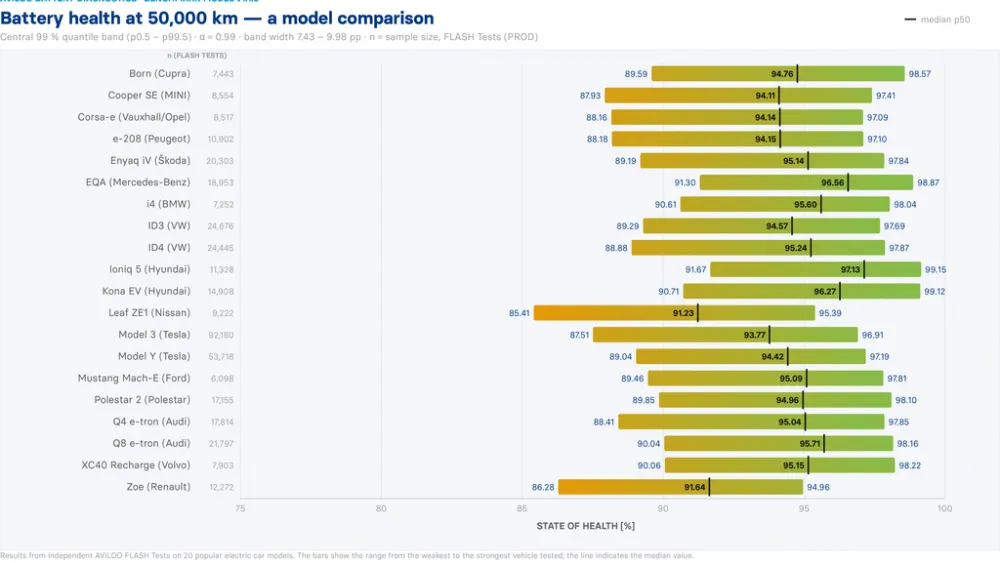
Behind this surprising brand, Mercedes, BMW, and Volvo stand out
This study confirms it, estimating that over a distance of 50,000 km, the Hyundai Ioniq 5 had the best battery condition among the models tested. With an average capacity of over 97%, it performed almost like a new electric vehicle. Following closely was the Mercedes EQA, at 96.56%.
That said, within this range—and aside from exceptions like the Nissan Leaf—read our review of its latest generation—and the Renault Zoe—all electric cars achieved an average battery health level of 94% or higher. According to Aviloo, the exceptions with the Nissan and Renault are due to their smaller batteries, which require more charging to cover the same distance. Naturally, these additional charging cycles further degrade the battery over time.
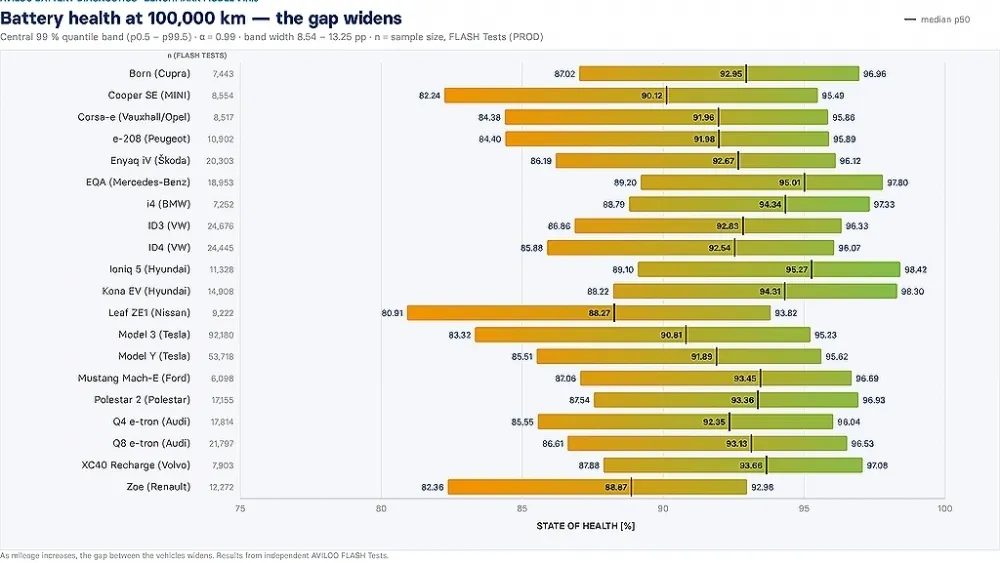
With twice the driving distance of 100,000 km, the Ioniq 5 once again came out on top, retaining over 95% of its battery capacity. Alongside it was the EQA, also at 95%; another model from the Korean brand, the Kona EV, scored 94.3%, and the BMW i4 also achieved 94.3%.
After 150,000 kilometers, the battery condition of these 20 electric cars stabilized between 90% and 94%. However, the previously mentioned Hyundai Ioniq 5 and Mercedes EQA were almost tied for first place, with capacities of 93.79% and 93.97%, respectively. The Hyundai Kona EV showed a battery health level of 92.95%.
Meanwhile, after 150,000 kilometers, the two Tesla models involved in this study—the Model Y and Model 3—fell in the middle to lower range of the study, with average battery health levels of 90.3% and 88.94%, respectively. What about BYD? Well, none of the Chinese manufacturer’s models were included in this study.
Even if you already own electric cars from the renowned Korean brand, Tesla, BYD, or Mercedes, the news for electric vehicle owners is encouraging. According to this study involving 500,000 battery inspections, these batteries show little degradation even after 150,000 kilometers. That said, after such a mileage, a 10% reduction in range does seem reasonable.