
New vehicle registrations in October 2026: Electric cars at 37 percent
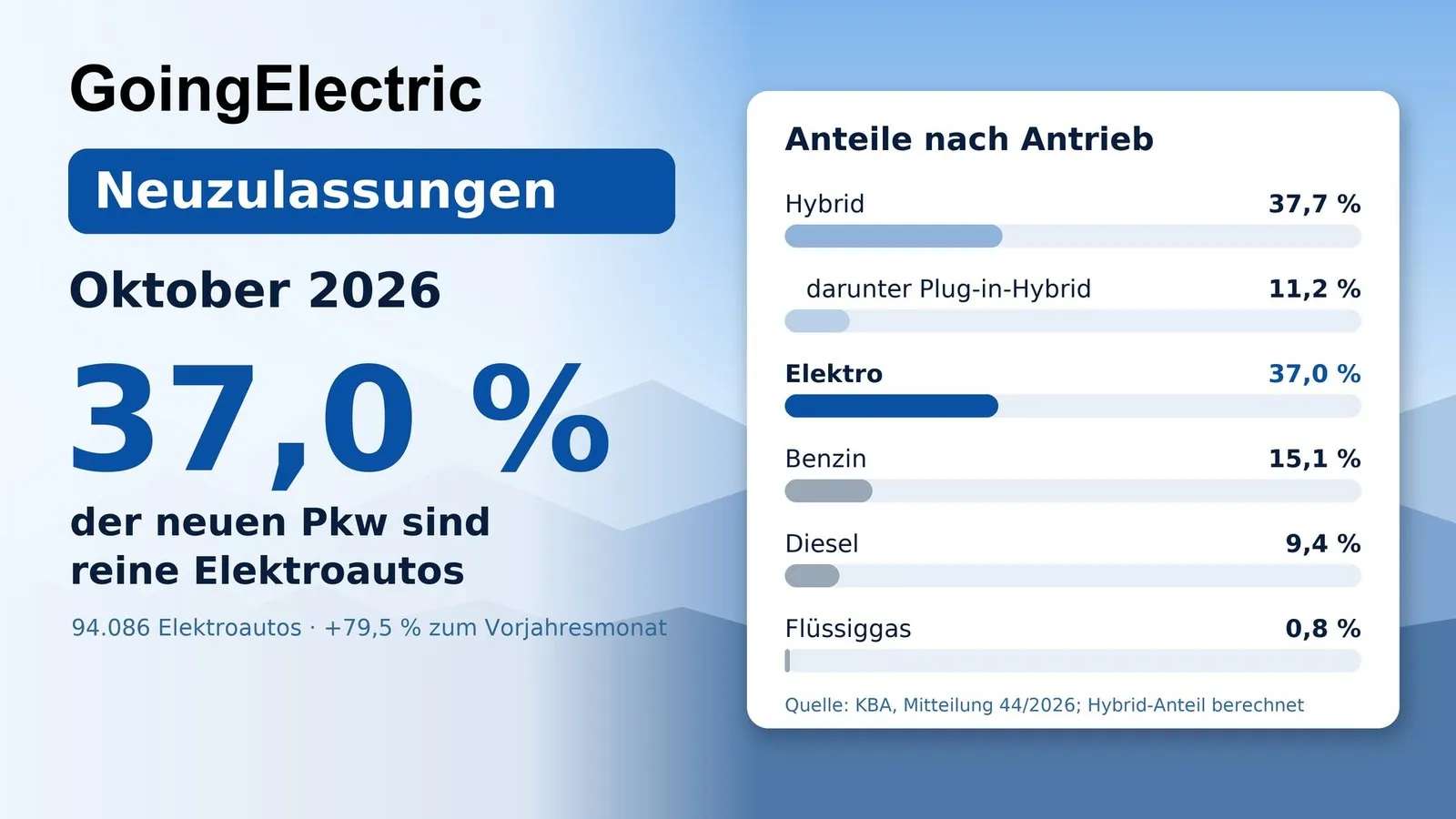
In October 2026, 94,086 electric cars were newly registered, 79.5 percent more than in the previous month. Their market share was 37.0 percent, while the number of gasoline cars decreased by 40.5 percent, with their share dropping to 15.1 percent.
Advertisement
In October 2025, pure electric vehicles accounted for 21.0 percent of new registrations, while that figure rose to 34.5 percent in September 2026. Now, the Federal Motor Transport Authority (KBA) has released the figures for October 2026. A total of 254,492 passenger cars were newly registered in Germany, which is 1.7 percent more than in the previous year’s month and 0.9 percent less than in September. From January to October, 2,476,290 passenger cars were newly registered, representing a 4.9 percent increase. Private new registrations rose by 20.6 percent in October, reaching 40.7 percent, while commercial registrations declined by 8.2 percent.
Power Types: Electric Vehicles at 37 Percent
Battery electric vehicles (BEVs) saw a 79.5 percent increase in new registrations at 94,086 units compared to the previous month. Compared to September, which saw 88,599 electric cars, this represents a growth of around 6.2 percent. Their market share was 37.0 percent, meaning more than one in three new passenger cars were fully electric.
The nearly largest group was made up of vehicles with hybrid powertrains: 95,931 new cars (-5.6 percent) fell into this category, accounting for around 37.7 percent of total registrations. Of these, 28,499 were plug-in hybrids, whose number decreased by 7.9 percent, resulting in a share of 11.2 percent. Excluding plug-in hybrids, the remaining hybrids totaled 67,432 vehicles, representing about 26.5 percent. Together, vehicles with plug-in capabilities—i.e., electric cars and plug-in hybrids—reached 122,585 units, accounting for roughly 48.2 percent of all new registrations.
There were 38,516 new registrations for gasoline vehicles, 40.5 percent fewer than in October 2025. Their share dropped to 15.1 percent. For diesel cars, the KBA recorded 23,882 units (-21.6 percent), accounting for 9.4 percent. Gasoline and diesel vehicles combined totaled 62,398 units, representing around 24.5 percent. In addition, there were 2,065 vehicles powered by liquefied gas, a 121.6 percent increase, with a share of 0.8 percent.
Advertisement
Brands: BYD and MG Roewe are growing, while Opel and Hyundai are declining
The brand table in this KBA report includes all types of propulsion systems and does not show the number of electric vehicles per brand.
German Brands
Smart recorded the highest percentage growth among German brands at 59.5 percent, accounting for 0.3 percent of the market. Mini also saw double-digit growth at +25.0 percent (1.7 percent), followed by MAN at +12.0 percent (0.0 percent). Mercedes saw an increase of 8.5 percent, reaching a 10.3 percent market share. BMW remained virtually at the same level as the previous year with a +0.1 percent increase, reaching 9.3 percent.
Declines were observed in Opel (-24.1 percent/4.0 percent), Ford (-9.8 percent/2.9 percent), Audi (-8.4 percent/6.9 percent), Porsche (-5.7 percent/0.9 percent), and VW. VW’s new vehicle registrations dropped by 4.0 percent, but it still remained the most dominant brand with a 18.2 percent share of the market.
Import Brands
Among imported brands with a share of at least 1.5 percent, BYD achieved the strongest growth with 5,173 new registrations and a 54.3 percent increase, bringing its share to 2.0 percent. MG Roewe (+48.5 percent/1.6 percent), Mazda (+23.5 percent/1.5 percent), Kia (+19.4 percent/2.4 percent), Dacia (+15.4 percent/2.7 percent), and Citroën (+10.0 percent/1.8 percent) also saw double-digit growth. Renault (+7.8 percent/2.2 percent) and Fiat (+7.4 percent/1.7 percent) experienced single-digit growth.
Below their previous year’s levels were Hyundai (-15.3 percent/2.7 percent), Skoda (-12.1 percent/7.7 percent), Seat (-8.7 percent/4.8 percent), Toyota (-7.5 percent/2.7 percent), Volvo (-4.1 percent/1.7 percent), and Peugeot (-1.0 percent/1.9 percent). Skoda remained the most prominent imported brand in terms of share.
According to the KBA brand table, several brands with high growth rates were below the 1.5 percent threshold. Tesla recorded 2,932 new registrations (+290.9 percent/1.2 percent), down from 4.9 percent in September. From January to October, the total was 47,742 vehicles (+206.1 percent/1.9 percent). Leapmotor achieved 3,661 vehicles (+288.6 percent/1.4 percent), while Xpeng had 1,380 vehicles (+284.4 percent/0.5 percent).
Segments: SUVs ahead of small cars and compact cars
SUVs once again accounted for the strongest segment, making up 37.8 percent with a 13.3 percent increase. Followed by compact cars (+9.1 percent/13.7 percent) and the compact class (-15.3 percent/13.6 percent). Minis saw the largest growth at 20.6 percent, representing 2.8 percent of the market. The luxury class (+11.1 percent/0.6 percent), utility vehicles (+3.6 percent/4.4 percent), and upper mid-size class (+1.3 percent/5.4 percent) also experienced increases.
Declines were observed in mini vans (-41.6 percent/0.5 percent), sports cars (-22.2 percent/0.4 percent), motorhomes (-20.2 percent/1.3 percent), large vans (-15.6 percent/1.2 percent), mid-size cars (-7.0 percent/8.0 percent), and SUVs (-6.4 percent/9.8 percent).
Vehicles for Commercial Use, Motorcycles, and Used Car Market
In the commercial vehicle sector, new registrations for buses rose by 39.2 percent, for tractors overall by 13.1 percent, and for trucks by 10.3 percent. Semi-trucks saw an increase of 19.6 percent, while other motor vehicles increased by 12.5 percent. Motorcycles recorded a rise of 25.4 percent. In total, 304,375 motor vehicles (+3.6 percent) and 20,997 trailers (-1.6 percent) were newly registered in October.
In the used car market, 619,460 motor vehicles changed ownership, 2.6 percent fewer than in October 2025. For passenger cars, there were 540,596 ownership transfers (-3.3 percent). The number for trailers was 35,771, 1.3 percent higher than in the previous year’s month.