
The new Voyah Passion S plummets headfirst through the tunnel
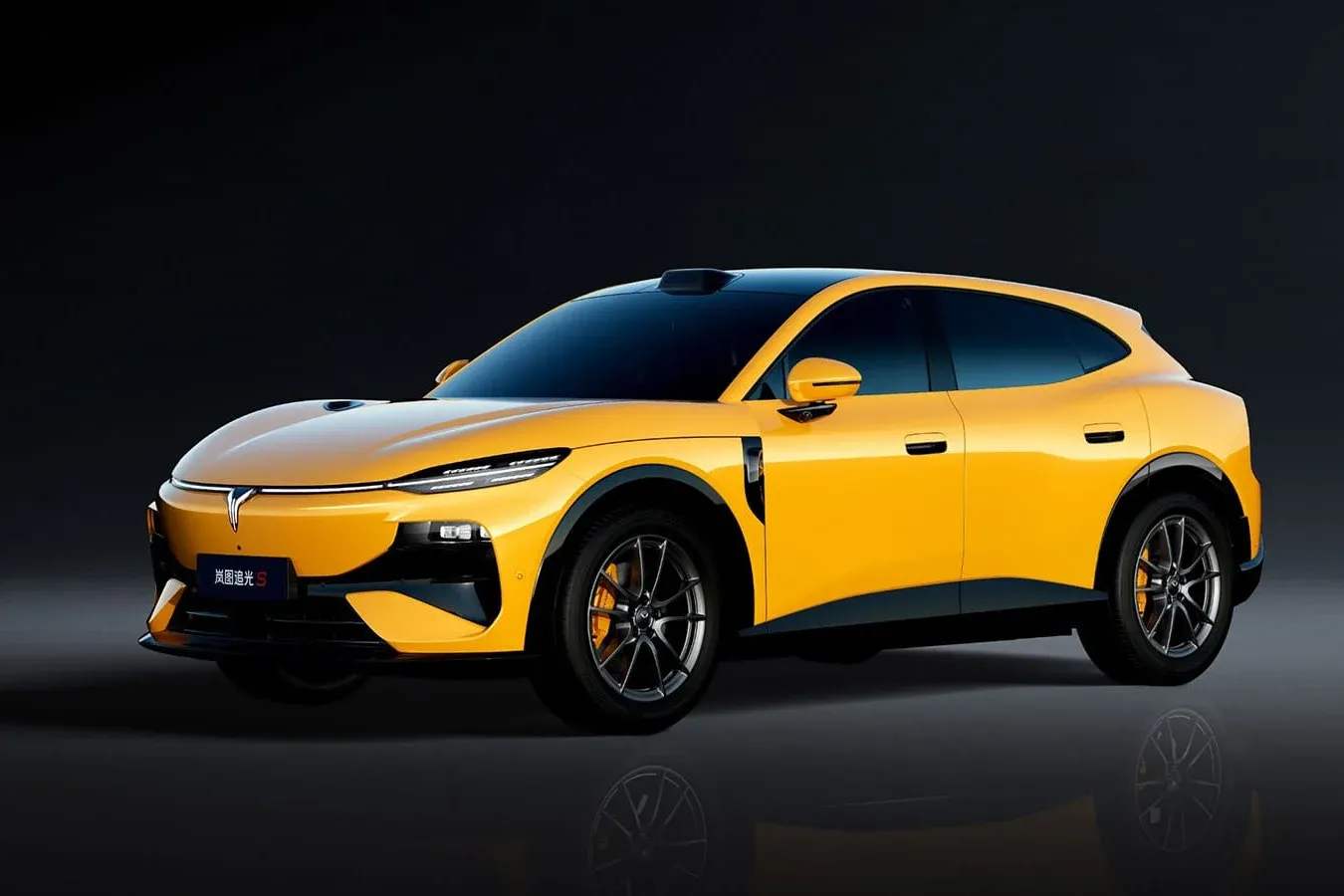
Voyah highlighted its new electric SUV, the Passion S, with a spectacular looping maneuver above a tunnel ceiling. But behind this Mercedes-style marketing stunt lies more: 800-volt technology, a range of up to 740 kilometers, and a competitive price point for the Chinese market.
Voyah drew attention to its new electric SUV, the Passion S, with a spectacular tunnel stunt: this over five meters long electric vehicle completed a full 360-degree loop in Wuhan, briefly driving upside down along the tunnel ceiling. Now, this Dongfeng luxury brand has launched the coupe-style SUV in China. Equipped with 800-volt technology, a CLTC range of up to 740 kilometers, and prices starting at 229,900 yuan (approximately 29,500 euros), the Passion S is aimed at competing with models like the Xiaomi YU7.
The template for this unusual marketing campaign is already 16 years old: In 2010, Mercedes-Benz showed a SLS AMG driven by Michael Schumacher in a commercial, seemingly performing a loop through a tunnel. However, it is not definitively proven that this maneuver was actually carried out in that form for the advertisement at the time. Voyah has now adopted this concept for the much larger and heavier Passion S.
According to the manufacturer, the Passion S drove at about 130 km/h into the steep wall of a closed test tunnel in Wuhan. It is said that a steering angle of around 16 degrees was required to do so. Voyah claims it was a standard vehicle, not one modified specifically for this test. This claim by the manufacturer has not been independently verified.
After initial doubts arose online about the heavily staged promotional video first released, Voyah published an unedited footage of the successful attempt. This version shows the entire flight path, with the maneuver appearing less flawless than in the promotional clip. Additionally, footage from a previous failed attempt is circulating, in which a camouflaged Passion S lost contact with the tunnel wall and crashed.
Voyah Passion S: Up to 475 kW and two battery sizes
Far from being a marketing stunt, Voyah positions the Passion S as a large, sporty electric SUV. With a length of 5.05 meters, width of 1.998 meters, and height of 1.656 meters, its size is roughly comparable to the Xiaomi YU7. The wheelbase measures exactly three meters. Voyah markets the Passion S as a so-called “FUV,” although it does not represent an established vehicle category.
In China, three versions are available: the two rear-wheel-drive models each deliver 300 kW of power and 390 Nm of torque. The base model pairs this powertrain with an 81.6 kWh LFP battery and is claimed to offer a range of 630 kilometers according to China’s CLTC cycle. With the larger 98.1-kWh battery, the standard range increases to up to 740 kilometers. Voyah states that acceleration from 0 to 100 km/h takes 6.7 or 6.9 seconds, respectively.
The top model is equipped with two electric motors. In addition to 300 kW at the rear axle, there are 175 kW at the front, resulting in a system power of 475 kW and a maximum torque of 765 Nm. According to the manufacturer, this all-wheel-drive vehicle accelerates from 0 to 100 km/h in 4.5 seconds and can travel up to 700 kilometers on a CLTC cycle thanks to its battery with a capacity of 98.1 kWh as well. While the rear-wheel-drive versions have adaptive dampers, the all-wheel-drive version also comes with a height-adjustable air suspension.
800 Volts and ten minutes to go from 20% to 80%
All variants share an 800-volt architecture using silicon carbide technology. According to Voyah, the LFP batteries support a charging rate of up to 5C. The manufacturer states that it takes ten minutes to charge from 20% to 80%, regardless of battery size. Voyah has not yet specified a concrete maximum DC charging power in kW. Additionally, the Passion S features Vehicle-to-Load (V2L) capability with a power output of up to 6 kW.
For auxiliary systems, Voyah relies on Huawei’s technology. Qiankun ADS 5 is standard across all three variants. A total of four LiDAR sensors are installed, including a so-called 896-line LiDAR at the front of the vehicle, along with three additional sensors for close-range monitoring. In total, the Voyah features 33 sensors. Inside, Huawei’s HarmonySpace 5.2 software is also used.
Voyah states that the trunk volume ranges from 584 to 1,744 liters, with an additional 80-liter frunk space. Other features include frameless doors, an adaptive rear spoiler, and wheels up to 21 inches in size.
Passion S starts just below the Xiaomi YU7
The regular list prices are 229,900 yuan (around 29,400 euros) for the base model, 255,900 yuan (around 32,700 euros) for the rear-wheel-drive version with a large battery, and 279,900 yuan (around 35,800 euros) for the all-wheel-drive version. Upon launch, Voyah is offering these models at temporarily lower prices.
The Passion S starts in China at a slightly lower price than the Xiaomi YU7, whose model range begins at 233,500 yuan (around 29,900 euros). A direct comparison with European vehicle prices is only limitedly meaningful, as taxes, tariffs, and other costs associated with a potential European launch are not taken into account.
It remains unclear whether the Passion S will even reach Germany or other European markets. Stellantis and Dongfeng signed a non-binding letter of intent in May 2026 to form a joint company that would, among other things, distribute Voyah models in selected European markets. However, no specific launch of the Passion S in Europe was announced at that time.
With the Passion S, Voyah introduces a technically ambitious electric SUV to the Chinese market, competing in an increasingly competitive segment with its fast charging speed, large battery capacity, and advanced driver assistance features. The tunnel-looping demonstration likely ensured the model received the attention it sought at launch.