
New hydrogen alliance finalizes plans — but only a little
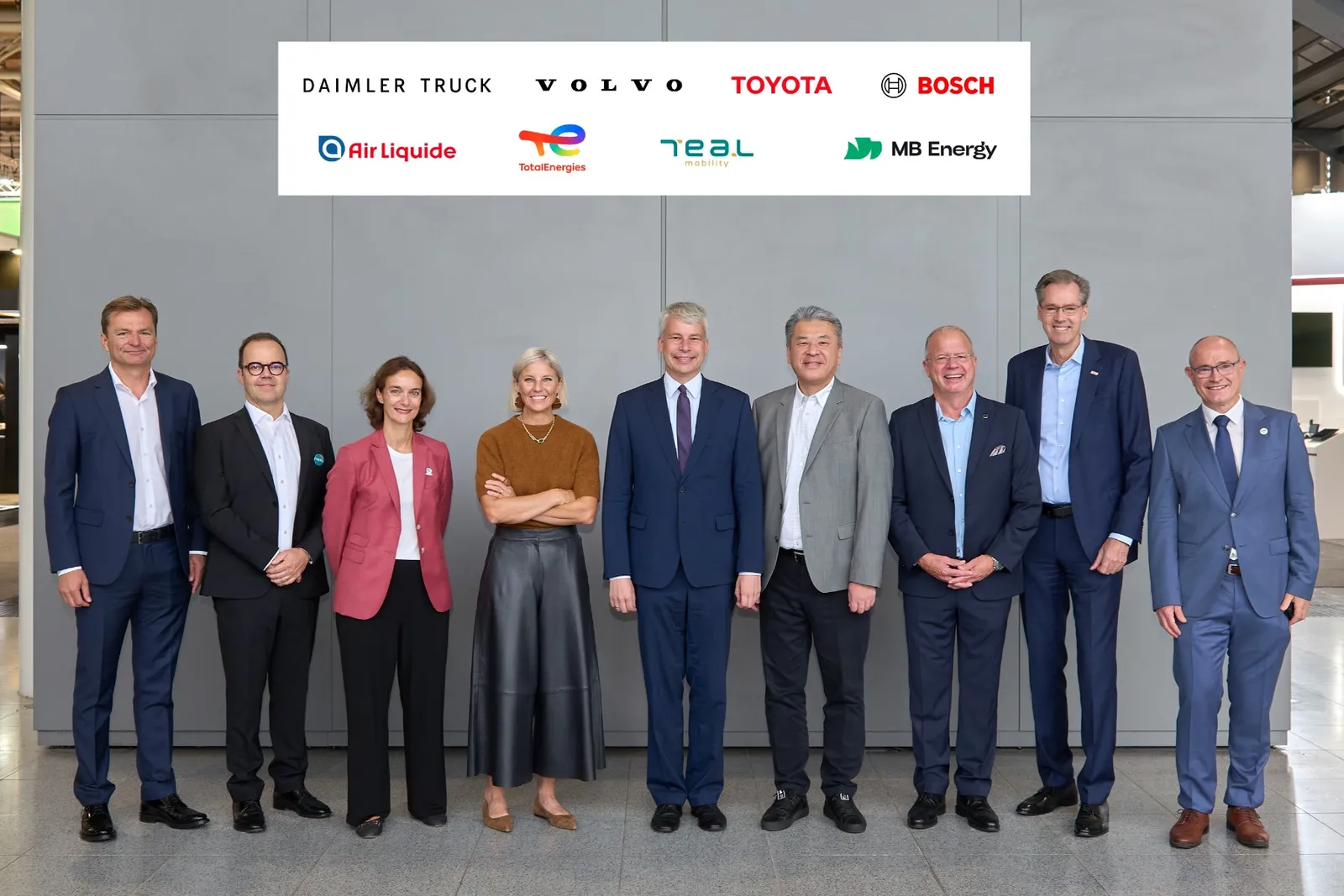
At IAA Transportation, Daimler Truck, the Volvo Group, Toyota, Bosch, Air Liquide, TotalEnergies, TEAL Mobility, and MB Energy presented their plans to accelerate the adoption of hydrogen-powered vehicles in Europe. The details are not very specific, but the goal is to scale up hydrogen trucks by 2030.
New Alliance for Hydrogen in Freight Transport
Image: Daimler Truck
A few days ago, the eight companies already announced their intention to introduce their new hydrogen alliance at the IAA Transportation in Hanover. This has now been done. The goal is to create a German ecosystem that meets all the requirements for the scalable use of hydrogen trucks by 2030. This ecosystem is intended to be supported by political backing and European industry leaders throughout the entire value chain.
However, the plans presented are rather vague and partly already well-known – but the IAA Transportation certainly provided an excellent platform to attract Federal Transport Minister Steffen Bilger (CDU) to the opening event. Without such political support, hydrogen trucks would likely be dead in Germany and Europe by now. After all, the range of fully electric trucks is now excellent – raising the question of whether there really is still a need for an ecosystem for hydrogen mobility, whose green production remains hardly scalable at present.
But let’s take a look at what the various partners involved in the alliance for hydrogen in commercial vehicles plan to do:
- Daimler Truck will put a small batch of 100 units of an H2 tractor truck named Mercedes-Benz NextGenH2 Truck into customer use by the end of 2026 – this has been known since January, and it is supported by a subsidy of 226 million euros from the federal government and the states of Rhineland-Palatinate and Baden-Württemberg. Meanwhile, the first trucks equipped with hydrogen combustion engines are set to be prepared for market launch next year. Overall, Daimler Truck aims to invest a several hundred million euro amount in hydrogen trucks by the end of the decade.
- The Volvo Group is advancing its hydrogen portfolio and investing substantial sums in hydrogen-powered vehicles for market launch by 2030, including both fuel cell trucks and trucks with hydrogen combustion engines.
The goal of the alliance is, among other things, to launch H2 fueling stations that can service up to 100 hydrogen trucks per day. The partners also benefit from EU regulations under the Alternative Fuels Infrastructure Regulation (AFIR), which require hydrogen fueling stations to be installed along major traffic routes. To meet the requirements of AFIR, the federal government issued a funding call in January, providing 220 million euros to support the construction of hydrogen fueling stations and fuel cell or hydrogen internal combustion engine trucks.
The funding for this “hydrogen pilot network” was overestimated, with an applied amount of 455 million euros. A total of 71 applications were submitted for hydrogen refueling stations and 455 for vehicles and vehicle fleets. The new hydrogen alliance sees this as confirmation of “strong commercial demand from the logistics industry.” Project selection will now take place “through a competitive process based on previously established criteria,” according to the statement. Applicants with approved applications will be notified in the second half of the year.