
“Grid Integration from Practice” – Sebastian Ewert, LichtBlick eMobility
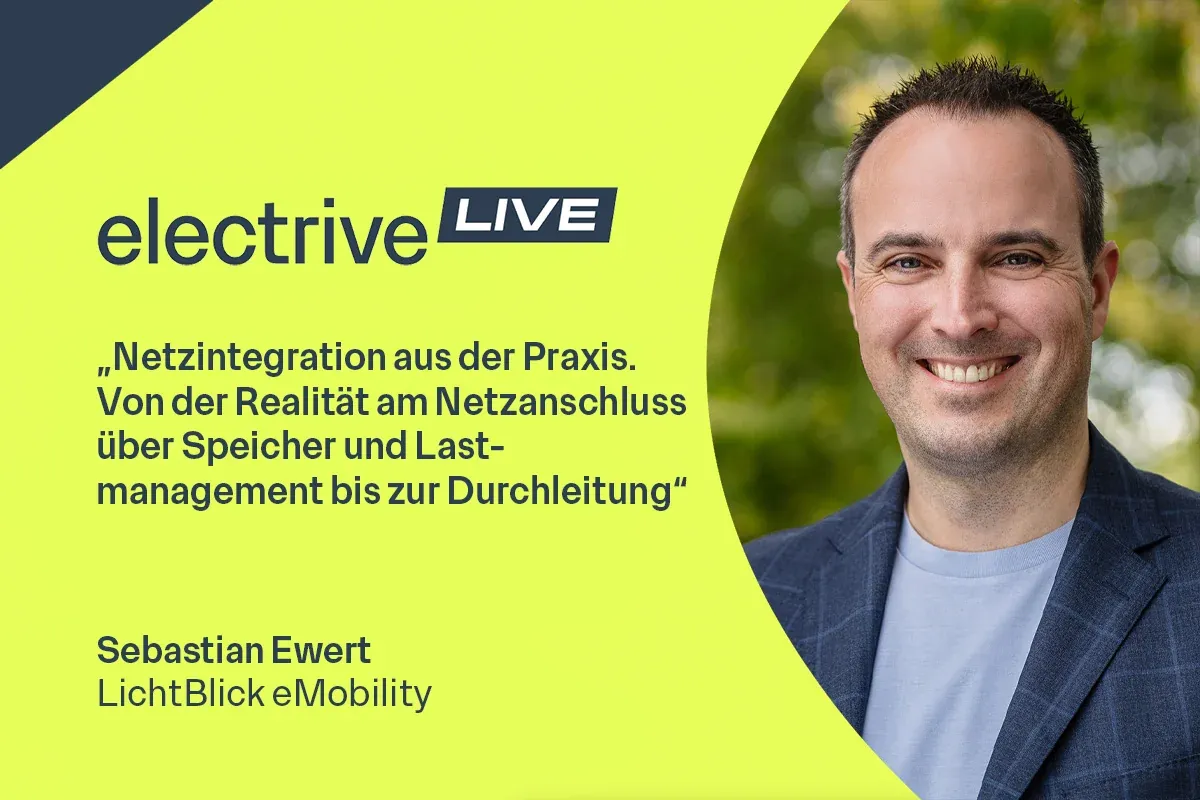
"We complain at a high level, but we won’t get anywhere if we really want to scale." With this clear statement, Sebastian Ewert, Managing Director of eMobility at LichtBlick eMobility, began his presentation at electrive LIVE. Under the title "Grid Integration from Practice," the industry expert described the everyday challenges in building fast-charging infrastructure for electric cars and electric trucks.
When establishing fast-charging parks at supermarkets or traffic hubs, LichtBlick frequently encounters administrative obstacles. In Germany, project developers deal with over 850 different distribution network operators. This diversity leads to severe fragmentation, as fundamental technical requirements are often implemented very differently, even though they follow identical DIN standards and VDE requirements. Standardization remains virtually non-existent in practice.
In addition, long processing times and a lack of digitization pose a huge obstacle. “There are utility providers that get in touch after four weeks. There are others that don’t respond at all after ten months.” Even when offers are available, the allocated capacity is often limited to a minimum. Ewert reported cases where a planned charging station requiring 800 kVA only received approval for 50 kW. Such uncertainty significantly hinders the refinancing of investments in the six-figure range.
LichtBlick is placing greater emphasis on battery storage
To overcome long wait times for grid upgrades while still offering customers high charging speeds, LichtBlick is increasingly relying on battery storage systems behind the power connection. This allows for attractive charging options even at weak low-voltage connections. If the utility provider only provides 80 kW, the capacity can be temporarily increased to over 400 kW through the storage system. This enables drivers to recharge enough for the entire week while making a quick stop at the supermarket.
Es is especially in heavy freight transport, for which LightBlick is currently installing electric truck charging stations in Baden-Württemberg together with Regioladen+, that this technology seems almost inevitable. “In the truck sector, we assume there will be no charging parks without battery storage, because the grid connections become extremely expensive once we reach megawatt levels.” Batteries also enable the use of variable electricity prices on the market. By charging the storage system at low market prices and discharging it during peak times, operating costs can be significantly reduced.
Flexible connections and a look at European neighbors
Another option to improve the utilization of existing grids is flexible grid connection contracts. With these, power injection or consumption is dynamically or statically throttled when shortages are likely. However, many grid operators lag behind in implementing this practically, as their internal systems are not yet designed for controllable loads.
A look at other European countries shows that the energy transition can function digitally and efficiently. In the Netherlands or Slovenia, the rollout of smart metering systems is nearly complete, while Germany falls short of its own goals. “Why have we spent so much time over the past ten years focusing on ourselves in the energy sector rather than on what we actually need to advance the energy transition?”
Creating incentives through feed-in tariffs and dynamic pricing
To ensure smooth operation, Ewert calls for faster virtual balancing and transmission of green electricity. Only in this way can price signals be transmitted directly to charging stations to motivate consumers to charge in a way that benefits the grid. “With storage, smart control, and transmission, we can maximize the use of today’s grids,” says the eMobility expert from LichtBlick. When policymakers, grid operators, and charging infrastructure providers work together, the existing grid can be utilized much more efficiently.
Would you like to watch the entire presentation? Use our video player above the article or go to YouTube.