
Munich has begun testing autonomous on-demand electric vehicles
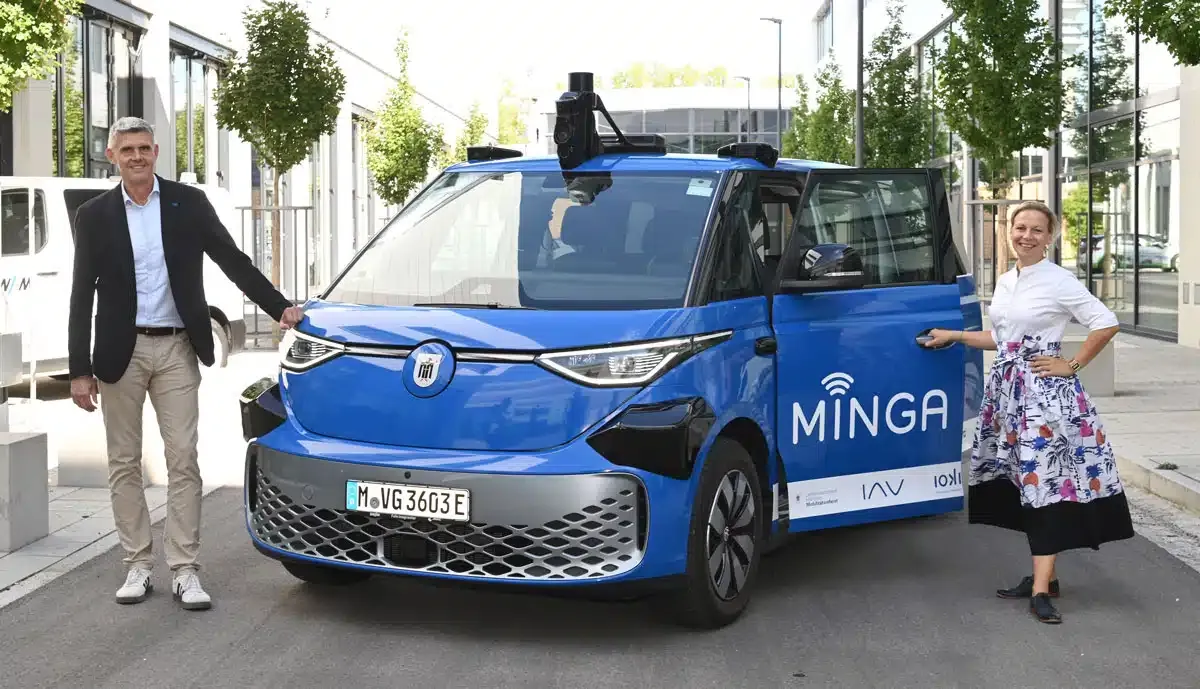
Image: MVG
Munich’s city utilities company (SWM), the Munich Transport Company (MVG), and the Engineering Society for Cars and Transportation (IAV) have launched a test operation of autonomous on-demand vehicles in public roads in Munich. Three autonomously driven electric VW ID. Buzz vehicles are being used in the Gern district of Neuhausen-Nymphenburg for this purpose. In the initial phase, these minibuses operate without passengers and with safety drivers aboard.
The test is part of the MINGA research project (“Munich’s automated public transport with ridepooling, single buses, and bus platoons”). The vehicles initially operate on designated routes, collecting data on driving behavior, environmental perception, traffic interaction, and operational stability.
“With the start of these test runs, autonomous public transport will appear on Munich’s streets for the first time. This phase is crucial for us to integrate technology, operation, and safety under real conditions and make them scalable,” explains Sinaida Cordes from SWM/MVG. “In this way, we gain valuable experience on how autonomous on-demand services can effectively complement existing public transportation in the future.”
IAV has developed a shuttle based on the VW ID. Buzz, equipped with sensors and self-driving software. This electric vehicle can perceive its surroundings, analyze traffic conditions, and drive autonomously along predetermined routes. Throughout testing, safety drivers monitor operations and can intervene at any time.
Gradual Approach to Passenger Service
The basis for these tests is a testing permit under the Regulation on the Authorization and Operation of Vehicles with Autonomous Driving Functions (AFGBV), which SWM/MVG has obtained since mid-August. In addition to technical capabilities, the requirements for future passenger service are a key focus. These include aspects such as passenger information systems, interior design, safety protocols, and integration into MVG’s operations and control center. The insights gained from these test drives are intended to inform the further development of autonomous public transportation services in Munich.
If the current trial operation functions safely and reliably, the operational area is planned to be expanded in a second phase, along with the integration of ioki’s on-demand system from a technology partner. At that point, autonomous electric vehicles will receive their routes based on short-term travel requests. Trips can be booked through an app, and multiple travel requests can be combined into a single vehicle trip. Once integration is successful and all necessary adjustments are made, carrying selected trial users is also planned.
The research vehicles are recognizable as such on public roads and drive cautiously and defensively according to the officials. No special rules apply to other road users. It is noted, however, that “since unusual but always controlled driving or braking maneuvers may occur occasionally, it is wise to maintain a safe distance from the test vehicle.”
16 partners are working together on the MINGA project. By mid-2027, an autonomous shuttle bus and a bus platoon are also set to be tested under real conditions. The Federal Ministry of Transport is funding the project with around 13 million euros.
Also interesting
About the author
Thomas Langenbucher is an expert in electromobility with professional experience in the automotive industry and finance sector. Since 2011, he has been covering electric vehicles, sustainable technologies, and mobility solutions for ecomento.de. Learn more.
Reader interactions