
MPK Świdnica has launched its own power plant. Buses will run on electricity from solar and wind energy.
In the article:
The power plant has an output capacity of 1.63 MW, while the energy storage system has a capacity of 6 MWh.
Renewable energy is intended to cover about 80 percent of the buses’ electricity needs.
MPK currently has 22 electric buses, and the facility is set up to charge 30 vehicles daily.
MPK Goes Renewable
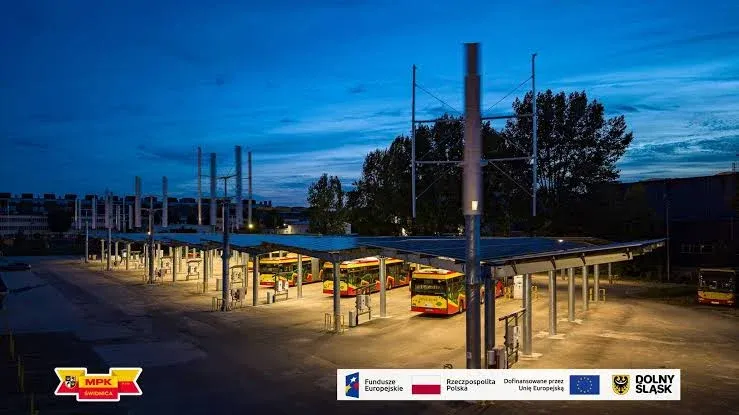
A renewable energy-powered power plant was installed at the Miejskiego Przedsiębiorstwa Komunikacyjnego depot in Świdnica on Inżynierska Street. The facility was officially put into use on October 26, 2026. Its primary function is to generate the energy required for charging electric buses.
The scale of this project is substantial for a municipal transit operator. Nineteen tall wind turbines were built above the parking bays, and according to the data presented at the opening, 2,280 solar panels were installed on them. Their combined peak capacity is approximately 1.39 MW.
Solar power is not the only source of electricity. There are also 30 vertical wind turbines on the depot grounds, each with a capacity of 10 kW, totaling 300 kW. The entire system has a nominal output capacity of 1.63 MW. The difference between the total capacity of the energy sources and the output capacity is due, among other factors, to the way the parameters of the solar installation and its AC-operating components are determined.

A huge energy storage system. It has a capacity of 6 MWh.
A key component of the power plant is an energy storage system with a capacity of 6 MWh. This allows electricity generated during peak sunlight hours to not be used immediately. It can be stored and utilized later, especially during nighttime charging of buses.
The entire system is controlled by an energy management system that adjusts electricity production, storage, and consumption to meet the operator’s needs.
MPK states that the installation is designed to enable the charging of 30 buses daily without issues. Currently, the operator has 22 electric buses and is preparing to purchase six more. Once delivered, the electric fleet will increase to 28 vehicles.
According to MPK President Tomasz Kurzawa, the system is designed to allow the transit operator to function primarily on its own energy for about 10-10.5 months per year. During the winter period, the company will still be able to use energy purchased from the grid, notably through two municipal pantograph charging stations.
The power plant operates outside the national grid
The power plant was designed as an off-grid system, meaning an island network independent of the public electricity grid.
The energy generated on site is not sold to the grid and then repurchased by MPK. It is intended to be used locally for charging buses. This allows the transit operator not only to reduce its energy purchases but also to avoid some of the costs associated with energy distribution.
MPK assumes that its own power plant will supply about 80% of the energy needed to power the buses. The remaining demand, especially in winter, will have to be met with electricity from the grid.
This is an important caveat, as the term “own power plant” does not mean complete energy independence for the transit operator 365 days a year.
Almost 2 million zł in savings per year
The construction of the entire system cost 45.19 million zł gross. However, MPK calculates that the difference between the operating cost of a bus powered by purchased energy and the same vehicle charged with its own electricity can be at least 1.5 zł per vehicle-kilometer on average.
Theoretically, this would result in around 2.4 million zł in savings per year. Since some energy will still need to be purchased in winter, the transit operator adopts a more cautious estimate, citing around 1.9 million zł in savings annually.
According to MPK’s calculations, the repayment of costs funded by commercial loans and own funds could take place after a little over five years. When including the preferential loan from the National Reconstruction Plan, the period extends to around seven years. Of course, these calculations depend on future energy prices.
The transport operator also estimates that the installation of renewable energy sources alone will allow for a reduction in carbon dioxide emissions of about 1600 tons per year. When accounting for the replacement of diesel buses with electric ones, the overall effect is expected to be close to 3000 tons per year.
Most of the money comes from external financing
The project was not funded solely by MPK. Over 14.35 million zł came from the Fund for Just Transition. Another 5 million zł is a preferential loan from the National Reconstruction Plan, with an interest rate of 1 percent and a term of 20 years.
It is worth clarifying here the amount of over 19.5 million zł mentioned for this investment from the European Funds for Infrastructure, Climate, and Environment (FEnIKS) program. This is the subsidy amount for a broader project that also includes the purchase of six new buses. Approximately 4.1 million zł of this subsidy goes toward energy infrastructure. The remaining funding for the power plant comes from sources such as MPK’s own funds and commercial loans.
It’s not just Świdnica. Other cities also want to produce electricity for buses.
Świdnica stands out primarily due to the scale of the project and the combination of photovoltaics, wind turbines, a large energy storage facility, and islanding operation. However, the idea of generating electricity for public transportation is not unique in Poland.
Zielona Góra has very ambitious plans and is already among Poland’s leaders in electrifying public transportation. By August 2026, 72 out of 92 buses operated by the Municipal Transportation Company were electric. As part of the next phase of transportation development, the city plans to build as many as 12 solar power installations along with energy storage facilities designed specifically for charging buses. The project is scheduled to be completed by the end of 2028.

Jaworzno is moving in a similar direction, having placed strong emphasis on electric buses for years. The Local Transportation Company there is preparing to build a much larger energy storage facility with a capacity of 8 MW and a storage volume of 14.88 MWh. Renewable energy installations are also planned in the bus depot area and along bus routes.
Warsaw is expanding its energy infrastructure for transportation as well. In 2026, the Municipal Bus Company conducted a project related to the Ostrobramska depot, which includes covered bus bays equipped with photovoltaic panels and energy storage systems.
Świdnica has gone a step further by integrating all these elements into one cohesive system designed almost exclusively for electric buses. The MPK president describes this installation as the first of its kind in Poland and notes that no similar operational system has been found in Europe either.
Piotr Sobczyk