
MYA Energy already has 100 own charging stations. The charging market in Poland is rapidly expanding.
In short:
The anniversary location of the charging station was set up in Szczecin and offers a capacity of 400 kW
Thus, Moya energia can now boast of having 100 charging stations and 272 own charging points
By the end of 2026, the operator aims to increase this number to nearly 350
GrenWay is by far the market leader in the charging infrastructure sector
Moya energia is catching up
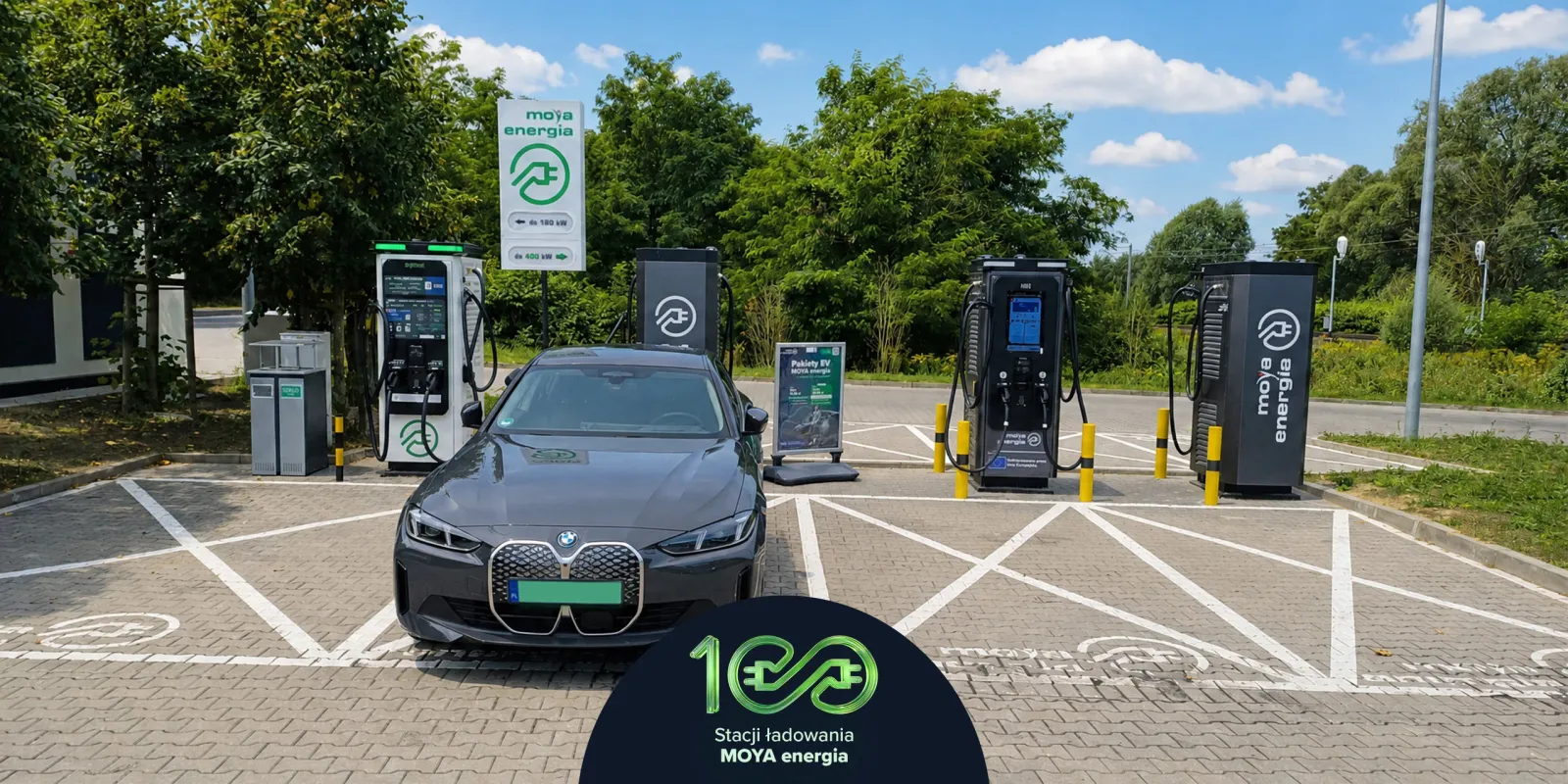
Moya energia remains a much smaller operator compared to the biggest players who have been in the Polish market for years, but it is expanding its network at a rapid pace. The 100th own charging station was opened at Rymarskiej 127 in Szczecin, near highway A6 and express road S3. This location is designed to serve both local traffic and drivers heading toward border crossings in Kołbaskowo and Pomellen, as well as further into Germany.
This is not a single charger located at a gas station, but a larger hub. Drivers have access to eight stations with CCS2 connectors. The first station there, with a capacity of 180 kW, was launched in January 2026, and now three more units have been added, each with a capacity of up to 400 kW.
100 stations does not mean 100 charging points
When describing infrastructure, it is important to distinguish between stations and charging points. One station can serve more than one vehicle at the same time, so the number of charging points is greater than the number of devices or locations alone.
MOYA energia currently operates 100 of its own stations, but together they provide 272 charging points. It is the number of charging points that better indicates how many drivers can use the infrastructure simultaneously.
For comparison, according to the Polish Association for New Mobility (PSNM), as of the end of July 2026, there were 13,454 public charging points in Poland. Of these, 6,751, or 50.2%, were fast DC charging stations. Just a few years ago, most of the infrastructure consisted of much slower AC devices.
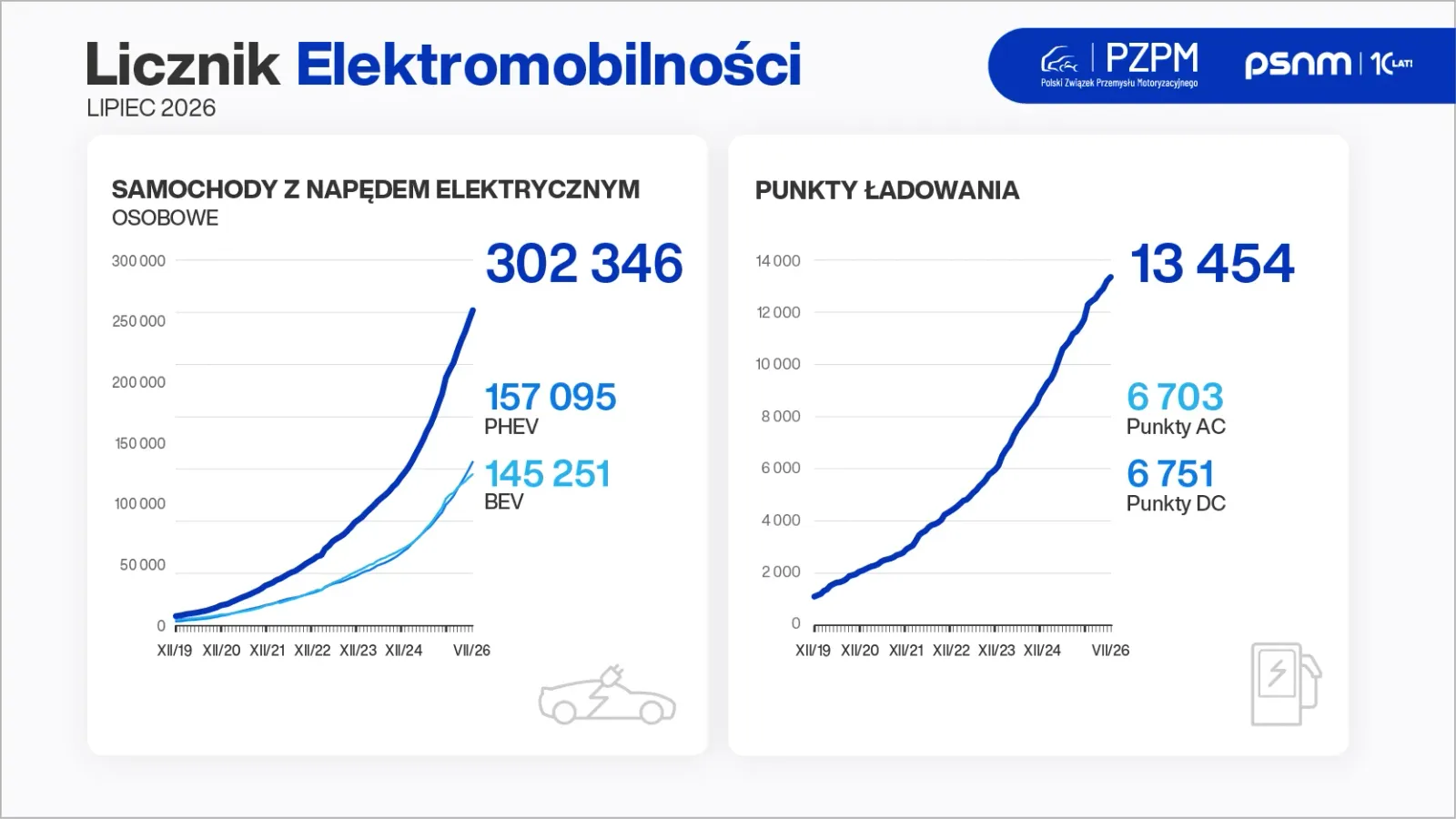
Thus, it’s not only the number of chargers that is changing, but also their capacity. Operators are increasingly building multi-station hubs equipped with devices capable of 200-400 kW instead of using individual 50 kW chargers.
MOYA aims to have nearly 350 charging points this year
The expansion pace is set to remain high. Anwim plans to launch nearly 40 more hubs by the end of 2026, primarily along highways, key transportation nodes, and European transport corridors.
The number of MOYA energia’s own charging points is expected to rise from the current 272 to nearly 350. Devices with capacities ranging from 60 to 400 kW are available.
The operator is expanding its network in two ways. Some chargers are installed at MOYA gas stations, which now number over 550, but the company is also building infrastructure on properties owned by external partners. Anwim also funds its own locations that are not directly linked to gas stations.
In subsequent phases, chargers for electric trucks are also set to be introduced. This is a direction in which other major operators are already investing as well. ORLEN launched the first public stations in Poland with MCS connectors for trucks along A1 in September, enabling power outputs of up to 1.5 MW.
There are over 11,000 charging points in the app, but most do not belong to the MOYA network.
Anwim also states that users of the Super MOYA app have access to over 11,000 charging stations. However, this number should not be confused with the size of the operator’s own network.
The operator owns 272 charging stations. The rest are available through roaming agreements, meaning partnerships with other operators. A driver can start charging and pay for the session via the MOYA app, even if the device itself belongs to another company.
This is a common solution in the market. GreenWay works similarly, allowing its customers to use not only its own infrastructure but also a extensive network of partners in Poland and other European countries.
Roaming increases convenience but also has price implications. The rate at a charging station owned by another operator may differ from the price offered directly by that operator.
How much does charging at MOYA energia cost?
MOYA uses different prices depending on the location and power of the device. According to the pricing list published in July 2026, DC charging at 60 kW at its own stations typically costs 1.99–2.09 PLN/kWh. At 120 kW, the rates are 2.29–2.49 PLN/kWh, while for devices at 180 and 400 kW they are usually 2.49–2.69 PLN/kWh. Drivers can see the exact price for a specific station in the app or on the terminal.
In addition, there are two subscription packages. Start costs 19.90 PLN for 30 days and reduces the price of each kWh by 25 groszy. Turbo costs 59.90 PLN and offers a discount of 50 groszy/kWh. According to MOYA’s calculations, the cost of the package is recouped at around 80 kWh per month for Start and 120 kWh for Turbo.
On the occasion of opening the hub in Szczecin, the operator has prepared an additional promotion. From September 11 to 13, users with the Turbo Package will pay 1 zł/kWh there. After the promotion ends, the regular rate for this package is 1.50 zł/kWh.
A price-diverse market
Public charging in Poland does not have a single price. Differences between operators, locations, and subscription plans currently exceed 1 zł per kWh.
GreenWay’s basic Energia Standard plan, without a monthly fee, currently charges 2.99 zł/kWh for DC charging. Energia Plus reduces the price to 2.40 zł/kWh, while Energia Max lowers it to 2.10 zł/kWh. In September, the monthly fees for these two packages are 4.99 zł and 39.99 zł respectively as part of the promotion. The operator also has selected locations under the “Map of Good Prices” program, where charging costs 1.50 zł/kWh or less.
ORLEN simplified its pricing structure starting in April 2026. Each DC charge costs 2.69 PLN/kWh regardless of the device’s power, while AC charging is 1.95 PLN/kWh. After 60 minutes at DC stations, a parking fee of 0.40 PLN per minute may apply.
Another provider uses Ionity, focusing on ultra-fast stations along routes. Without a subscription, direct charging costs 3.27 PLN/kWh in Poland. The Motion package reduces the rate to 2.42 PLN/kWh with a monthly fee of 28.50 PLN, while the Power package brings it down to 1.94 PLN/kWh with a monthly subscription fee of 51.50 PLN.
Powerdot operates differently. The provider does not have a single nationwide price — the rate depends on the specific location and device power. The company states that it can range from around 1 PLN to over 3 PLN/kWh.
GreenWay outside coverage
In terms of its own infrastructure, MOYA is still catching up to the largest operators. As of the end of 2025, GreenWay had 2,021 public charging points in Poland, including 1,496 owned by the company and 525 through partnerships. The network expanded by 401 points alone in 2025.
The company is heavily investing in the same format that Anwim currently focuses on. In 2025, GreenWay launched 35 ultra-fast hubs featuring 253 DC charging points with capacities up to 400 kW.
Other players in the market include ORLEN Charge, Powerdot, Eleport, Ionity, and Shell Recharge, with infrastructure increasingly being installed near supermarkets and shopping malls. Powerdot is expanding its network around Biedronka stores, while Eleport signed an agreement with NEPI Rockcastle to build 114 charging points with capacities up to 400 kW at shopping malls in 11 Polish cities.
This means competition increasingly isn’t just about who has the most chargers. Their power, number of locations in one site, proximity to major routes, reliability, and price also play important roles.
Fast chargers are starting to dominate
The expansion of MOYA aligns well with the changes in Poland’s entire market. At the beginning of 2026, fast DC stations were still in the minority. By the end of January, they accounted for 47% of the publicly available infrastructure, and by July their share had already exceeded 50%.
In the first half alone, operators launched over 1000 new fast DC stations. By the end of June, there were 6668 in operation, up from 5980 three months earlier.
At the same time, the number of vehicles that can use such infrastructure is increasing. By the end of July 2026, Poland had 158,365 fully electric passenger and commercial vehicles registered, of which 145,251 were electric passenger cars.
The hundredth MOYA energia charging station represents yet another step in the competition to attract drivers who increasingly expect not just a single charger but several or even a dozen charging points in one location. Anwim still has a long way to go to match the scale of the largest operators, but its 272 own charging points, with capacities up to 400 kW, and the announcement of nearly 40 more hubs show that the company aims to quickly narrow this gap.
Piotr Sobczyk