
MOYA energia has 100 of its own charging stations. It continues to pursue GreenWay but is already setting up 400 kW hubs.
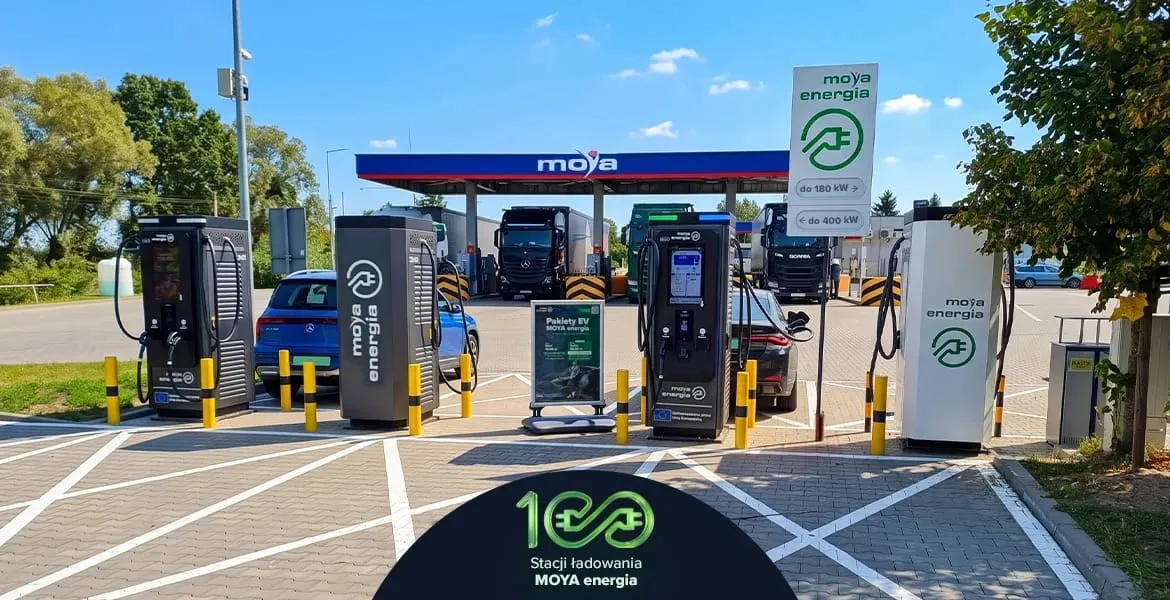
MOYA has opened its hundredth charging station in Szczecin. It is a hub at Rymarska 127 with eight CCS2 slots and a capacity of up to 400 kW. For drivers, this is another sign that in Poland, there are more and more large charging points along routes rather than individual poles.
100 stations does not mean 100 cars at once
The milestone location is near A6 and S3, so it is designed to serve not only Szczecin but also traffic heading toward Kołbaskowo, Pomellen, and further into Germany. The first 180 kW charger was installed there in January 2026, and now three more 400 kW units have been added.
It’s important to distinguish between two numbers here. MOYA mentions 100 of its own stations, but the entire network currently has 272 charging points. It is the number of charging points that better indicates how many cars can be charged simultaneously.
As of the end of July 2026, there were 13,454 publicly available charging points in Poland, of which 6,751, or 50.2%, were fast DC charging points according to PSNM. Just a few years ago, AC charging dominated. Today, the market is clearly shifting toward 200-400 kW hubs.
The goal by the end of 2026 is nearly 350 charging points
Anwim plans to launch almost another 40 hubs by the end of 2026. These are expected to be located mainly along highways, key junctions, and European transport corridors. The number of its own charging points is set to rise from 272 to nearly 350.
The company is building chargers not only at its MOYA fuel stations, which number over 550, but also on partner sites and at its own locations not directly related to fuel. Chargers for electric trucks are also in the plans. The market is accelerating here as well: ORLEN launched the first public MCS stations in Poland with 1.5 MW capacity along the A1 highway in September.
One must also be cautious about another figure mentioned by the company. The Super MOYA app shows over 11,000 charging points, but most of them do not belong to MOYA. It owns 272 of them, with the rest operating through roaming. Convenient and clear. The issue is that the price at a third-party station can differ from that of the charger’s operator.
MOYA uses a pricing structure based on power and location. At its own DC stations, 60 kW typically costs 1.99–2.09 PLN/kWh, 120 kW costs 2.29–2.49 PLN/kWh, while 180 kW and 400 kW usually cost 2.49–2.69 PLN/kWh. There are also subscription plans: Start at 19.90 PLN with a discount of 25 groszy/kWh, and Turbo at 59.90 PLN with a discount of 50 groszy/kWh. The company sets the break-even point at around 80 kWh per month for Start and 120 kWh for Turbo.
When opening in Szczecin, the operator added a promotion from September 11 to 13. Users with the Turbo package will pay 1 PLN/kWh there, after which the regular rate for this plan is set at 1.50 PLN/kWh.
Compared to competitors, MOYA remains smaller in scale. As of the end of 2025, GreenWay had 2,021 public charging points, including 1,496 its own and 525 partner-owned ones, and it opened 401 more points during 2025 alone. In addition, there are 35 ultra-fast hubs with 253 DC charging points offering 400 kW of power. GreenWay is now out of reach, but the competition has become more interesting. Especially since ORLEN charges 2.69 zł/kWh for DC charging, Ionity aims for 3.27 zł/kWh without a subscription, while Powerdot can charge anywhere from around 1 to over 3 zł/kWh.
The number of chargers itself is becoming less important, with more focus on whether there are 4–8 charging stations available, sufficient power output, and no waiting times. What’s your opinion on this trend: more large hubs along routes or still a greater need for regular charging points in cities?
LovEV Newsletter
Want more content like this?
Sign up — we’ll send you a weekly summary once the newsletter starts.