
A motorcycle without compromises? The Australian Cellcius C-01 replaces the battery with clutches.
In the article:
- What makes the Hex-Core modular battery system unique?
- Cellcius C-01 can be lighter or heavier depending on the user’s needs.
- How did the designers solve the problem of charging a motorcycle in the city?
- The Australian concept is winning awards despite still being in the design phase.
Cellcius C-01: a motorcycle that can be “loaded” with energy
One of the biggest challenges in electric mobility is finding a balance between range and vehicle weight. This issue is particularly evident in motorcycles, as every additional kilogram affects handling and driving dynamics. The Australian studio Clandestine Design Group decided to approach this problem in an unconventional way by introducing the conceptual electric motorcycle Cellcius C-01. The design has generated interest in the industry and has already won several prestigious awards, including the Australian Good Design Award 2026 in the Concept Design category, the Silver Pin at the New Zealand Best Design Awards, and the Tokyo Design Award.
Battery tailored to needs
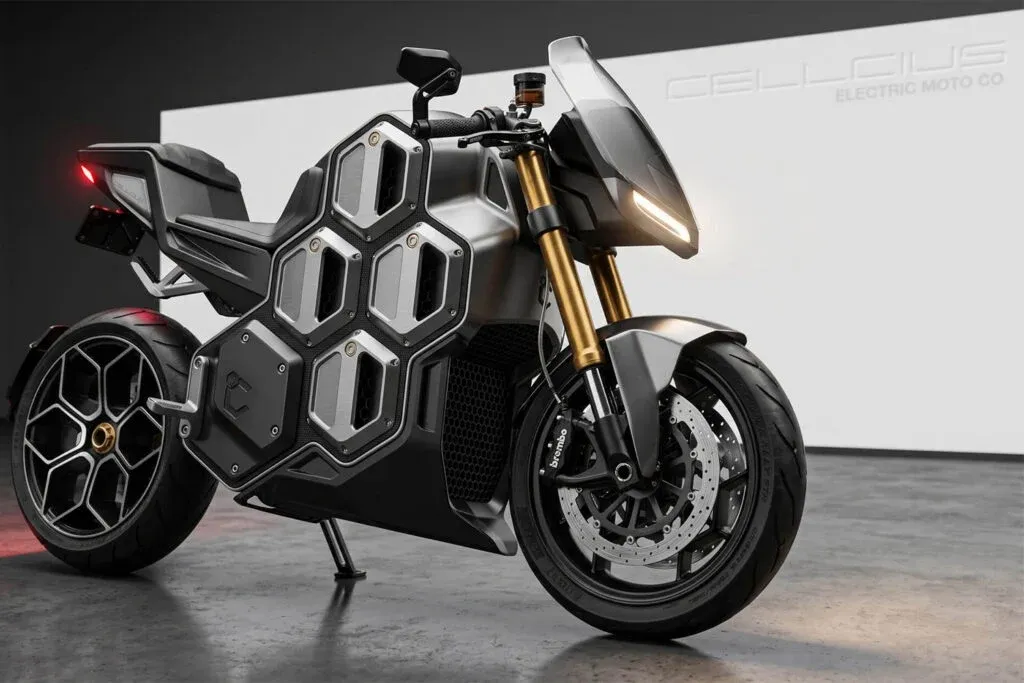
The core of this motorcycle is the Hex-Core system developed by the designers. Instead of one large battery, eight interchangeable hexagonal modules, each with a capacity of 3 kWh, are used. Thus, the maximum capacity of the setup is 24 kWh.
As the head of the studio, Neil Davidson, explains, the goal was to create a vehicle that can be tailored to specific applications. “C-01 sets a new standard for electromobility thanks to the world’s first scalable Hex-Core architecture, allowing the motorcycle to dynamically adapt to the user’s needs,” he wrote on LinkedIn.
This means that a biker heading to work can only carry a partial set of batteries, thereby reducing the vehicle’s weight. On the other hand, during longer trips or track riding, they can install a full set of eight modules.
According to information published by the industry portal THE PACK, a motorcycle with two modules weighs around 160 kg, while with a full set of eight cells, the weight increases to 220 kg.
More than just an energy storage unit
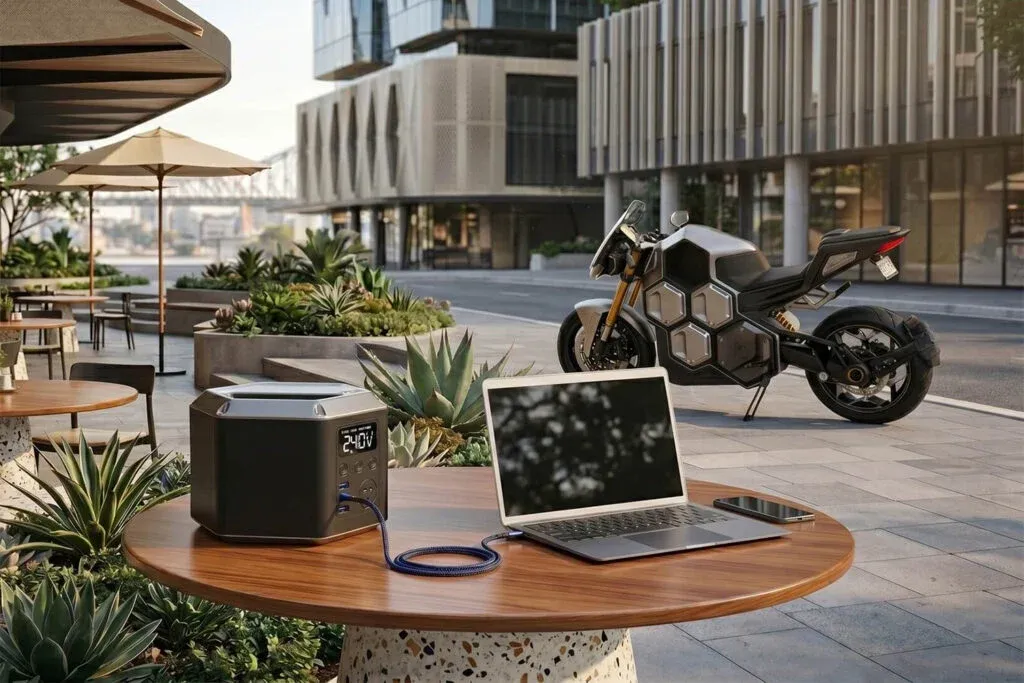
The designers went a step further than most electric motorcycle manufacturers. The spaces left by unused modules can serve as mounting points for special hexagonal-shaped luggage. Moreover, the batteries themselves have additional uses. Once removed from the motorcycle, they can function as portable power banks equipped with AC and USB ports. This allows users to power electronic devices during camping or in areas without access to the power grid.

Charging available even for apartment dwellers
One of the biggest barriers to the development of electric motorcycles is access to charging infrastructure. Clandestine Design Group claims that the C-01 was also designed with people living in apartment buildings in mind.
The modules can be removed from the motorcycle, carried in a special backpack, and charged using a household outlet. For users who have a garage, a wall-mounted docking station is available to charge multiple modules at once. The vehicle also features a built-in CCS fast-charging connector.
A bold vision for the future, but…
The Cellcius C-01 remains unfortunately a conceptual project. The manufacturer has not yet disclosed details on its propulsion system, performance, range, or production timeline. It is also unclear whether a partner will emerge to commercialize this technology. Nevertheless, the project illustrates an interesting direction for the development of electric mobility. Rather than continuously increasing the capacity of individual batteries, Australian designers propose a more flexible solution that better meets users’ actual needs.

In one of his posts, Neil Davidson emphasized that “shifting to electric powertrains should not mean giving up on the driver’s character, flexibility, or engagement.” It is this philosophy that underpins the Cellcius C-01, which aims to prove that an electric motorcycle doesn’t have to be just another vehicle with a large battery hidden in the frame.
Oskar Włostowski