
Momenta grew by 75.9% in half a year. The Chinese autonomy provider is close to achieving zero emissions.
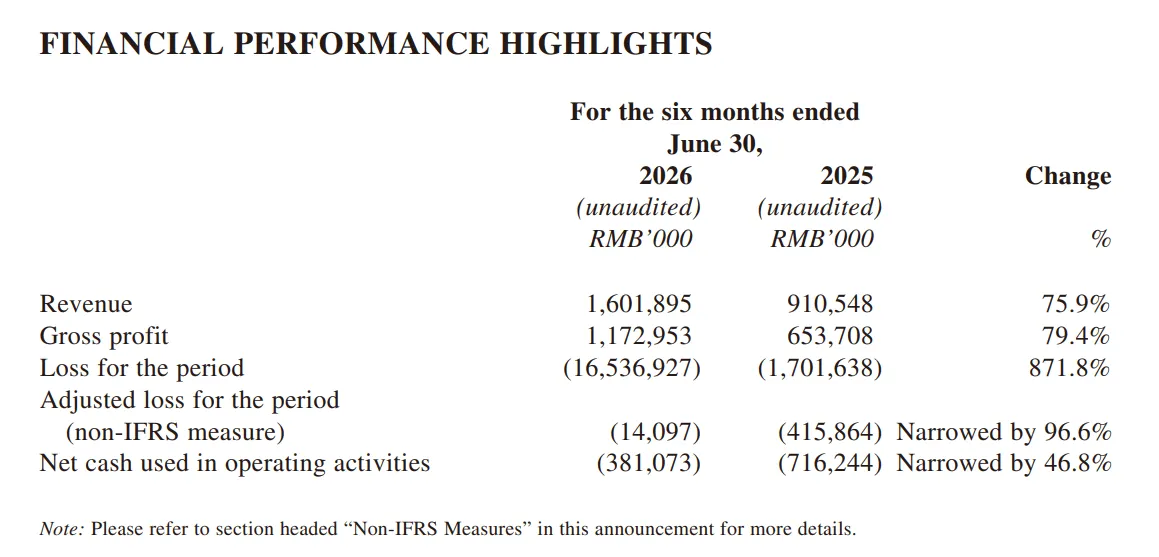
Momenta released its first results after its July debut on the Hong Kong stock market, and they are strong: in the first half of 2026, revenue rose to 1.602 billion yuan, a year-on-year increase of 75.9%. The second figure is even more interesting: the adjusted net loss dropped by 96.6–97%, to around 14.1 million yuan.
Table of Contents
Show
Hide
To drivers, this name still sounds exotic. But not in the industry anymore. Momenta is now one of China’s most important independent suppliers of assisted driving systems and urban NOA, with its software already in use in over a million vehicles.
Business is growing faster than costs
In the first half of 2026, Momenta had revenue of 1.602 billion yuan, while R&D costs rose to 1.16 billion yuan, an increase of 18.6% year-on-year. This figure tells a more compelling story than just sales growth, as it shows an improvement in operational leverage. The company continues to invest heavily in development, but now on a much larger scale.
According to the reported data, the gross margin was 73.2%, and after deducting some equity costs, the company claims it is around 75%. For a software and ADAS integration company, this is a very high level. It sounds good on paper, though it should be remembered that this is not an automaker with high capital expenditures, but rather a technology provider.
The revenue structure is also clear. Technical development services generated 995 million yuan, accounting for 62.1% of total revenue. Licensing brought in 607 million yuan, representing 37.9% of revenue.
On an IFRS-reported basis, the company showed a huge net loss of 16.54 billion yuan. However, this relates to stock market accounting practices rather than a business downturn. The main reason was an overestimated non-cash expense of 16.31 billion yuan, stemming from changes in the valuation of preferred shares and other financial liabilities before and after the initial public offering. After going public, the preferred shares were converted into ordinary shares, so this effect does not imply future cash outflows.
This is a classic case where headlines about an “enormous loss” would be misleading. Operationally, Momenta appears much healthier today than the IFRS results suggest.
Over a million vehicles on roads and 65% of the urban NOA market
Momenta’s core business is providing solutions for production vehicles, not demo models. In the first half of the year, the number of new installations increased by 83.7% year-on-year to around 321,000 vehicles. In total, the company’s systems have been installed in over 1.1 million vehicles.
The company collaborates with 26 automobile manufacturers worldwide. It also has project nominations secured for 219–230 models, depending on the data update time, of which 114 have not yet entered the SOP phase, meaning production has not started. In other words, there is a long queue for additional implementations.
By the end of June, Momenta had delivered 105–110 production models, adding 37 new ones alone in the first half of the year. Its systems have been installed in over 10 countries and regions across Asia, Europe, Oceania, Latin America, and North Africa.
The strongest figure in terms of market position is different: the company claims to hold a 65% share of China’s market for external urban NOA suppliers and leads the field there. This is significant with one caveat. We are talking about the segment of independent suppliers, not the entire autonomy market, where in-house brands such as Huawei, Xpeng, and BYD are also developing their own systems.
R7 World Model: A Common Foundation for ADAS, Robotaxis, and Delivery Vehicles
In March, Momenta unveiled the R7 World Model, an next-generation AI model designed to serve as a common foundation for production cars, robotaxis, delivery vans, and truck robots. It is an ambitious plan, but at least it is backed by a large dataset.
By the end of June, Momenta’s systems had collected over 13 billion kilometers of real-world driving data. In a more recent update, the company now cites 15 billion kilometers. In addition, there are over 100 million selected clips labeled as “Golden Data.” In the world of autonomy, data volume matters, though the sheer number of kilometers alone doesn’t guarantee anything. What’s important is how the data is described and how it translates into a vehicle’s performance in challenging scenarios.
The deployment of R7 in production vehicles is set to begin in the third quarter of 2026. After that, the platform is also planned for delivery vehicles, robotaxis, and robotic trucks. If successful, Momenta will gain what half of the industry is currently seeking: a single software architecture for multiple commercial applications.
L3 by 2027, but with a caveat
Momenta is now working not only on L2 systems and urban NOA. The company is also developing L3 functions, with the SAIC Audi AUDI E7X set to be the first model. Additional vehicles from partners are in preparation, with mass production planned for 2027.
However, a small caveat is needed here. L3 involves not just software and sensors but also homologation, legal responsibilities, and regulatory approvals. Until the system reaches regular sales with full functionality, it’s more of a promise than a ready product.
This doesn’t change the fact that Momenta is moving up a level. If this Chinese supplier succeeds in delivering L3 for global brands, its position in the supply chain will significantly strengthen.
Robotaxis and robovans are no longer a niche
The second front involves autonomous services beyond regular passenger cars. Momenta’s robotaxis are already operating in six cities around the world, with plans to expand to over 10 cities by the end of 2026. The company aims to have hundreds of robotaxis on roads in China and abroad by then, along with the necessary operating licenses.
It has strong partners: Uber, Grab, Lumo, and SAIC’s mobility platform EnjoyGo. This is important because software alone isn’t enough; one also needs a fleet, an operator, an app, and city approval.
The German development is also noteworthy. In the summer of 2026, Momenta received approval to test L4-class robotaxis on urban roads in Germany. This is the first time a Chinese company has been allowed to do so across such a large area in that country. While these tests are not a commercial service, they show that expansion into Europe goes beyond just an investor presentation.
The robovan is a smaller-scale business in terms of media coverage, but potentially very practical. The company is running a pilot project in Xiangcheng, Suzhou, in collaboration with large courier and logistics firms. According to the schedule, the first mass-produced model of the robovan is set to enter broader commercial use in the second half of 2026.
This is precisely the sector where autonomy can be implemented faster than in taxis. Routes are more repetitive, operations are less chaotic, and the cost of drivers in logistics is a significant factor.
Cash after IPO and whether Momenta will expand beyond China
As of the end of June, Momenta had 10.3 billion yuan in cash, no interest-bearing debt, and about 780 million yuan in unused bank lines. After its IPO in Hong Kong on July 8, which raised approximately 6.8 billion HKD, its cash reserves exceeded 15 billion yuan.
This gives the company time. And in autonomy, time is a currency as important as data. Especially since 79.1% of the workforce are R&D employees, and spending on research accounts for 72.6-73% of revenue.
For European drivers, the most important question today is not “Is Momenta big?” but “In whose car will I get it?” If the company indeed already has implementations in Europe and is developing projects with global brands, its software could also appear in cars sold more widely in our market. The branding, however, will likely be different. Drivers often buy an Audi, SAIC, or a specific brand model, rather than “autonomy from Momenta.”
Chinese autonomous driving software is no longer a local curiosity and is beginning to compete for a place in global vehicles. Which scenario seems more realistic to you: Momenta as a quiet supplier to well-known brands or an independent, widely recognized player in robotaxis?