
Michael Schiebe, head of production at Mercedes, warns the European Union that two German factories are in grave danger.
23/09/2026 13:30
Updated to
23/09/2026 13:30
Mercedes-Benz’s production in Germany is not competitive by international standards, largely due to its high labor costs. The company itself has acknowledged this after one of its senior executives warned workers that two plants might close if the situation doesn’t change.
The warning came from Michael Schiebe, a member of Mercedes’ production board, during a workers’ assembly held in Sindelfingen. According to excerpts from his speech shared by the company, “If we can’t manage it, we will have to close a German assembly plant and a German engine plant.” Mercedes has not specified which facilities would be at risk.
An industrial network with six plants on the line
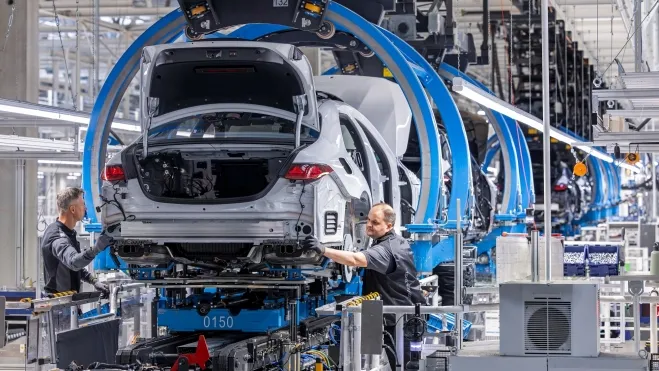
Mercedes’ German manufacturing network includes a variety of distinct operations. There are three passenger vehicle assembly plants located in Sindelfingen, Rastatt, and Bremen. Additionally, there are plants dedicated to propulsion systems, situated in Untertürkheim, Berlin, and Hamburg. Schiebe did not specify which of these facilities might be affected, limiting his description to the two sites at risk based on their function: one body shop for final assembly, and an independent propulsion plant that manufactures engines, transmissions, or electric drive components.
This warning does not come out of nowhere. Mercedes had already reduced its fixed costs by 25% since 2019, though the company acknowledges that further progress is needed. During its Capital Markets Day in 2025, the Stuttgart-based manufacturer announced its intention to cut production costs by 10% by 2027 while adjusting its nominal capacity. Under this plan, the global production capacity for passenger cars was expected to drop from 2.5 million vehicles in 2024 to between 2 and 2.2 million.
A 70% cost difference compared to Hungary
The most significant comparison in this equation is the one Mercedes makes with its plant in Kecskemét, Hungary. According to available data, production costs in Germany, primarily driven by labor expenses, are approximately 70% higher than those at the Hungarian facility. This difference has already influenced previous strategic decisions, such as moving the production of small cars and the G-Class to Hungary, a pattern that reflects the cost balance within the group itself.
Mercedes aims to align its German plants with an annual production capacity of around 900,000 vehicles, which would require optimizing the use of facilities and reducing costs per unit produced. This figure gives a clear idea of just how much the company wants to scale up its industrial footprint in the country. A few months ago, the company’s CEO, Ola Källenius, raised concerns, criticizing the European Union as the cause of the “collapse of the European market.”
Union protests amid collective bargaining
The announcement comes just as collective bargaining in the metal and electrical industries is set to begin at the beginning of October. The workers' assembly took place against a backdrop of nationwide protests organized by the IG Metall union, in which tens of thousands of automotive workers demonstrated against mass layoffs in the sector, which is struggling to compete with low-cost Chinese rivals while facing high tariffs imposed by the United States.
Mercedes is not the only German brand facing this kind of decision. Volkswagen has already begun its own restructuring, which includes closing four German factories between 2031 and 2034. Audi has also indicated a risk of closing its plant in Neckarsulm for similar reasons related to production costs. A Mercedes spokesperson confirmed Schiebe’s statements, though they did not specify when a final decision would be made, using the warning as pressure in ongoing negotiations over labor costs.