
MG IM6 in first test: 553 kW and air suspension for 62,990 euros
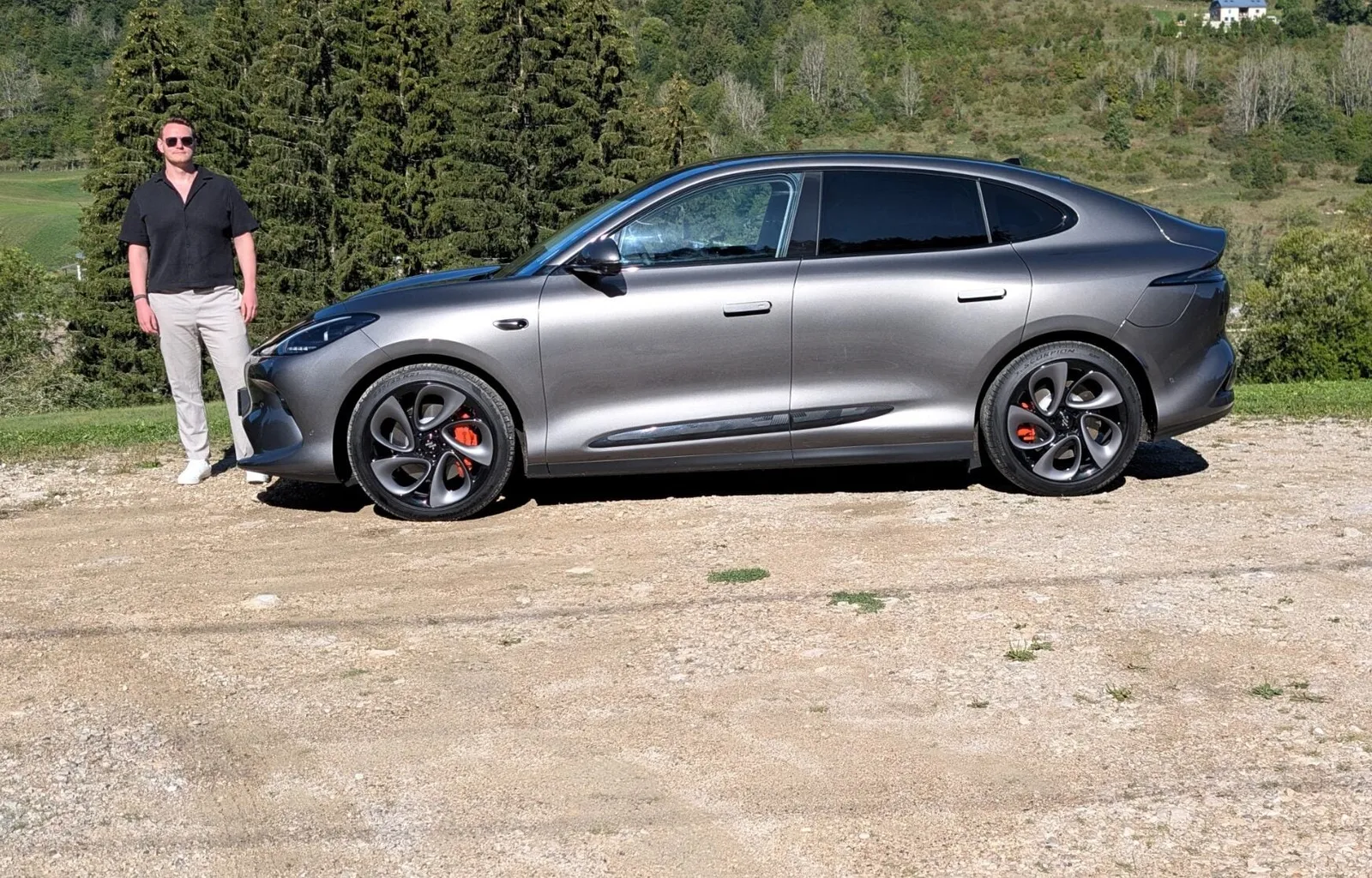
The MG IM6 is the SUV counterpart to the sedan MG IM5. Both models share the same platform, identical 100 kWh battery, same powertrains, and similar user interface. However, the MG IM6 is the only one of the two that offers air suspension for an additional 2,000 euros. We drove both models on the same roads in the French Jura on the same day under similar weather conditions, alternating between them. What the sedan can do is covered in the upcoming review of the MG IM5. Here, we focus on how well the SUV performs compared to the sedan, its shortcomings, and who would benefit from paying the extra cost over the sedan version.
Two Cars, One Platform
"IM" stands for "Intelligence in Motion." The brand, like MG, belongs to the Chinese SAIC conglomerate and was initially launched in China as a separate brand. It made its debut in the UK in summer 2025, where the vehicles are sold through the existing MG dealership network (as we reported). Since July 2026, the MG IM5 and MG IM6 are also available at German dealerships, alongside France, Belgium, and the Netherlands.
The MG IM6 is 2 centimeters shorter than the IM5 at 4.90 meters, but it is 2.8 centimeters wider and nearly 20 centimeters taller. The wheelbase remains the same at 2.95 meters, as does the 100 kWh battery, the 800-volt architecture, all-wheel steering, and the two power levels: 300 kW (407 horsepower) with rear-wheel drive and 553 kW (751 horsepower) with all-wheel drive. In terms of price, the SUV is 3,000 euros more expensive than the sedan with rear-wheel drive, at 56,990 euros. For the all-wheel drive version, it costs 2,000 euros more than the sedan, at 60,990 euros.
The fact that these competitive prices are achievable despite EU tariffs on electric vehicles manufactured in China shows how aggressively SAIC is approaching the European market. In the medium term, SAIC plans to address this issue by producing up to 120,000 vehicles per year in Ferrol, Galicia, starting in 2028 (as we reported).
The design stands out
The more upright design of the SUV comes at the cost of aerodynamics. A cW value of 0.259 is respectable for an SUV of this size, but it falls significantly short compared to the IM5’s 0.237. This directly affects its range: 625 WLTP kilometers for the rear-wheel drive version versus 710 for the IM5, and 545 WLTP kilometers for the all-wheel drive version versus 575. Those who order the Drive Pack with air suspension for the IM6 get a WLTP range of 505 kilometers.
The MG IM6 is visually inspired by sedans. Its roofline drops sharply like a coupe, the rear features a continuous lighting design, and the doors are frameless. Additionally, the door handles blend seamlessly into the surface. From the back, the vehicle appears wider and more substantial than from the front, where the narrow lighting pattern looks almost delicate. The Rembrandt Grey color of the test vehicle complements it exceptionally well. What sets it apart from many competitors is that the MG IM6 omits the plastic panels on the wheel arches and door sills that other manufacturers use to suggest off-road capability, which no one actually uses. As a result, it resembles more of a tall station wagon rather than a compact car on stilts, which is closer to its true nature.
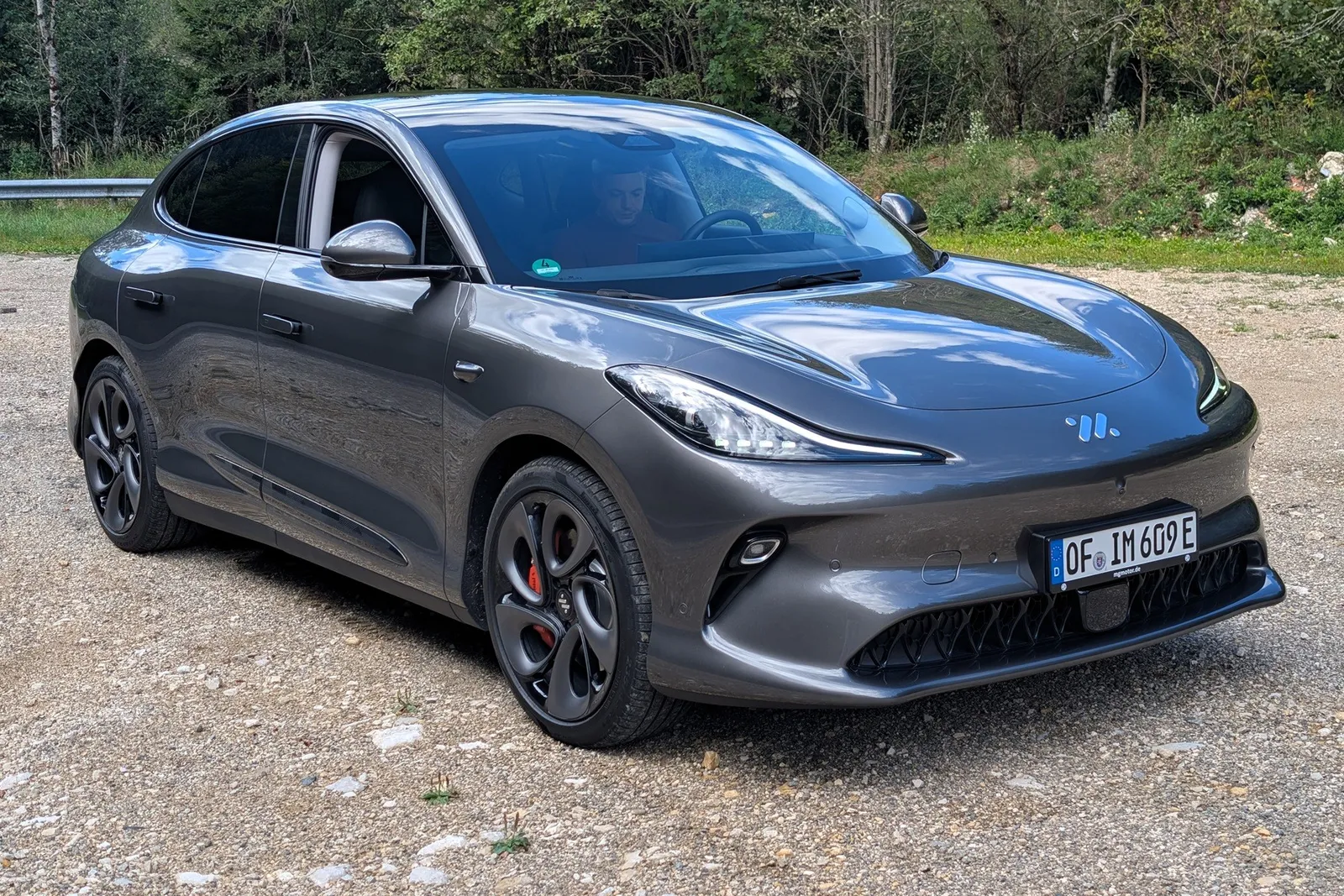
Image: Kasimir Hupe
- 1/7
- 2/7
- 3/7
- 4/7
- 5/7
- 6/7
- 7/7
The Drive Pack is the biggest difference
For 2,000 euros, MG offers only the all-wheel-drive version of the MG IM6 with a package that includes adaptive air suspension, adaptive damping, and 21-inch wheels. This is the only feature that technically sets the IM6 apart from the IM5, as the sedan is available only with steel springs. Our test vehicle came equipped with this package, and it’s worth discussing briefly.
The suspension stiffness and vehicle height can be adjusted separately. If you leave the system as is, you get a setup that is significantly stiffer and sportier than one would expect from a 2.5-ton SUV. The MG IM6 keeps the chassis flat, allows for aggressive driving, and remains comfortable on poor roads. Those who drive heavily on highways should set the damping softer and the chassis lower. Those who prefer country roads should turn up the damping stiffness. Both options work well, and the difference is substantial enough to be noticeable.
The only drawback of this package is mentioned in the specifications. With the Drive Pack, the standard range drops from 545 to 505 kilometers, while the standard fuel consumption increases from 21.7 to 23.4 kWh per 100 kilometers. The 21-inch wheels take their toll. Those who primarily drive on the highway and rely heavily on range will fare better with steel springs and 20-inch wheels. Those who enjoy tuning their vehicles are willing to spend the 2,000 euros. There is no real wrong choice in either case.
| | **MG IM6 100 kWh Premium** | **MG IM6 100 kWh** **Premium AWD** |
| --- | --- | --- |
| Powertrain | Rear-wheel drive (RWD) – one engine at the back | All-wheel drive (AWD) – two engines |
| Power | 300 kW (407 hp) | 553 kW (751 hp) |
| Torque | 500 Nm | 802 Nm |
| Acceleration | 5.4 s | 3.5 s |
| Top speed | 235 km/h | 239 km/h |
| Battery capacity (net) | 96.5 kWh Nickel-Manganese-Cobalt (NMC) | 96.5 kWh Nickel-Manganese-Cobalt (NMC) |
| Range (WLTP) | 625 km | 545 km, 505 km with Drive Pack |
| Combined fuel consumption (WLTP) | 18.2 kWh/100 km | 21.7 kWh/100 km, 23.4 kWh/100 km with Drive Pack |
| DC charging capacity | 396 kW | 396 kW |
| DC charging time (10–80%) | 17 minutes | 17 minutes |
| AC charging capacity | 11 kW (three-phase) | 11 kW (three-phase) |
| AC charging time (0–100%) | 10 hours 30 minutes | 10 hours 30 minutes |
| Unloaded weight | 2,320 kg | 2,410 kg |
| Maximum allowable weight | 2,771 kg | 2,961 kg |
| Length / Width / Height | 4.90 m / 1.99 m / 1.67 m | 4.90 m / 1.99 m / 1.67 m |
| Turning radius | 10.18 meters | 10.18 meters |
| Trunk volume | 665 to 1,640 liters | 665 to 1,640 liters |
| Front trunk volume | 32 liters | 32 liters |
| Towing capacity (unbraked / braked) | 750 kg / 1,500 kg | 750 kg / 1,500 kg |
| Suspension | Steel springs | Steel springs with air suspension and Drive Pack |
| Base price** | 56,990 Euros | 60,990 Euros; Drive Pack adds 2,000 Euros |
Powertrain and suspension: The strengths of the MG IM6
The same technology is used under the hood as in the IM5, giving a nearly identical driving feel. It takes 3.5 seconds to reach 100 km/h, which is three tenths longer than the sedan version. This difference goes almost unnoticed in everyday use. The top speed of the MG IM6 is 239 km/h instead of 268 km/h, likely due to aerodynamics and gearing. More importantly, the 802 Nm of torque is delivered just as instantly with no reduction in power.
The all-wheel steering also applies an angle of up to six degrees at the rear axle. The turning circle is 10.18 meters — twenty centimeters more than the IM5 — a figure that would still be unexpected for an SUV just under five meters long. In practice, this means the difference between making one U-turn and three. At higher speeds and in curves, the rear wheels gently assist with steering and stabilize lane changes, an advantage that is even greater with its higher body shape compared to a sedan.
The MG IM6 uses wider tires at the rear than at the front. On the test vehicle with the Drive Pack, they are 245/45 R21 at the front and 265/40 R21 at the rear; without the pack, they are 235/45 R20 at the front and 265/40 R20 at the rear. This tire sizing is common in rear-wheel-drive electric vehicles and contributes to the stable driving feel the MG IM6 offers when accelerating out of curves.
The braking system is the same as in the IM5: Continental supplies ventilated discs with a 365 millimeter diameter and four-piston calipers at the front, along with 356 millimeter discs at the rear. With an extra 110 kilograms in curb weight, one might have expected a slightly softer pedal feel. Yet the braking point remains as precise as in the sedan, and the transition from regenerative braking to friction braking occurs without the mushy area that many electric cars have in the middle of the pedal travel.
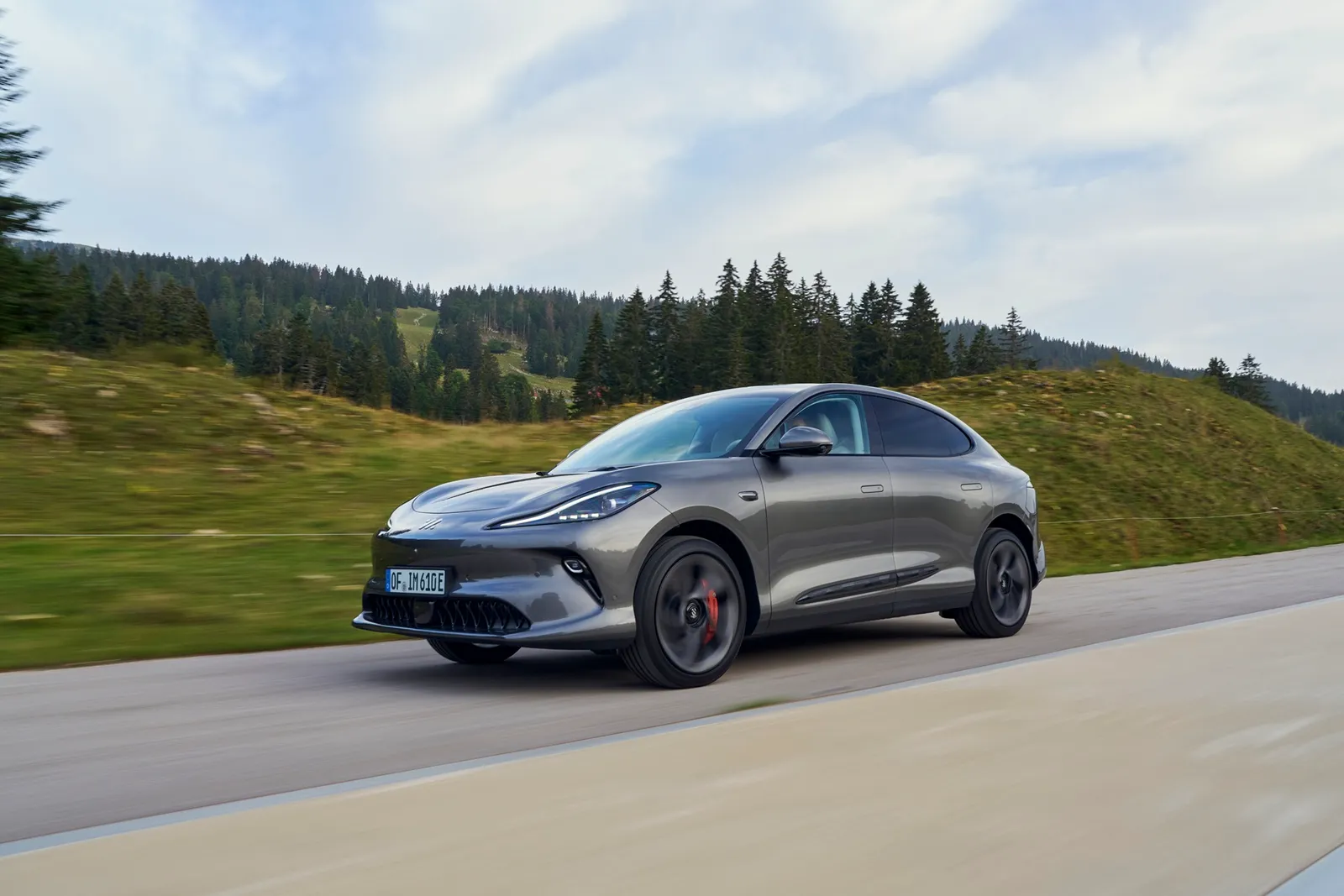
Image: MG
- 1/5
- 2/5
- 3/5
- 4/5
- 5/5
Consumption and range: The price of frontal area
On the Jura route, the onboard computer showed a fuel consumption of 23 to 24 kWh per 100 kilometers. The IM5 managed around 20 to 21 kWh on the same roads. The difference is thus almost one-fifth. More frontal area, more weight, larger wheels: physics cannot be negotiated, and the 21-inch wheels of the Drive Pack add extra cost. This is fine for a route with climbs and curves. It also means that the IM6 lacks any efficiency buffer it could rely on in everyday use.
With a full battery and even before departure, the display of the all-wheel-drive IM6 with Drive Pack showed a remaining range of 463 kilometers. Yet more telling is the calculation based on what the vehicle actually consumed during driving: 96.5 kWh of usable energy divided by approximately 23.5 kWh per 100 kilometers results in around 410 kilometers. Those who buy the IM6 as a long-distance vehicle should therefore expect around 400 kilometers between two charging stops; at highway speeds, it’s likely even less.
Charging is done like the IM5, with up to 396 kW of direct current. MG claims it takes about 17 minutes to charge from 10 to 80 percent. The IM6 accepts alternating current at 11 kW, with no 22-kW option available. As with the sedan, charging performance is one of the car’s strongest points. However, we were unable to test it on that single day of our first drive. This will be covered in our detailed review.
Interior: Here the SUV has the edge
The trunk holds 665 liters, which increases to 1,640 liters when the seats are folded down. This is 208 liters or 350 liters more than the IM5. Additionally, there is 32 liters rather than 18 liters of space under the hood. With the Drive Pack, these figures drop to 646 liters and 1,621 liters respectively. For those who regularly transport luggage for four people or a dog, this SUV is clearly the better choice. It can tow up to 1,500 kilograms with braking force.
The height also pays off in the back seat. With 101.4 centimeters, the headroom is 6.6 centimeters greater than that of the sedan, and the legroom is 96.7 centimeters, five centimeters more than the IM5. Getting in is easier, the seating position is more upright, and the panoramic glass roof is large, though it has a relatively dark tint. Those expecting more lightness will be somewhat disappointed; however, it remains pleasantly cool in summer.
The seats are sportily shaped like those in the IM5, providing good side support and remaining comfortable over long distances. They offer electric seat position adjustment, seat heating, and seat ventilation. The MG IM6 also comes standard with a massage function for the driver, which is not available in the sedan version. All of these features are standard in both models and are not taken for granted at this price point.
The road noise remains at a very low level. The double glazing, acoustic glass, and active noise reduction work just as well as in the sedan, even though the larger front surface should normally result in more wind noise. The sound system with 20 speakers is adequate, offering strong bass and allowing for fine tuning. It doesn’t compare to systems from established audio brands, but it’s sufficient for everyday use.

Photo by: Kasimir Hupe
- 1/7
- 2/7
- 3/7
- 4/7
- 5/7
- 6/7
- 7/7
Controls: Good idea, known weaknesses
The cockpit is identical to that of the IM5: A 26.3-inch panoramic display spans across the dashboard, and a 10.5-inch vertical touchscreen is located in the center console. This layout is well thought out, as driving-related information stays within easy sight at the top, while climate controls, seat functions, and parking aids are within reach of the right hand at the bottom. The usability is better than one might expect given the absence of physical buttons.
The criticism points remain the same. The driving mode can only be selected through the display, though there is a quick menu available. The warnings from the assistance systems can be silenced in seconds using a button on the steering wheel, which is a well-designed solution. The adaptive pilot is controlled via paddles on the steering wheel and adjusted in speed, whereas most manufacturers place the regenerative function elsewhere. One gets used to it, but it isn’t intuitive. There is no head-up display, and there is only one Qi-standard inductive charging pad with 50 watts of power.
The regenerative braking is weak in standard mode, and there is no one-pedal drive. The options are only “Standard” and “Low,” with no further settings available. Visibility behind is limited by the small rear window, which isn’t surprising given the coupe-like roofline. However, the cameras in the 360-degree system provide excellent resolution, similar to that found in more expensive vehicles. Combined with the small turning radius, this makes parking much less daunting. Visibility ahead and to the sides is very good.
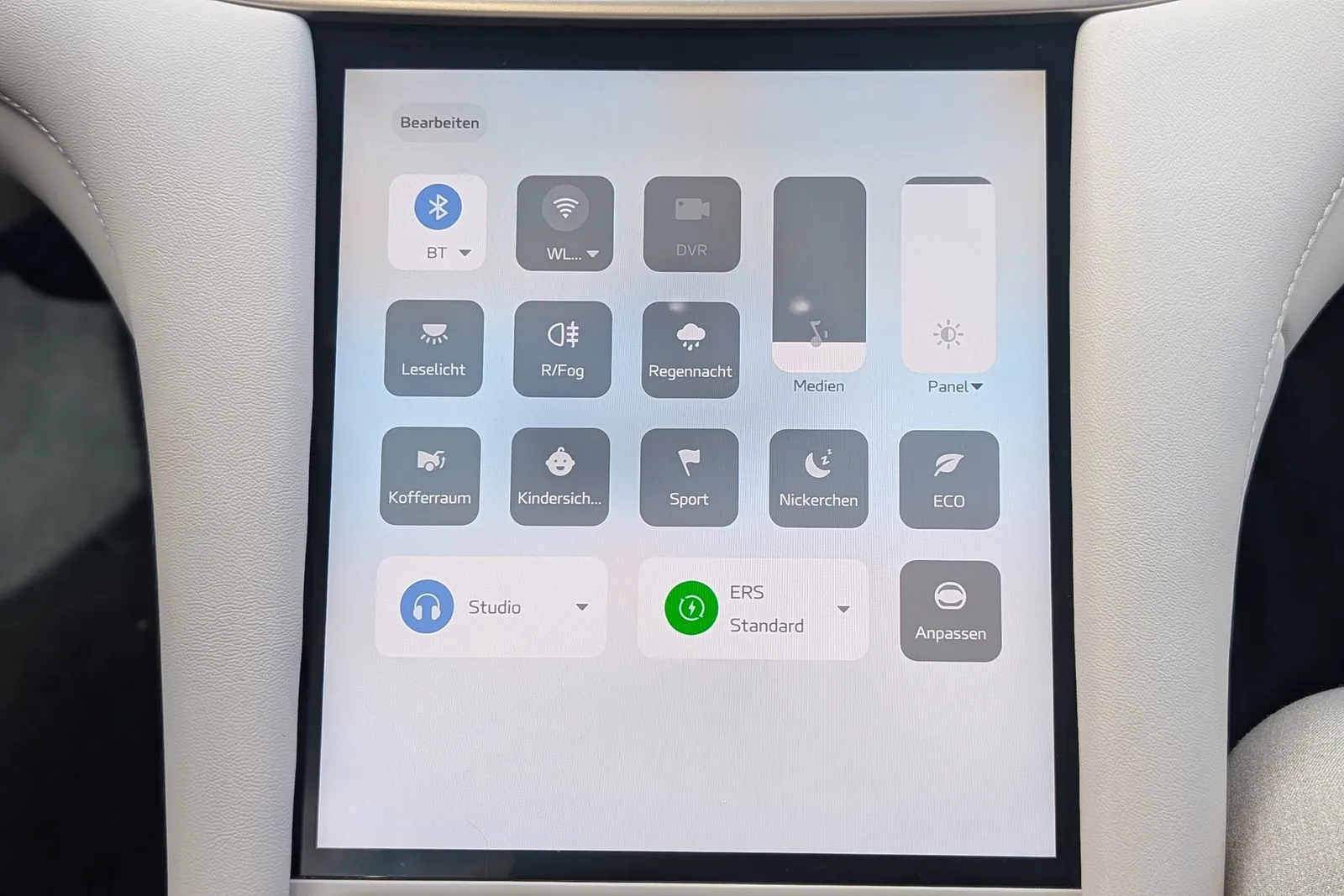
Photo by: Kasimir Hupe
- 1/15
- 2/15
- 3/15
- 4/15
- 5/15
- 6/15
- 7/15
- 8/15
- 9/15
- 10/15
- 11/15
- 12/15
Who are the competitors of the MG IM6?
The Xpeng G6 AWD Performance is the closest rival, costing starting at 51,600 euros, which is about 9,400 euros less than the MG IM6 with all-wheel drive. It delivers 358 kW (487 horsepower), accelerates from 0 to 100 km/h in 4.1 seconds, and can charge at up to 451 kW, resulting in a charging time of around twelve minutes to reach 80 percent charge. Its 80 kWh battery provides a range of 510 kilometers according to WLTP standards. The G6 is 15 centimeters shorter and has significantly less trunk space at 571 liters. In terms of price and charging speed, the Xpeng G6 AWD Performance is ahead, while the MG IM6 has the advantage in performance, battery size, and interior space.
The Tesla Model Y Performance costs 63,970 euros, which is nearly 3,000 euros more than the MG IM6 all-wheel-drive version. With 461 kW (627 horsepower) and a 0-60 mph time of 3.5 seconds, it is slightly weaker but just as fast in acceleration. However, it has a top speed limit of 155 mph and is significantly more efficient with 580 kilometers of WLTP range per 79 kWh of battery capacity. Its weakness lies in charging: a peak power of 250 kW and a system voltage of 400 volts are not a strong advantage compared to the MG’s 396 kW and 800 volts. When it comes to trunk space, Tesla has the edge: 854 liters far exceeds the MG IM6’s 665 liters.
The Audi Q6 Sportback e-tron quattro, like the A6 compared to the IM5, belongs to a different price segment. With 340 kW (462 horsepower), 0-100 km/h in 5.1 seconds, a WLTP range of 657 kilometers from a 100-kWh battery, and a charging capacity of 269 kW, it costs 77,100 euros. That’s 16,110 euros more than the MG IM6 all-wheel-drive model, despite being slower, having weaker charging capabilities, and offering 511 liters less cargo space. What the Audi excels at are efficiency and range. Whether this added value justifies the higher price is a decision each person must make for themselves.
Conclusion on the MG IM6: A great value
After a day driving both cars, the decision isn’t so easy after all. The IM5 handles better on the road, uses less fuel, has a longer range, and is 3,000 euros cheaper as a rear-wheel-drive model and 2,000 euros cheaper as an all-wheel-drive version. Those who don’t need to transport a family or simply prefer its design are likely to choose the sedan.
The MG IM6 wins in every aspect related to everyday use. It offers 208 liters more trunk space, an easier entry, more head and leg room in the back seat, a massage function, and the option to add air suspension for 2,000 euros, which significantly changes the car’s character. These are strong arguments that still hold weight even after two years of ownership, while the 0.3-second difference in acceleration no longer interests anyone.
The weaknesses in both cars are the same: lack of one-pedal driving, weak regenerative braking in standard mode, only one charging port in the center console, no head-up display, and limited rear visibility. What remains untested on this first day is the charging performance in cold weather and over long distances, as well as fuel consumption on highways over extended periods. What the first day with the IM6 does show, however, is a SUV that manages to hide its 2.5 tons quite well and offers more technology for the price than is typical in this class. As for efficiency, the MG IM6 must be given credit for being a heavy SUV after all.
mg.de (Press release)
_Author: Kasimir Hupe_