
Mercedes-Benz tests electric CLA in severe intersection collision
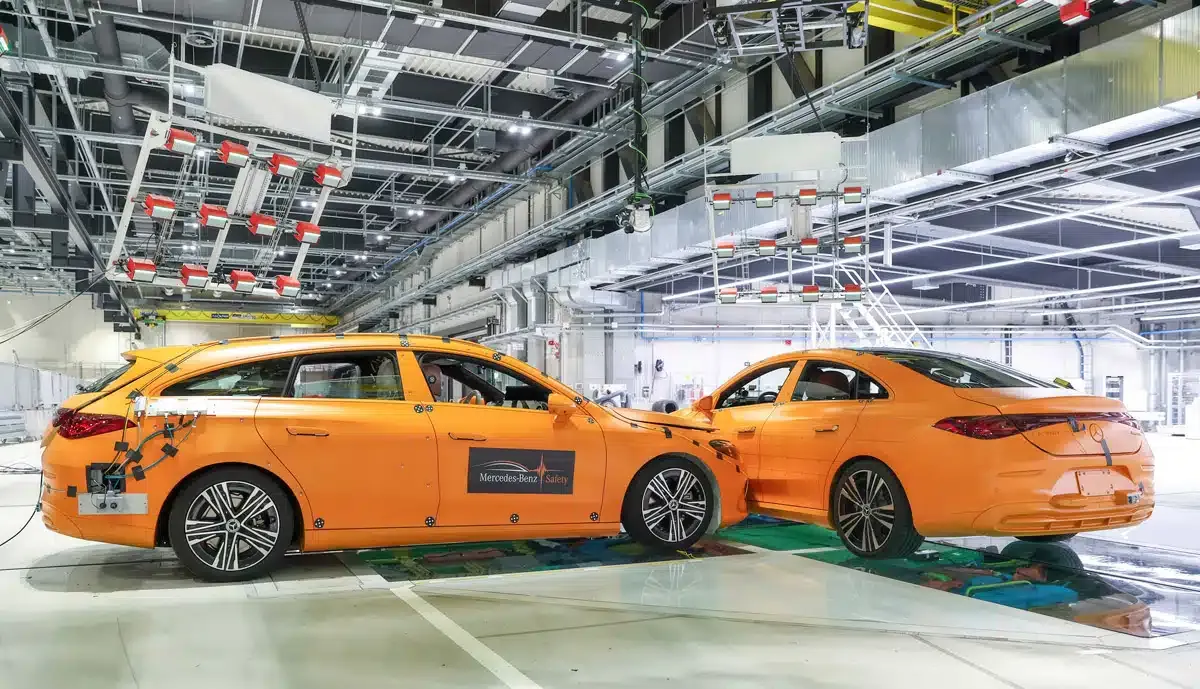
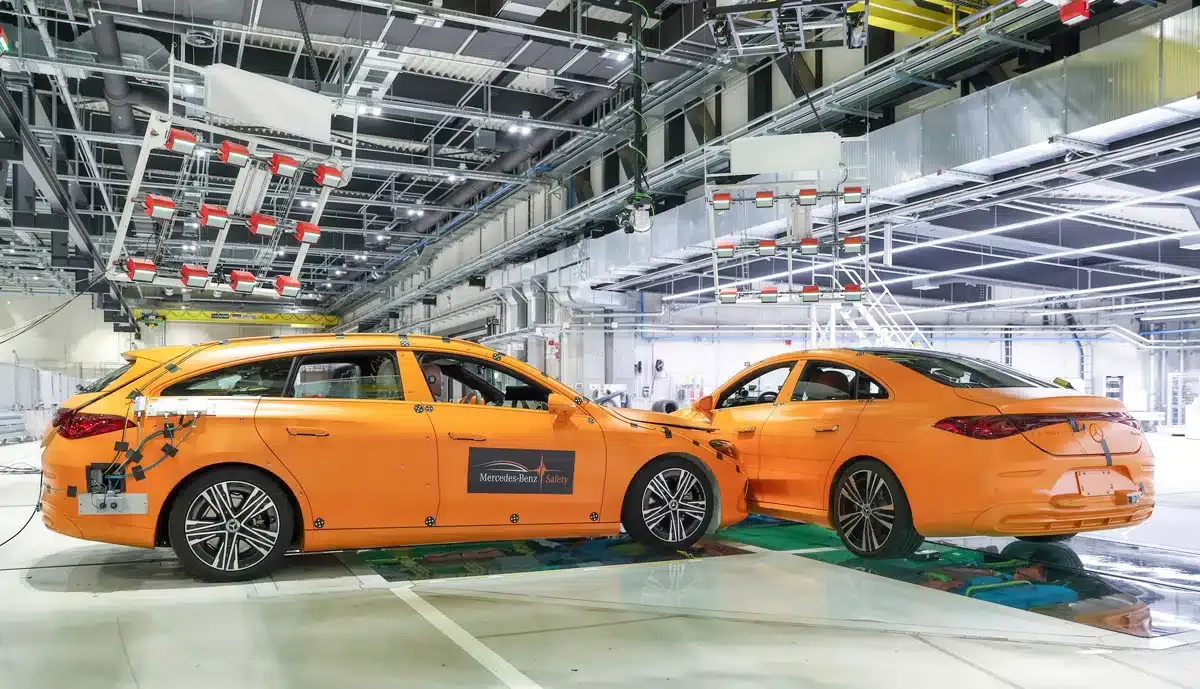
Image: Mercedes‑Benz
Mercedes-Benz simulated a severe intersection collision involving two road‑legal vehicles in a crash test, with the event shown to an audience. In this scenario, a CLA Shooting Brake equipped with an electricized internal combustion engine collided at 56 km/h with the driver’s side of a fully electric CLA that was also traveling at 56 km/h.
Both vehicles weighed over two tons each and were not braked prior to the impact. According to the automaker, this scenario was based on real accident data and went beyond the requirements of legal regulations and standard safety tests.
The passenger compartments of both CLA models remained stable during the impact, while all measurement values from the eight crash test dummies were below biomechanical thresholds. The dummies representing four adults and four children provided data from up to 150 measurement points per dummy, indicating a low risk of severe or life-threatening injuries.
Mercedes-Benz reports that the high-voltage battery of the all-electric CLA also remained undamaged despite the direct side impact. The Stuttgart-based company emphasizes that the CLA’s driver assistance systems are designed to prevent such collisions on roads or to reduce their severity.
Since 1969, Mercedes-Benz has been investigating and reconstructing real traffic accidents, analyzing around 6,000 such incidents in collaboration with research teams in Germany, China, and India. The insights gained are incorporated into the development of vehicle body structures, restraint systems, and the company’s own safety standards. According to the company, each new model undergoes approximately 15,000 virtual crash simulations and around 150 actual crash tests during development. Artificial intelligence helps refine these predictions.
You are currently viewing placeholder content from YouTube. To access the actual content, click the “Unlock content” button. Please note that data will be transmitted to third parties in this process.
More Information
"Our goal is for Mercedes-Benz to build the safest vehicles in the world. That’s why we develop safety systems based on what actually happens on the roads. The world’s first public intersection crash test in this configuration underscores this commitment," says Technology Chief Jörg Burzer.
"Those who want to build the safest vehicles must also incorporate insights from real accidents into their models’ requirements. We call this ‘Real-Life Safety.’ This test with two CLA models demonstrates how we achieve this successfully," says Paul Dick, Director of Vehicle Safety at the company.
For the first time, the “Mercedes-Benz Rescue Intelligence” system was also presented, which is set to be introduced gradually starting next year. It aims to establish a direct connection between accident-stricken vehicles and rescue teams, providing important accident data even while they are on their way. Depending on technical availability and the specific situation, this may include information such as the number of occupants, the status of airbags, seat belts, and high-voltage systems, open doors, as well as battery temperature. This enables rescue teams to assess the situation earlier, prepare for their response, and select appropriate rescue equipment.
Also interesting
About the author
Thomas Langenbucher is an expert in electromobility with professional experience in the automotive industry and finance sector. Since 2011, he has been covering electric vehicles, sustainable technologies, and mobility solutions for ecomento.de. Learn more.
Reader interactions