
The Mercedes-AMG GT SUV has 1169 horsepower and a charging capacity of 710 kW. The virtual V8 is just an extra feature.
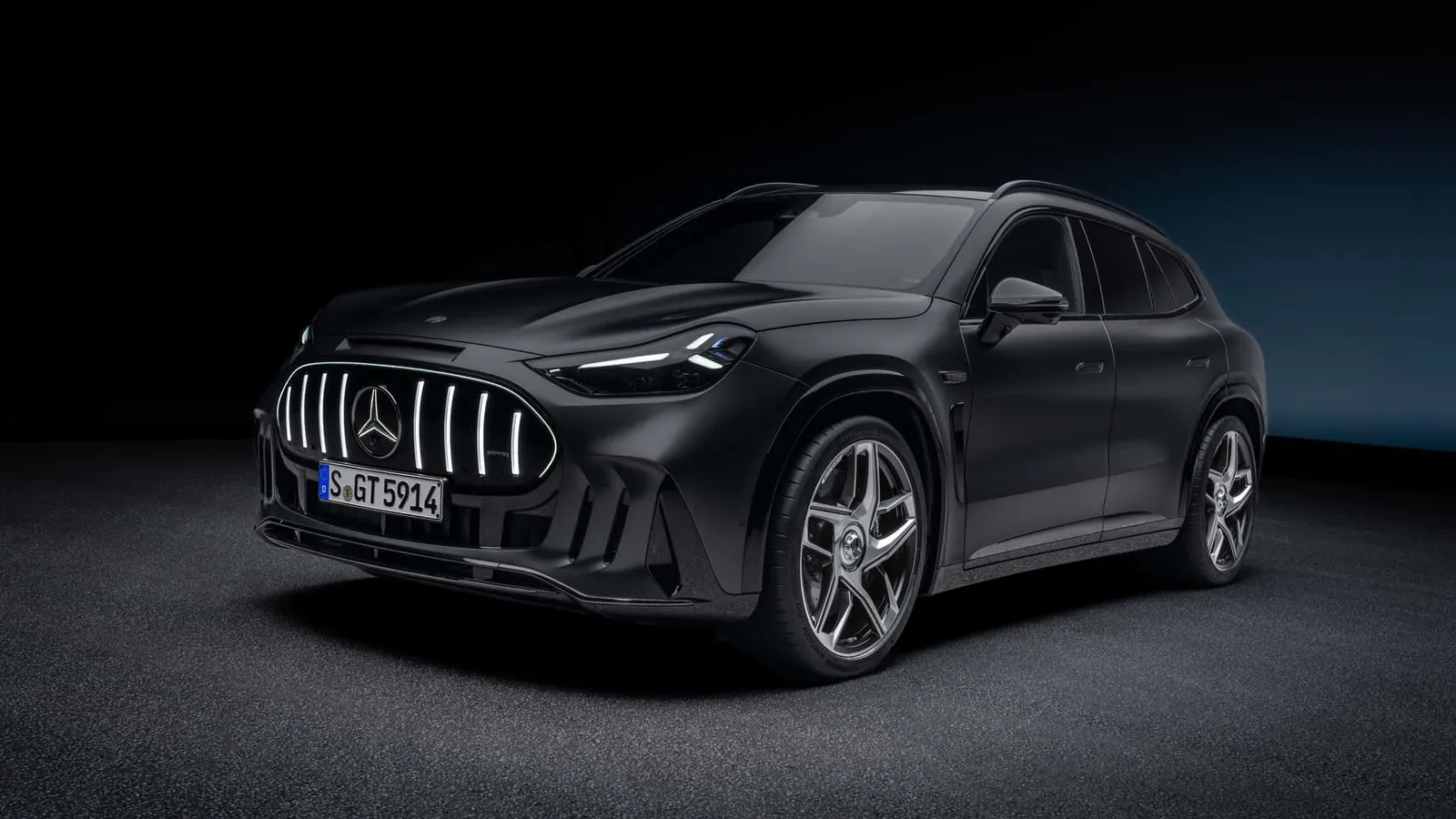
Mercedes-AMG unveiled an electric GT SUV on October 17, 2026, the first full-size SUV developed entirely by AMG. The most powerful version delivers 1169 horsepower, has a 128 kWh battery, and can be charged at up to 710 kW. The first vehicles will arrive in U.S. dealerships in the summer of 2027, while Mercedes’ Polish site states the model will be available “soon.”
Table of Contents
Show
Hide
The GT SUV is the second vehicle on the AMG.EA platform, following the electric AMG GT 4-door Coupé shown in May 2026. It is not another gasoline-powered Mercedes adapted for electric drive, but rather a design conceived from the start around an 800 V system, a large battery, and YASA in-wheel motors.
Three versions, but YASA engines start with the GT 55
The base AMG GT 53 SUV is equipped with two classic synchronous engines featuring permanent magnets. It delivers 544 horsepower and 800 Nm of torque, accelerating from 0 to 100 km/h in 4.2 seconds and reaching a top speed of 250 km/h. A two-speed transmission operates on the rear axle to balance strong acceleration with efficiency at higher speeds.
The GT 55 and GT 63 use three axial-flow engines instead. One drives the front axle, while the other two drive the rear wheels separately. This allows for very precise distribution of torque during turns. The front engine can be mechanically disconnected while driving at low speeds.
The engines are supplied by YASA, a British company acquired by Mercedes-Benz in 2021. This type of engine resembles a flat disc and weighs around 24 kg according to the manufacturer, offering higher power density than typical radial-flow engines.
Version
Peak Power
Turning moment
0-100 km/h
Net battery capacity
AMG GT 53 SUV
544 HP
800 Nm
4.2 s
106 kWh
AMG GT 55 SUV
816 HP
1860 Nm
3.1 s
128 kWh
AMG GT 63 SUV
1169 HP
2000 Nm
2.7 s
128 kWh
Mercedes lists peak powers available for a limited time. The GT 55 and GT 63 have around 530 kW of continuous power, which is approximately 721 HP. That’s still very high, but the difference clearly shows how carefully one should interpret the four-digit figures for the most powerful electric vehicles.
The GT 63 weighs around 2695 kg, yet it can reach 200 km/h in 7.2 seconds. The maximum speed of the GT 55 and GT 63 versions can be up to 270 km/h. These performance figures are on par with those of the electric Porsche Cayenne Turbo, which, according to Porsche, has 1139 horsepower and accelerates from 0 to 60 mph in 2.4 seconds using the American rollout procedure.
128 kWh and 83 kWh charged in 10 minutes
The power of the engines is impressive, but what’s more interesting is the charging system. The GT 55 and GT 63 come equipped with a battery having a usable capacity of 128 kWh, built from tall, narrow cylindrical cells. Mercedes refers to it as an NCMA cathode, silicon in the anode, and an energy density exceeding 298 Wh/kg per cell. Each cell is directly cooled by non-conductive oil.
The maximum DC charging power is 710 kW. The manufacturer claims it can charge from 10% to 80% in 12 minutes. The car should absorb 48 kWh in five minutes and as much as 83 kWh in 10 minutes, which corresponds to an average power of around 498 kW. Mercedes calculates this as a maximum WLTP range of 454 km added in 10 minutes.
On a charger limited to 400 kW, the 10-80% charging process will take 16 minutes. This is a more practical figure, as charging points capable of delivering 710 kW are practically non-existent outside of China. Thus, the car will be ready for infrastructure that still needs to be built.
The GT 53 uses a smaller 106 kWh battery and can accept up to 600 kW. Charging from 10% to 80% should take 11 minutes, while at a 400 kW charger it will take about 14 minutes. All versions support AC charging at 11 kW.
The claimed range for the GT 55 and GT 63 is 620-700 km WLTP. The lighter and less powerful GT 53 is said to have a range of 597-668 km. These are the manufacturer’s preliminary figures, as are the acceleration and charging times.
Large SUV, active hydraulics, and a V8
The GT name might suggest a coupe body style, but the car features a classic large SUV silhouette. It measures 508 cm in length, 200 cm in width, and 165 cm in height, with a wheelbase of 304 cm. The trunk holds 607 liters, while the front compartment has 78 liters.
All versions come equipped with a steerable rear axle that can tilt up to 6 degrees. The GT 63 standardly features AMG Active Ride Control+, which uses hydraulics instead of traditional stabilizers. This system limits body roll, understeer during braking, and oversteer during acceleration. In the GT 55, it will be an option, along with carbon-ceramic brakes.
The cabin features 10.2-inch digital displays, a 14-inch central screen, and an optional passenger display of the same size. Mercedes retained three physical knobs for quick adjustment of drive and suspension settings. A panoramic roof with adjustable transparency is standard.
AMG also introduced the AMGFORCE Sport+ mode. The GT 55 and GT 63 play back V8 engine recordings, while the GT 53 features a six-cylinder engine sound. Virtual gear shifts activated by levers and seat vibrations complement the audio experience. The entire setup can be turned off in Silent mode, so it isn’t mandatory for every journey.
The production is set to take place in Sindelfingen. The European price for the base version is expected to start around 113,000 euros, but the price list for Poland has not yet been released. The biggest uncertainty remains not the car’s power, but rather the availability of chargers that will turn its 710 kW into something more than just a figure in the technical specifications.
LovEV Newsletter
Want more content like this?
Sign up — we’ll send you a weekly summary once the newsletter starts.