
Mercedes-AMG GT SUV: up to 860 kW and 450 km in 10 minutes
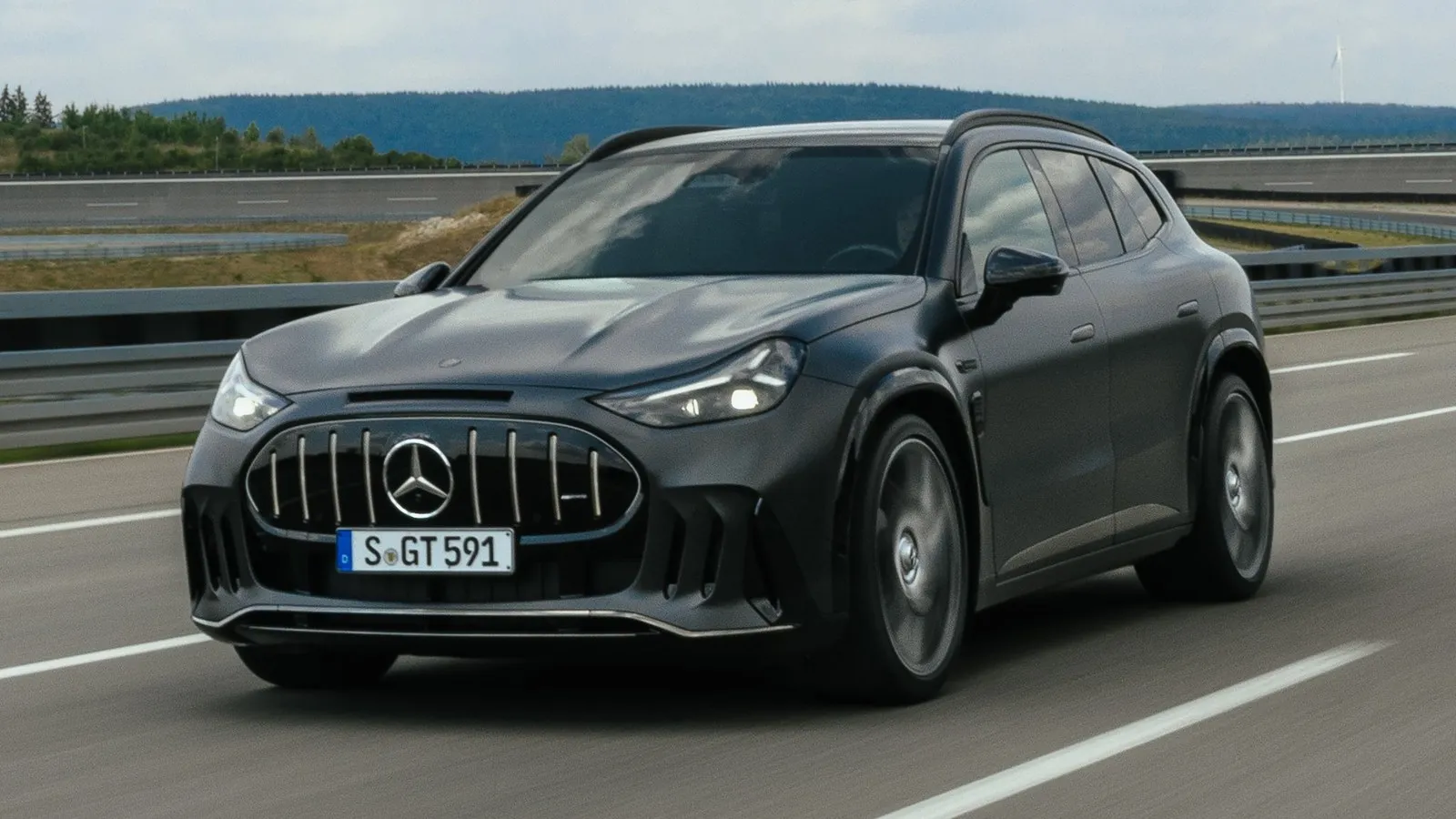
Mercedes-AMG introduces the GT SUV as its first electric SUV developed in-house: The GT 63 is powered by three axial-flux motors delivering up to 860 kW (1,169 horsepower), with a 128-kWh battery charged at up to 710 kW. The GT 53 will be available for ordering starting October 20 at 113,050 euros, followed by the GT 55 and GT 63 in 2027.
Advertisement
In May 2026, Mercedes-AMG introduced the GT 4-door Coupé as the first production model based on the AMG.EA platform. A SUV follows as the second vehicle to utilize this architecture. According to the company, it is the first full-size SUV that Mercedes-AMG has developed from scratch. The SUV features the axial-flow engines from the Coupé in the GT 55 and GT 63 versions; all editions use a directly cooled battery, which is offered in a larger version for the SUV as well. The vehicle is manufactured at the Mercedes-Benz plant in Sindelfingen, in Hall 32 that has been upgraded for AMG.EA technology.
Three versions are available: AMG GT 53 SUV, AMG GT 55 SUV, and AMG GT 63 SUV. The entry model is the GT 53 SUV, which is the only version equipped with two synchronous motors; its suggested price in Germany is 113,050 euros including VAT. Mercedes has not yet announced prices for the GT 55 and GT 63. All three versions feature the variable all-wheel drive system AMG Performance 4MATIC+, with the GT 55 and GT 63 additionally having torque vectoring between the rear wheels.
Powertrain: Axial-flow engines or two synchronous motors
The two more powerful versions use three axial flux motors. Two of them are located in the rear drive unit along with a planetary gear each, while the third operates on the front axle. In axial flux motors, the magnetic flux runs parallel to the axis of rotation, allowing for a very compact design. The front motor is activated only when additional power or traction is required; under light loads, a Disconnect Unit isolates it to reduce drag losses.
The GT 63 SUV delivers a peak power of 860 kW (1,169 hp) and a continuous power output of 530 kW (721 hp), with a maximum torque of 2,000 Nm. According to the specifications, it accelerates from 0 to 100 km/h in 2.7 seconds (2.5 seconds with a 1-foot rollout) and reaches 200 km/h in 7.2 seconds. With the Driver’s Package, its top speed is 270 km/h. The GT 55 SUV has a peak power of 600 kW (816 hp) and 1,860 Nm of torque, achieving a 0 to 100 km/h acceleration time of 3.1 seconds.

The GT 53 SUV is powered instead by two permanently excited synchronous motors, one per axle. Together they produce 400 kW (544 HP); Mercedes lists the continuous power output at 270 kW (367 HP) and the torque at 800 Nm. A two-speed transmission is installed on the rear axle: the shorter first gear is designed for starting and urban driving, while the second gear is intended for higher speeds at lower RPMs. Here too, the front motor is disconnected under light load. The GT 53 SUV accelerates to 100 km/h in 4.2 seconds, with a top speed of 250 km/h when equipped with the Driver’s Package.
Advertisement
Suspension, Aerodynamics, and Design
Mercedes has newly developed the AMG ACTIVE RIDE CONTROL+ suspension system. Instead of conventional stabilizers, hydraulic components regulate the body’s pitch and roll movements, along with triple-switchable air springs and an 8.2-liter pressure reservoir for rapid level adjustments. This system is available as an option on the GT 63 SUV Series and the GT 55 SUV. All versions come standard with rear-wheel steering of up to 6 degrees: below 80 km/h, the rear wheels steer in opposite directions, and above that speed, they steer in the same direction up to one degree. The GT 63 SUV comes standard with carbon-ceramic brakes, which are optional on the GT 55, while the GT 53 uses steel brakes.
The aerodynamics include an active airpanel in the front bumper, whose fins open only when cooling is needed, as well as an active roof spoiler on the GT 55 and GT 63 models that changes position at speeds of 150 km/h. The cW value is 0.27 (GT 53: 0.28), with a frontal area of 2.80 m². The rear features six round taillights in a turbine design, optionally supplemented by a continuous light strip. The headlights have a daytime running light in a star design, and the radiator grille and Mercedes star are available with lighting as an option.

Battery with 106 or 128 kWh
The AMG High Performance Electric Battery operates at 800 volts and is available in two sizes: one with 18 modules and a usable capacity of 106 kWh, or one with 22 modules and 128 kWh. The GT 53 SUV is listed only with the smaller battery, while the GT 55 and GT 63 come in both versions. It uses cylindrical cells that are 105 millimeters tall and 26 millimeters in diameter. The cell chemistry combines an NCMA cathode (nickel, cobalt, manganese, aluminum) with a silicon-containing anode, and the energy density is over 298 Wh/kg according to the manufacturer. Each cell is surrounded directly by a non-conductive oil. Mercedes cites this as ensuring even temperature distribution, which allows for consistent performance even when full power is demanded repeatedly.
Specifications
Range and Consumption
Mercedes claims a WLTP range of 597 to 668 kilometers for the GT 53 SUV, with a combined fuel consumption of 18.8 to 21.1 kWh/100 km. The GT 63 and GT 55 offer a range of 525 to 585 kilometers with the 106-kWh battery and 620 to 700 kilometers with the 128-kWh battery. Their fuel consumption ranges from 20.9 to 23.8 kWh/100 km depending on the battery. The ranges are based on the WLTP cycle. According to Mercedes, the fuel consumption and charging figures are preliminary, as an EU type approval has not yet been obtained.
Charging Power and Charging Times
An 800-Volt fast-charging station can deliver up to 600 kW to the SUV with a 106-kWh battery and up to 710 kW (1,000 amps per Mercedes) with a 128-kWh battery. According to the manufacturer, it takes 11 minutes to charge from 10% to 80% with the smaller battery and 12 minutes with the larger one. At a 400 kW charging station, Mercedes estimates 14 minutes for the 106 kWh battery and 16 minutes for the 128 kWh battery. The SUV can gain 70 kWh or 83 kWh of charge in ten minutes, respectively, and 41 kWh or 48 kWh in five minutes.
Converted to WLTP range, Mercedes claims 440 kilometers in ten minutes for the GT 53 SUV. According to the specifications, the GT 55 and GT 63 models achieve 386 kilometers with the smaller battery and 454 kilometers with the larger battery. However, in the press release overview, Mercedes states up to 380 kilometers for the 106-kWh battery. At 400-volt charging stations, the system automatically switches to a 400-volt mode. AC charging can charge the vehicle at up to 11 kW. The SUV is equipped for fast charging standards CCS2, GB/T, CHAdeMO, CCS1, and NACS.

Dimensions and Space
The SUV is 5,084 millimeters long (GT 53: 5,080 mm), 2,001 millimeters wide, and 1,656 millimeters high (GT 53: 1,653 mm), with a wheelbase of 3,040 millimeters. Mercedes states that the curb weight according to DIN is 2,525 kilograms for the GT 53, and 2,585 to 2,715 kilograms for the GT 55 and GT 63. The trunk capacity is 607 liters per VDA standards, rising to 1,740 liters with the rear seats folded down. There is also an additional storage space under the hood with a capacity of 78 liters per VDA standards.
Advertising
Interior and Operation
The cockpit features a 10.2-inch combined instrument cluster alongside a 14-inch multimedia display that tilts toward the driver. The passenger receives their own 14-inch display. The MBUX infotainment system is based on the MB.OS operating system and integrates AI assistants such as ChatGPT, Microsoft Bing, and Google Gemini. In addition, there are AMG-specific apps for driving data, vehicle settings, and track functions. The GT 55 and GT 63 models have three rotary controls from the AMG RACE ENGINEER in the center console, allowing adjustment of response behavior, cornering characteristics, and traction control.

In total, seven driving programs are available, including an Eco mode with front axle decoupling and the AMGFORCE Sport+ program. This plays recorded sounds of an AMG V8 (GT 55 and GT 63) or an AMG six-cylinder engine (GT 53) and simulates gear shifts that can also be triggered manually via the steering wheel paddles. For racing tracks, there is the Predictive Performance Manager, which distributes power output according to different sections of the track; it was first used during the record-breaking drive of the CONCEPT AMG GT XX in Nardò in 2025. In the back, there is a three-seater bench seat whose backs can be folded down. The panoramic glass roof can be switched between transparent and opaque modes.
What do you think of an electric SUV with simulated internal combustion engine sounds and a charging capacity of up to 710 kW – is the GT SUV more of a family car or a sports car for you?